
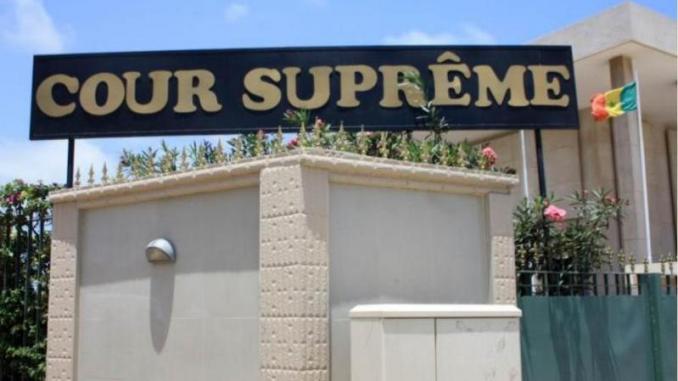
Cour Suprême Sénégal: Rejet FDR Demande Urgence Élections Locales
Summary
- The Administrative Chamber of the Supreme Court of Senegal rejected an urgent application by the FDR concerning local elections.
- The FDR sought immediate electoral preparations, including voter list revisions and a calendar, citing risks to electoral freedoms.
- The Court ruled that "urgency" was not met, citing the five-year mandate for councilors and the lack of a precise deadline for the election decree.
- The Electoral Code allows elections to be held anytime within the fifth year of the mandate, with a final deadline of January 23, 2027.
- This decision maintains uncertainty regarding the exact date of Senegal's municipal and departmental elections.
Supreme Court Rejects Urgent Election Demand
The ruling explicitly stated that, in all cases, elections must take place within the fifth year of the mandate.
The Administrative Chamber of the Cour suprême Sénégal has dismissed an urgent application filed by the Front pour la défense de la démocratie et de la République (FDR), a coalition seeking to compel immediate action regarding upcoming local elections. This `référé-liberté` procedure, aimed at securing swift judicial intervention, was met with a `rejet demande urgence élections locales`, leaving the precise timing of municipal and departmental elections in Senegal uncertain. The decision means the FDR's demands for prompt preparatory measures will not be enforced through this judicial avenue.
The application was brought by several prominent political figures, including Modou Diagne, president of LDR/Yessal; Khalifa Ababacar Sall of Taxawu Sénégal; Samba Sy of PIT; Oumar Sarr of PLD/And Suqali; and Abdou Mbow of the APR. Their collective effort sought to address what they perceived as critical delays in the electoral process for the `élections locales`.
Legal Context and Court's Reasoning
In its ruling, the high court clarified its interpretation of "urgency," stating that it necessitates a sufficiently grave and immediate infringement upon a public interest or the rights of the applicants. The `Chambre administrative Cour suprême Sénégal` found that the conditions for such an urgent intervention were not met in this instance. It referenced `Code électoral Sénégal articles L.230 L.236`, L.265, and L.269 to support its position.
The Supreme Court emphasized that the mandate for departmental and municipal councilors is set for five years, with their renewal scheduled to occur within thirty days prior to the conclusion of the fifth year. While articles L.236 and L.269 do allow for exceptions under specific circumstances, the Court also highlighted Article L.63, which stipulates that the date for the ballot is to be fixed by decree, without imposing a precise deadline for its issuance. The ruling explicitly stated that, in all cases, elections must take place within the fifth year of the mandate. Consequently, the Court concluded that the current absence of such a decree does not, based on the legal and factual analysis, compromise the organization of the elections.
FDR's Unsuccessful Demands
The FDR had argued that delays in the electoral process could lead to irreversible consequences for the exercise of electoral freedoms. To avert these perceived risks, the coalition had specifically requested that the Court acknowledge alleged failures on the part of the minister responsible for elections, the broader electoral administration, and the autonomous national electoral commission (CENA).
Their petition sought several concrete actions: the immediate initiation of voter list revisions, the determination of candidate deposits, and the publication of a provisional electoral calendar. However, the Supreme Court's Administrative Chamber rejected all these demands as part of its decision on the urgent procedure, effectively denying the immediate implementation of these preparatory steps.
Why It Matters: Continued Electoral Uncertainty
Despite the Supreme Court's definitive rejection of the urgent application, its decision does not establish a specific date for the upcoming local elections. The legal framework indicates that these elections must be held no later than January 23, 2027. This leaves a significant window of time during which the exact timing remains undetermined.
The ruling underscores the ongoing `incertitude élections municipales Sénégal` and the fact that several critical preparatory operations for these elections continue to be subjects of contention. The Court's stance affirms the government's discretion in setting the election date within the statutory five-year mandate, provided it adheres to the ultimate deadline, thereby impacting the strategic planning of political parties and candidates across `Sénégal`.
Practical Implications
Lawyers advising political parties or candidates in Senegal should note that the Supreme Court has affirmed the government's discretion in setting local election dates within the statutory five-year mandate, rejecting urgent applications to compel earlier action. This ruling clarifies that the absence of an immediate decree does not constitute a legal 'urgency' for intervention, meaning clients must prepare for continued uncertainty regarding the precise timing of these elections.
Source
Source: Original reporting via Rewmi
How does this affect you?
Get an AI analysis of this article grounded in your jurisdictions, practice areas, and any policy documents you've uploaded to Wansom.
Finish Reading the Full Story and the Expert Analysis.
Wansom is AI and can make mistakes.