
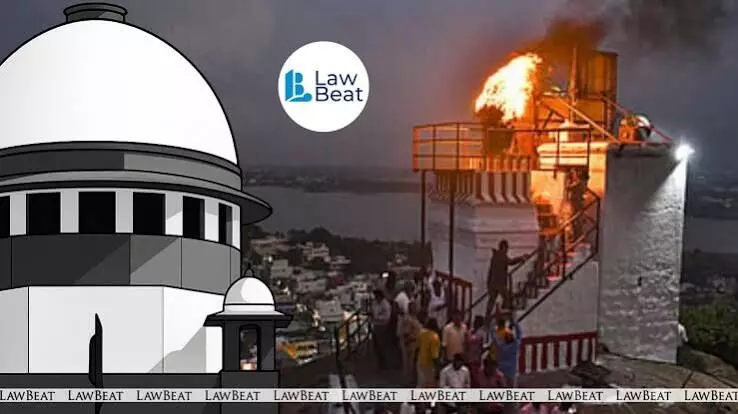
SC Contempt Notices: TN Officials Face Action Over Thiruparankundram Deepam
Summary
- The Supreme Court ordered the Karthigai Deepam to be lit at Thiruparankundram hill on November 28, 2026, under the supervision of two Court Receivers.
- Contempt notices were issued to the Tamil Nadu Chief Secretary, DGP, Madurai Collector, HR&CE officials, police, and Arulmigu Subramaniaswamy Temple trustees for alleged wilful disobedience of a November 20 order.
- The Court observed "administrative chaos" in Tamil Nadu and suggested executive authorities acted at the dictates of "political bosses."
- The Board of Trustees of the Arulmigu Subramaniaswamy Temple was suspended due to a "complete failure" in administration.
- Former High Court judges Justice S. Vaidyanathan and Justice V. Parthiban were appointed as Court Receivers to administer the temple and ensure the Deepam lighting.
Immediate Judicial Directives
The Supreme Court emphasized that any wilful non-compliance with its orders, particularly by executive authorities, cannot be overlooked and must be addressed with "iron hands," signaling a zero-tolerance approach to such defiance.
The Supreme Court, on Friday, November 27, 2026, issued a directive for the Karthigai Deepam to be lit at the Deepathoon, a prominent stone pillar atop Thiruparankundram hill, on the following day, November 28. This crucial order came amidst the ongoing Thiruparankundram Karthigai Deepam controversy and was mandated to occur under the direct oversight of two former High Court judges, who have been appointed as Court Receivers. This action by the apex court signals a firm response to what it perceived as a disregard for its previous instructions.
In a significant move, the bench comprising Justice Aravind Kumar and Justice Vipul M. Pancholi also initiated contempt proceedings by issuing notices to a broad array of Tamil Nadu officials and the temple's governing body. Those served with SC contempt notices Thiruparankundram Deepam include the Tamil Nadu Chief Secretary, the Director General of Police, the Madurai District Collector, senior officials from the Hindu Religious and Charitable Endowments (HR&CE) Department, various police officials, and the Board of Trustees of the Arulmigu Subramaniaswamy Temple. These individuals and entities are required to provide an explanation as to why contempt proceedings should not be launched against them for their alleged wilful disobedience of the Court's order issued on November 20. All recipients of these notices have been ordered to appear personally before the Supreme Court on December 15, 2026.
Scrutiny of Administrative Conduct
The Supreme Court's strong order highlighted a series of events that, in its preliminary assessment, indicated a "brazen and wilful disobedience" of its prior directives, alongside a "flagrant disregard" for an undertaking previously given to the Madras High Court. The bench critically observed that these developments pointed to "a state of administrative chaos in the State of Tamil Nadu, or at least in Madurai District." This assessment underscores the judiciary's concern over the functioning of state administration in relation to religious institutions.
Furthermore, the Court expressed its belief that executive authorities appeared to have acted under the influence of their "political bosses," suggesting a need to uncover the full circumstances surrounding the non-implementation of its order to uphold the integrity of the judicial process and ensure purity in the administration of justice. The Supreme Court emphasized that any wilful non-compliance with its orders, particularly by executive authorities, cannot be overlooked and must be addressed with "iron hands," signaling a zero-tolerance approach to such defiance. This firm stance led to the immediate suspension and supersession of the Board of Trustees of the Arulmigu Subramaniaswamy Temple, citing a "complete failure" in their administrative duties for the Devasthanam.
Ensuring Compliance and Future Administration
To rectify the administrative shortcomings and ensure the proper conduct of the Deepam, the Supreme Court appointed Justice S. Vaidyanathan, former Chief Justice of the Meghalaya High Court, and Justice V. Parthiban, a former Judge of the Madras High Court, as Court Receivers for the Thiruparankundram temple. These Receivers were directed to assume control of the temple's administration immediately, ideally on Friday itself, and to manage it in strict adherence to its established traditions, rituals, and sanctity. The state government has been instructed to provide all necessary logistical support to facilitate their duties.
A primary responsibility of the newly appointed Receivers is to guarantee the lighting of the Karthigai Deepam at the Deepathoon on November 28. They are tasked with determining the precise timing in consultation with the temple's sthanikars, or hereditary priests. The Court also specified that the flame lit at the Uchipillaiyar Mandapam on November 24 could be utilized if it remained active; otherwise, the Receivers possess the authority to arrange for an alternative flame. Additionally, the Supreme Court vacated its interim stay from November 20 on the Madras High Court judgment, thereby permitting devotees to light lamps on Thiruparankundram hill, provided they adhere to specified security safeguards. This permission allows lighting at the Deepathoon or any other designated spot at least 50 meters away from the Darg.
Practical Implications
This ruling underscores the Supreme Court's strict stance against wilful disobedience of its orders by executive authorities and temple trusts in India. Lawyers advising government officials, religious institutions, or public bodies must emphasize the critical importance of immediate and full compliance with judicial directives to avoid severe contempt proceedings, including personal appearances and potential suspension of administrative bodies. It sets a precedent for judicial intervention in cases of perceived administrative chaos or political interference in the implementation of court orders.
Source
How does this affect you?
Get an AI analysis of this article grounded in your jurisdictions, practice areas, and any policy documents you've uploaded to Wansom.
Finish Reading the Full Story and the Expert Analysis.
Get the latest legal & regulatory intelligence in India
Wansom is AI and can make mistakes.