
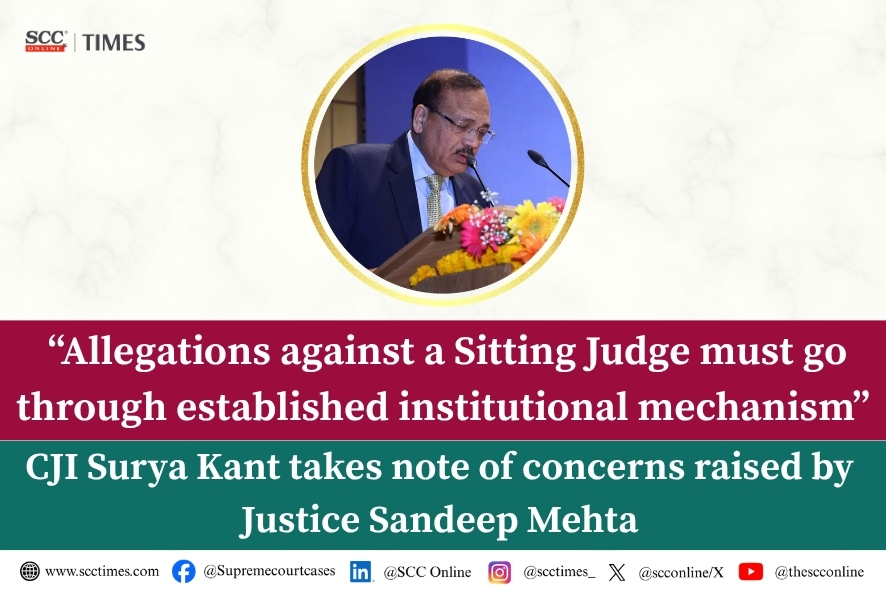
CJI Surya Kant: Justice Sandeep Mehta Allegations Handled Internally
Summary
- CJI Surya Kant acknowledged concerns raised by Supreme Court Justice Sandeep Mehta.
- The Chief Justice stated that these allegations against a sitting judge would not be adjudicated publicly.
- CJI Kant affirmed that the concerns would be addressed through the established institutional mechanism.
- This position emphasizes the judiciary's reliance on internal processes for judicial accountability in India.
CJI Addresses Concerns Regarding Justice Sandeep Mehta
Chief Justice Kant affirmed that these issues would be thoroughly addressed through the existing institutional mechanism designed for such purposes.
Chief Justice of India (CJI) Surya Kant recently acknowledged concerns that had been brought forward by Justice Sandeep Mehta, a sitting judge of the Supreme Court of India. This acknowledgement came with a clear directive regarding the appropriate forum for addressing such matters, emphasizing the judiciary's commitment to its established internal processes.
The CJI explicitly stated that the concerns raised by Justice Sandeep Mehta, which pertain to allegations against a sitting judge, are not suitable for adjudication in the public domain. Instead, Chief Justice Kant affirmed that these issues would be thoroughly addressed through the existing institutional mechanism designed for such purposes. This stance reinforces the Supreme Court of India's judicial conduct protocols and the formal channels available for handling sensitive complaints.
Upholding Institutional Mechanisms for Judicial Complaints
The directive from CJI Surya Kant underscores the judiciary's long-standing preference for handling allegations against sitting judges through established internal procedures rather than public discourse. This approach is fundamental to maintaining the integrity and independence of the judicial system in India. The institutional mechanism for judicial complaints is designed to ensure a fair and impartial review while protecting the judiciary from undue external pressure or speculative public debate.
This principle is crucial for judicial accountability in India, as it outlines a structured pathway for addressing serious issues concerning judicial conduct. The emphasis on an internal, established process for allegations against sitting judges highlights the judiciary's self-regulatory capacity and its commitment to resolving sensitive matters discreetly and effectively, thereby preserving public trust in the institution.
Implications for Judicial Accountability and Transparency
The CJI's statement regarding Justice Sandeep Mehta's concerns carries significant implications for how allegations against sitting judges are perceived and managed within the Indian legal framework. By firmly directing that such matters must pass through the established institutional mechanism, CJI Surya Kant reinforces the idea that formal channels are the primary and most appropriate avenue for resolution, rather than public debate or media trials.
This approach, while sometimes perceived as lacking in public transparency, is argued to be essential for safeguarding the judiciary's impartiality and preventing the politicization of judicial complaints. It highlights the importance of understanding the specific institutional mechanism for judicial complaints and the structured processes that govern judicial accountability in India, ensuring that serious concerns are addressed with due diligence and within the prescribed legal and ethical boundaries.
Practical Implications
This reinforces the established internal processes for addressing judicial misconduct allegations in India, indicating that public discourse is not the primary channel for resolution. Lawyers should be aware of the formal institutional mechanisms for such complaints rather than relying on public pressure, especially when advising on judicial ethics or potential complaints.
Source
Source: Original reporting via SCC Times
How does this affect you?
Get an AI analysis of this article grounded in your jurisdictions, practice areas, and any policy documents you've uploaded to Wansom.
Finish this article free. Just your email for instant unlock.
Wansom is AI and can make mistakes.