
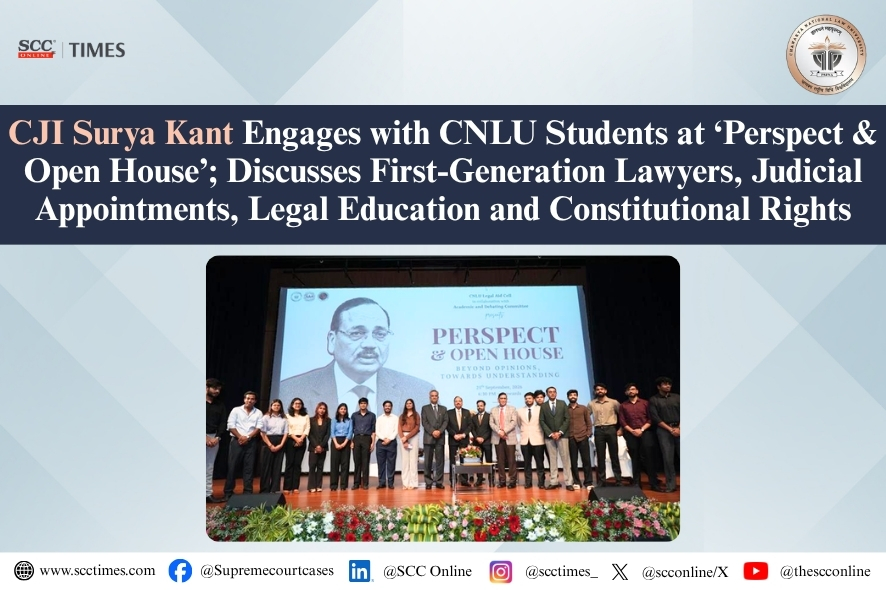
CJI Surya Kant: CNLU Discussions Tackle Judicial Appointments, First-Gen Lawyers
Summary
- Chief Justice of India (CJI) Surya Kant engaged with students and faculty at Chanakya National Law University (CNLU) during a special event.
- The interaction, titled ‘Perspect & Open House’, facilitated discussions on critical legal themes.
- Key topics included First-Generation Lawyers, Judicial Appointments, Legal Education, and Constitutional Rights.
- Notable attendees included Justice V. Kameswar Rao, Chief Justice of the Patna High Court and CNLU Chancellor, and Prof. (Dr.) Faizan Mustafa, CNLU Vice-Chancellor.
Judicial Engagement at CNLU
The engagement of CJI Surya Kant with the CNLU community, particularly through an open forum like ‘Perspect & Open House’, serves as a vital mechanism for bridging the gap between academic legal studies and the practical realities of judicial administration.
Chief Justice of India (CJI) Surya Kant recently participated in a significant interactive session with students and faculty at Chanakya National Law University (CNLU). This engagement formed part of an event specifically titled ‘Perspect & Open House’, designed to foster direct dialogue between the highest echelons of the judiciary and aspiring legal professionals. The presence of such a distinguished judicial figure provided a unique opportunity for the university community to gain direct insights into contemporary legal thought and challenges.
The interaction saw a notable gathering of legal luminaries and academics. Among the key attendees was Justice V. Kameswar Rao, who holds the dual roles of Chief Justice of the Patna High Court and Chancellor of CNLU, underscoring the institutional importance of the event. Also present was Prof. (Dr.) Faizan Mustafa, the esteemed Vice-Chancellor of CNLU, alongside various members of the university's faculty and a substantial number of its students. This collective participation highlighted the event's role as a crucial platform for intellectual exchange within the legal academic sphere.
Core Themes of Discussion
During the ‘Perspect & Open House’ event, CJI Surya Kant led discussions across several pivotal areas pertinent to the Indian legal landscape. A central theme explored was the experience and challenges faced by First-Generation Lawyers, a topic of increasing relevance in promoting inclusivity and diversity within the legal profession. This focus acknowledges the unique journey of individuals entering the legal field without prior family connections or established networks, highlighting the importance of support systems and opportunities for this demographic.
Another significant subject addressed was Judicial Appointments, a critical aspect of the justice delivery system that shapes the composition and future direction of the judiciary. Discussions around this area by the Chief Justice of India offer valuable perspectives on the processes, criteria, and broader implications of selecting judges. Furthermore, the interaction delved into the evolving landscape of Legal Education, examining its current state, future reforms, and its role in preparing competent and ethically sound legal practitioners. The Chief Justice's views on legal education are particularly influential, given his position at the apex of the judicial system.
Finally, the dialogue encompassed Constitutional Rights, a foundational pillar of India's democratic framework. This topic underscores the judiciary's role in upholding and interpreting the fundamental rights guaranteed to citizens, and discussions on this subject provide crucial insights into contemporary constitutional jurisprudence. The comprehensive range of topics covered during the interaction reflects a broad engagement with both the practical and theoretical dimensions of law, offering a holistic view to the participating students and faculty.
Broader Context of Legal Dialogue
The engagement of CJI Surya Kant with the CNLU community, particularly through an open forum like ‘Perspect & Open House’, serves as a vital mechanism for bridging the gap between academic legal studies and the practical realities of judicial administration. Such direct interactions provide students with an unparalleled opportunity to understand the perspectives of the highest judicial office on matters ranging from career pathways for new lawyers to the intricacies of constitutional interpretation. These discussions are instrumental in shaping the intellectual development of future legal professionals, offering them a deeper appreciation for the challenges and responsibilities inherent in the legal field.
The participation of key figures like Justice V. Kameswar Rao and Prof. (Dr.) Faizan Mustafa further elevates the significance of these dialogues, establishing a precedent for robust engagement between the judiciary and legal academia. These exchanges contribute to a more informed legal discourse, fostering an environment where critical issues such as judicial appointments and the quality of legal education can be openly considered. The insights shared by the Chief Justice of India during these discussions offer valuable guidance and inspiration, reinforcing the importance of a strong, independent, and well-educated legal fraternity for the nation's democratic health.
Practical Implications
This article reports on a discussion and does not contain direct actionable legal implications for practitioners, but offers insight into judicial perspectives on legal education and appointments.
Source
Source: Original reporting via SCC Times
How does this affect you?
Get an AI analysis of this article grounded in your jurisdictions, practice areas, and any policy documents you've uploaded to Wansom.
Finish Reading the Full Story and the Expert Analysis.
Get the latest legal & regulatory intelligence in India
Wansom is AI and can make mistakes.