

Christa Pike and Tennessee's First Execution of a Woman in 200 Years: The Legal Questions
Summary
The crime and sentence: Pike was convicted in 1996 of the brutal 1995 killing of 19-year-old Job Corps classmate Colleen Slemmer. Her 17-year-old co-defendant received life with parole eligibility, and a third teenager received probation.
Clemency denied: a 226-page petition cited documented childhood sexual abuse, which the state does not dispute, as well as bipolar disorder and PTSD, her age of 18, and sentencing disparity. Governor Lee said he would uphold the sentence.
The age line: Roper v. Simmons bars executions only for crimes committed under 18. Some state courts have extended youth protections to 18- to 20-year-olds for life-without-parole sentences, but not for the death penalty.
Final litigation: the Tennessee Supreme Court rejected her lethal-injection challenge on 23 September. Her US Supreme Court application raises a due-process argument about Tennessee's execution-litigation rule.
An outlier in Tennessee: of eight people sentenced to death in the modern era for crimes at 18, she is the only one whose sentence stands. No one executed in the state's modern era was younger than 23 at the time of the crime.
Women on death row: 45 women nationwide, and 18 executed since 1977, about 1% of all executions.
The Case
The crime. On 12 January 1995, Christa Pike, then 18, killed 19-year-old Colleen Slemmer, a fellow trainee at the Knoxville Job Corps Center, a federal vocational programme for young people. Pike, her 17-year-old boyfriend Tadaryl Shipp and 18-year-old Shadolla Peterson led Slemmer to a secluded area near the University of Tennessee campus, where she was beaten and killed. The attack was prolonged and brutal, and Pike has never denied her role. The three were arrested within about 36 hours, and Pike confessed to police.
Slemmer's mother, May Martinez, remembers her daughter as trusting and easy-going: she volunteered with the Special Olympics, loved roller skating and hoped for a career in computers.
Three defendants, three outcomes:
Defendant | Age at the crime | Outcome |
|---|---|---|
Christa Pike | 18 | Convicted of first-degree murder and conspiracy (22 March 1996); sentenced to death (30 March 1996) |
Tadaryl Shipp | 17 | Convicted in 1997; jury could not agree on life without parole, so the judge imposed life with parole eligibility plus a consecutive 25 years; denied parole in October 2025 |
Shadolla Peterson | 18 | Testified for the prosecution; pleaded guilty as an accessory after the fact; probation |
Pike was the only defendant the state prosecuted capitally. Shipp could not face the death penalty because he was under 18. Pike became one of the youngest women sentenced to death in the modern era.
Three decades of litigation:
Period | Development |
|---|---|
2001–2002 | Pike twice asked to drop her appeals, then reversed course; an August 2002 execution date was stayed |
2001–2004 | Convicted of the attempted first-degree murder of another inmate in a 2001 prison attack |
2008 | State post-conviction relief denied; state appeals exhausted |
2016 | Federal district court rejected her habeas claims, including ineffective assistance of counsel and mental illness |
2019 | Sixth Circuit unanimously affirmed |
2023 | Knox County court held that State v. Booker (2022), which limited automatic life sentences for juveniles, did not apply to an 18-year-old |
30 September 2025 | Tennessee Supreme Court set her execution for 30 September 2026 |
23 September 2026 | Tennessee Supreme Court denied a stay and rejected her challenge to the lethal injection protocol |
28 September 2026 | Governor Bill Lee declined clemency |
The execution is scheduled for 10 a.m. Central time on Wednesday, 30 September 2026. A stay application is pending before the US Supreme Court.
Clemency: The Petition and the Governor's Decision

The power. Under Article III, section 6 of the Tennessee Constitution, the governor may grant reprieves and pardons after conviction. That includes commuting a death sentence. Clemency is an act of executive discretion, not judicial review. The governor can weigh mercy, fairness and context in ways the procedural rules that confine the courts do not allow.
The petition. Pike's lawyers filed a 226-page petition asking Governor Bill Lee to commute her sentence to life imprisonment without parole. Its main arguments:
Ground | The petition's case |
|---|---|
Childhood trauma | Repeated sexual abuse from about age two, a rape at 11 by a neighbour who later pleaded no contest, and a rape by a stranger at 17, about a year before the crime. At a court hearing in August, the state did not dispute the abuse |
Mental illness | Later diagnoses of bipolar disorder and PTSD, and expert evidence linking prenatal alcohol exposure to frontal-lobe damage |
Age and consistency | Of more than 200 people sentenced to death in Tennessee's modern era, eight were 18 at the time of the crime. The other seven sentences, all of men, have been vacated. The 17 people executed in the modern era averaged just under 29 at the time of the crime, and the youngest was 23 |
Disparity | Shipp, 17, received life with parole eligibility, and Peterson received probation. Shipp's own trial lawyer wrote in support of clemency, arguing the difference in sentences reflects a slight age gap rather than their respective roles |
Rehabilitation | Pike, now 50, is described as remorseful, treated and a mentor to other incarcerated women |
Support came from UN human rights experts, the ACLU, Amnesty International and more than 100 anti-violence organisations. The anti-violence groups stressed that her history explains the crime without excusing it.
The decision. On 28 September 2026, Governor Lee said that, after deliberate consideration and a thorough review of the case, he was upholding the sentence and did not plan to intervene. Pike's attorneys said they were deeply saddened. They argued the state was disregarding decades of research on how much responsibility an 18-year-old with severe trauma should bear.
The Legal Questions
1. Is 18 the right line?
In Roper v. Simmons (2005), the Supreme Court held that the Eighth Amendment bars executing anyone for a crime committed under the age of 18. The Court drew the line at 18 while acknowledging that the qualities distinguishing juveniles from adults do not disappear on an 18th birthday. The categorical rule, it explained, had to be drawn somewhere.
Pike was 18 years and 10 months old. Her lawyers argue that brain-development research since Roper shows the same features of youth, including impulsivity, susceptibility to peer influence and capacity for change, extend into the early twenties. Some state courts have accepted versions of that reasoning for life-without-parole sentences:
Court | Decision | Holding |
|---|---|---|
Washington Supreme Court | In re Monschke (2021) | Mandatory life without parole unconstitutional for 19- and 20-year-olds under the state constitution |
Michigan Supreme Court | People v. Parks (2022) | Mandatory life without parole unconstitutional for 18-year-olds under the state constitution |
Massachusetts Supreme Judicial Court | Commonwealth v. Mattis (2024) | Life without parole unconstitutional for 18- to 20-year-olds under the state constitution |
None of these decisions concerns the death penalty or binds Tennessee. In Pike's own case, a Knox County court held in 2023 that the Tennessee Supreme Court's decision in State v. Booker (2022), which limited automatic life sentences for juveniles, applies only to offenders under 18. The US Supreme Court has not extended Roper itself beyond 18.
2. Did the jury hear the full mitigating case?
Pike's federal defender argues that her trial lawyers failed to present critical evidence of her abuse history at the penalty phase, or to argue her age. The governing standard is Strickland v. Washington (1984): deficient performance plus a reasonable probability of a different outcome. Wiggins v. Smith (2003) confirms that failing to investigate a defendant's life history can meet that standard in a capital case. Pike's ineffective-assistance claims were rejected on state post-conviction review. The federal courts then denied relief in 2016 and 2019, applying the deferential review that federal habeas law requires. At this stage, the argument is directed mainly to clemency rather than to the courts.
3. The method of execution
Pike's final litigation challenged Tennessee's lethal-injection protocol. She argued that thrombocytosis, a blood-platelet condition, created a risk of severe pain, and that restraint, observation by male officers and IV placement could re-traumatise a survivor of sexual abuse. On 23 September, the Tennessee Supreme Court rejected the challenge. Under Baze v. Rees (2008), Glossip v. Gross (2015) and Bucklew v. Precythe (2019), a prisoner must show a substantial risk of severe pain and identify a feasible, readily available alternative, which is a demanding test. The state has agreed to allow her spiritual adviser into the execution chamber, consistent with Ramirez v. Collier (2022).
4. The pending US Supreme Court application
Pike's lawyers are asking the US Supreme Court to stay the execution. They argue that Tennessee Supreme Court Rule 12(4)(E), which governs litigation over the method or timing of executions, prevented substantive review of her claims, raising a due-process question. Last-minute stays from the Supreme Court are rare.
Women and the Death Penalty: A Rare Sentence
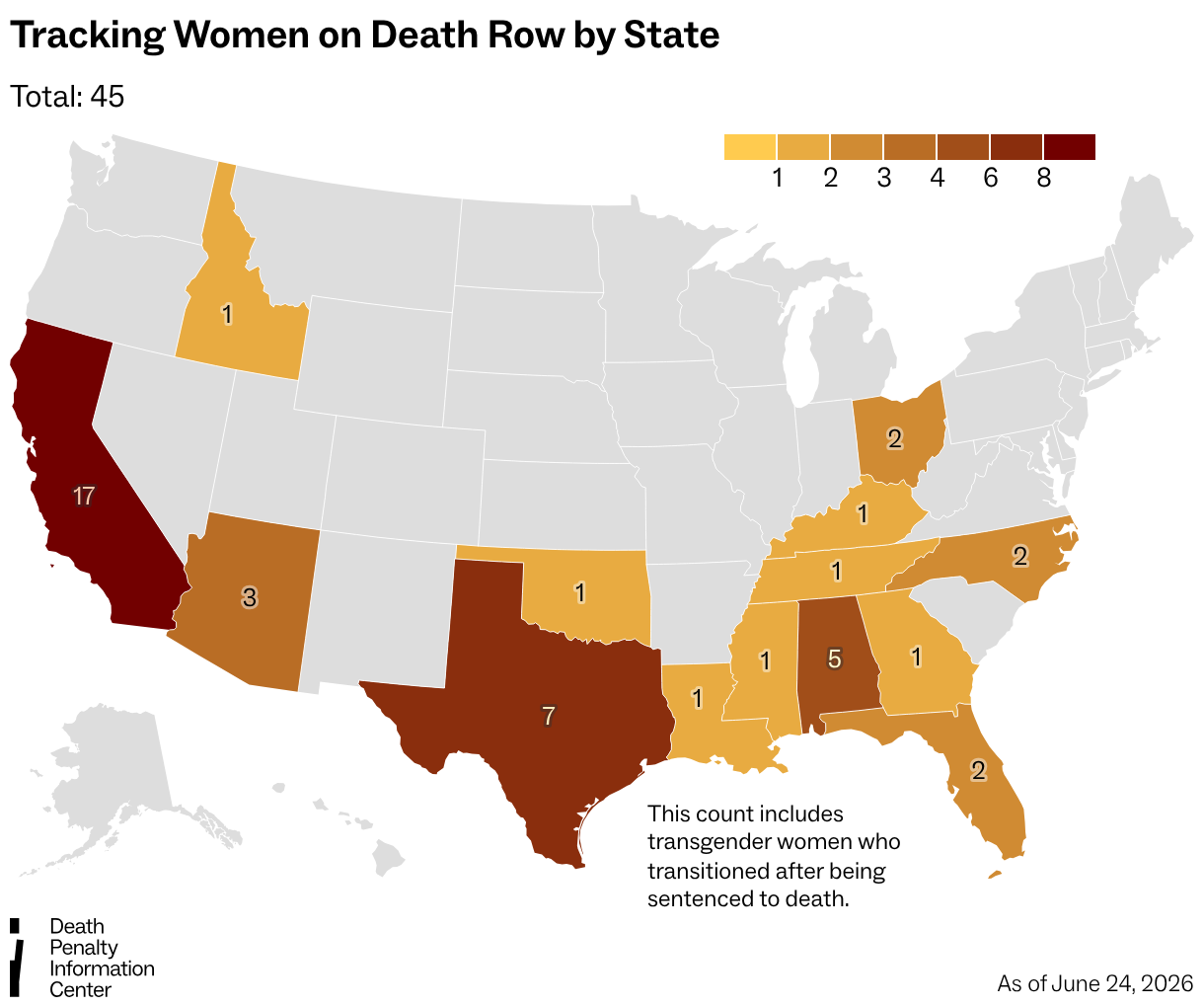
The numbers. Women are a very small share of both death sentences and executions in the United States:
Measure | Figure |
|---|---|
Women executed since the modern era began (1977) | 18, about 1% of all executions |
Women executed since 1900 | 56; New York and Texas carried out the most |
Women on death row (Cornell Center on the Death Penalty Worldwide, 24 June 2026) | 45 |
Most recent execution of a woman | Amber McLaughlin, Missouri, January 2023 |
Last federal execution of a woman | Lisa Montgomery, January 2021, the first in nearly 70 years |
Last execution of a woman in Tennessee | 1820 |
Where they are. Of the 45 women on death row, 17 are in California, where Governor Gavin Newsom's 2019 moratorium means no executions are carried out. Texas holds seven and Alabama five. Pike is the only woman on Tennessee's death row.
Why so few. Experts point first to the fact that women commit a much smaller share of homicides. Robin Maher of the Death Penalty Information Center adds that juries weighing who deserves the most severe punishment may find that women rarely fit their mental image of that person.
A distinctive profile. Researchers at the Cornell Center on the Death Penalty Worldwide report that 96% of women on death row experienced rape, childhood sexual abuse or domestic violence before their arrest. Its founding director, Sandra Babcock, says prosecutors often minimised or dismissed those experiences. Because women on death row are so few, they are also frequently held alone, compounding the isolation of capital confinement.
Gender and fair trials. The Supreme Court has recently engaged with gender bias in capital trials. In Andrew v. White (2025), it held that the Due Process Clause can be violated where prosecutors rely on unduly prejudicial evidence, and sent back the case of Brenda Andrew, the only woman on Oklahoma's death row, whose trial featured extensive evidence about her sex life and appearance. In August 2026 the Tenth Circuit declined to rehear her case, and her lawyers have said they will return to the Supreme Court.
Tennessee's Execution Framework
Who sets the date. In Tennessee, the state Supreme Court sets execution dates, usually on the Attorney General's motion once ordinary appeals are exhausted. It set Pike's date a year in advance, on 30 September 2025.
Method. Lethal injection is the default. Prisoners whose offences predate 1999 may elect electrocution instead, and Pike falls into that group.
A protocol rebuilt after failure:
Date | Development |
|---|---|
2020 | Governor Lee issues reprieves during the COVID-19 pandemic |
April 2022 | Oscar Smith's execution is halted about an hour beforehand after lapses in drug testing emerge; Lee pauses all executions |
2022–2023 | An independent review finds the Department of Correction repeatedly failed to follow its own protocol, including on testing the drugs |
December 2024 | The Department adopts a single-drug pentobarbital protocol |
2025 | Executions resume: Oscar Smith (22 May), Byron Black (5 August) and Harold Nichols (December) |
The new protocol remains contested. Nine death-row prisoners sued in 2025, arguing that pentobarbital carries a high risk of a torturous death. During Byron Black's execution he repeatedly groaned and said he was in pain, and his autopsy reported pulmonary congestion and oedema. Pike's own challenge failed in the Tennessee Supreme Court on 23 September 2026.
Pike's place in that record. Of the 17 people Tennessee has executed in the modern era, none was younger than 23 at the time of the crime. If the execution goes ahead, Pike will be the first person executed in Tennessee's modern era for a crime committed as a teenager, and the first woman the state has executed since 1820.
Competing Perspectives
The case divides opinion along lines that run through the wider death-penalty debate.
The case for carrying out the sentence. A jury convicted Pike of a premeditated and exceptionally brutal killing, and the sentence has survived three decades of state and federal review. She was legally an adult, and the Supreme Court drew the constitutional line at 18. Her later conviction for attempting to kill another inmate in 2001 undercuts claims that she is no longer dangerous. Supporters of the sentence also stress finality for the victim's family after more than 30 years. On this view, clemency is not a forum for relitigating arguments the courts have rejected.
The case for commutation. Pike was 18 and had suffered years of documented sexual abuse that the state does not dispute. Her co-defendant, less than two years younger, has been eligible for parole. Every other Tennessee death sentence for an 18-year-old has been vacated, and no one executed in the state's modern era was younger than 23 at the time of the crime. Supporters argue that life without parole would still ensure she is never released, while recognising the role of trauma, mental illness and youth.
The legal significance. Whatever happens, the case sharpens three questions courts will keep facing:
whether the age line drawn in Roper should move, as some state courts have moved it for life-without-parole sentences;
how capital juries should hear, and prosecutors treat, evidence of abuse, particularly for women defendants; and
how far method-of-execution challenges can account for a prisoner's specific medical and psychological condition.
What to Watch
The US Supreme Court's ruling on the stay application, which is expected before the scheduled time of 10 a.m. Central on 30 September 2026.
Any last-minute executive action. Governor Lee retains the power to grant a reprieve up to the moment of execution, although he has said he does not plan to intervene.
Further proceedings in Brenda Andrew's gender-bias case and other challenges to women's death sentences.
Briefly will update this analysis as events develop.
Frequently Asked Questions
Who is Christa Pike? The only woman on Tennessee's death row. She was convicted in 1996 of the January 1995 murder of 19-year-old Colleen Slemmer, a fellow Knoxville Job Corps trainee, committed when Pike was 18.
When is the execution scheduled? At 10 a.m. Central time on Wednesday, 30 September 2026, at Riverbend Maximum Security Institution in Nashville.
Why did the governor deny clemency? Governor Bill Lee said that after deliberate consideration and a thorough review of the case, he would uphold the sentence and not intervene. He did not give more detailed reasons.
Can someone be executed for a crime committed at 18? Yes. Roper v. Simmons (2005) bars the death penalty only for crimes committed under 18. Pike's lawyers argue that her age, trauma and mental illness should still weigh heavily against execution.
How many women are on death row in the US? 45 as of June 2026, according to the Cornell Center on the Death Penalty Worldwide. Eighteen women have been executed since 1977, about 1% of all executions.
When was a woman last executed in Tennessee? In 1820, according to the Death Penalty Information Center.
Citations
- 1.• Tennessee is set to execute a woman for the first time in 200 years, NPR (29 September 2026)
- 2.• Governor Lee does not plan to intervene in Christa Pike execution, WATE (28 September 2026)
- 3.• Tennessee governor denies clemency for death row inmate Christa Pike, FOX 17 (28 September 2026)
- 4.• Tennessee Supreme Court declines to stay execution of Christa Pike, WATE (24 September 2026)
- 5.• Tennessee Supreme Court denies stay for death row inmate Christa Pike, The National News Desk (26 September 2026)
- 6.• Christa Pike Requests Clemency Ahead of September 30 Execution Date, Death Penalty Information Center (updated 25 September 2026)
- 7.• Women on Death Row, Death Penalty Information Center
- 8.• Tennessee state profile, Death Penalty Information Center
- 9.• Death Penalty in Tennessee, Tennessee Department of Correction
- 10.• Christa Pike Faces Tennessee Execution as Supreme Court Weighs Stay, Freedom for All Americans
- 11.• Plans for Tennessee to execute Christa Pike remain in place, Nashville Banner (28 September 2026)
- 12.• Pike v. Gross, US Court of Appeals for the Sixth Circuit (2019)
Finish Reading the Full Story and Expert Analysis.
Get the latest legal & regulatory intelligence in United States
Wansom is AI and can make mistakes.