
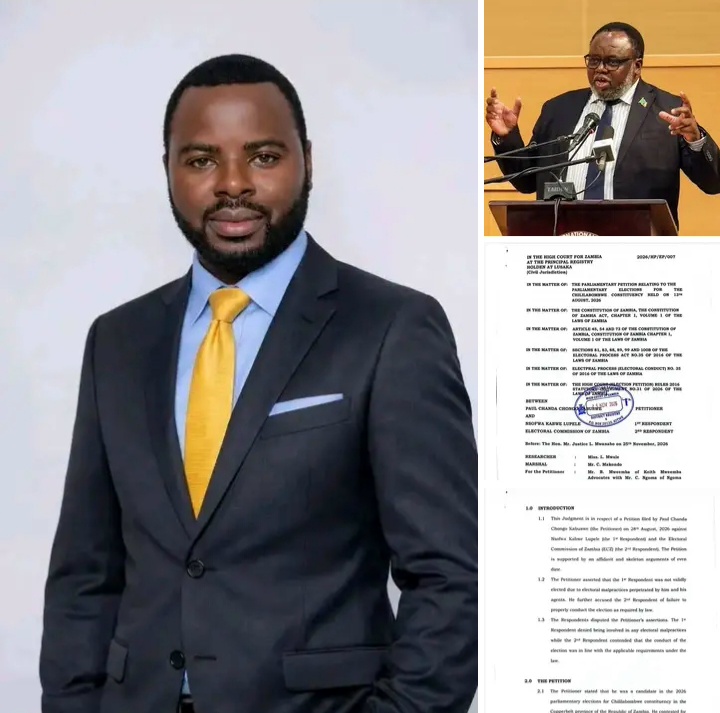
Zambia High Court: Chililabombwe Election Nullification for Nsofwa Lupele
Summary
- The Zambian High Court nullified Nsofwa Kabwe Lupele's election as Member of Parliament for Chililabombwe.
- Justice Lastone Mwanabo issued the ruling on November 25, 2026, following an election petition.
- The case was brought by Paul Chanda Chongo Kabuswe against Nsofwa Kabwe Lupele and the Electoral Commission.
- This decision underscores the High Court's critical role in upholding electoral integrity in Zambia.
What Happened
Lawyers should analyze this High Court decision as it establishes a precedent for the grounds and judicial standards applied in election nullification petitions in Zambia.
The Zambian High Court recently delivered a significant ruling concerning the parliamentary seat for Chililabombwe. On November 25, 2026, Justice Lastone Mwanabo presided over the case of Paul Chanda Chongo Kabuswe v Nsofwa Kabwe Lupele and the Electoral Commission. This legal challenge culminated in the nullification of Nsofwa Kabwe Lupele’s election as the duly elected Member of Parliament for the Chililabombwe constituency.
This judicial decision effectively invalidated the outcome of the election that had previously seen Ms. Lupele declared the winner. The High Court's intervention underscores the rigorous scrutiny applied to electoral processes in Zambia, particularly when a petition is lodged by an aggrieved party. The specific details leading to this nullification, while not elaborated in the immediate announcement, represent a critical judicial review of the electoral integrity in Chililabombwe.
Legal Context
In Zambia, the High Court plays a pivotal role in adjudicating disputes arising from parliamentary elections. An election petition, such as the one filed by Paul Chanda Chongo Kabuswe, serves as a formal legal challenge to the validity of an election result. These petitions typically allege irregularities, malpractice, or non-compliance with electoral laws that could have materially affected the outcome. The High Court is empowered to hear such cases and, if sufficient grounds are established, to declare an election null and void.
The nullification of a parliamentary election by the High Court, as seen in the Chililabombwe election nullification of Nsofwa Lupele, is a serious judicial pronouncement. It signifies that the court found compelling reasons to invalidate the original declaration of results. This process ensures that the principles of free, fair, and transparent elections are upheld, providing a crucial check on the Electoral Commission's conduct and the candidates' actions during the election period. The ruling by Justice Lastone Mwanabo in this specific Zambian parliamentary election nullification case highlights the judiciary's commitment to maintaining electoral integrity.
Why It Matters
The High Court's decision to nullify the Chililabombwe parliamentary election has immediate and far-reaching implications. For the Chililabombwe constituency, it means that the electoral process for their representative will need to be revisited, potentially leading to a by-election. This outcome directly impacts the political landscape and the representation of the constituents in the national assembly. The ruling serves as a stark reminder to all political actors, including candidates and the Electoral Commission, of the strict adherence required to electoral laws and regulations.
Lawyers should analyze this High Court decision as it establishes a precedent for the grounds and judicial standards applied in election nullification petitions in Zambia. This ruling offers critical insight for advising political clients on the viability of challenging or defending election results for parliamentary seats. The specific case of Paul Chanda Chongo Kabuswe v Nsofwa Kabwe Lupele provides a concrete example of the judiciary's willingness to intervene when electoral integrity is compromised, reinforcing the importance of robust legal challenges in safeguarding democratic processes. The Justice Lastone Mwanabo ruling will undoubtedly be a reference point for future Zambian parliamentary election nullification cases.
Practical Implications
Lawyers should analyze this High Court decision as it establishes a precedent for the grounds and judicial standards applied in election nullification petitions in Zambia. This ruling offers critical insight for advising political clients on the viability of challenging or defending election results for parliamentary seats.
Source
How does this affect you?
Get an AI analysis of this article grounded in your jurisdictions, practice areas, and any policy documents you've uploaded to Wansom.
Finish Reading the Full Story and the Expert Analysis.
Get the latest legal & regulatory intelligence in Zambia
Wansom is AI and can make mistakes.