
Canadian eDiscovery Data Complexity: Legal Teams Adapt Strategies
Summary
- Modern Canadian litigation faces significant eDiscovery complexity due to fragmented evidence across diverse digital sources.
- Courts and opposing counsel in Canada demand greater proportionality and defensibility in eDiscovery processes.
- Advanced analytics, Technology-Assisted Review (TAR), and generative AI are crucial tools for managing data and improving efficiency in Canadian litigation.
- Array Canada, with over 25 years of experience, provides expertise and technology solutions for complex eDiscovery matters.
- Legal teams must integrate these advanced technologies to efficiently manage data volumes and ensure defensible discovery outcomes.
Evolving eDiscovery Challenges
Lawyers and compliance officers in Canada must evaluate and integrate advanced analytics, Technology-Assisted Review (TAR), and generative AI into their eDiscovery workflows to efficiently manage fragmented data volumes, meet proportionality demands, and ensure the defensibility of their discovery processes in litigation.
Modern Canadian litigation now contends with a more intricate challenge than mere data volume: the pervasive Canadian eDiscovery data complexity arising from fragmented evidence. This evidence is dispersed across a multitude of non-traditional sources, including various cloud applications, collaboration platforms, mobile devices, and messaging systems. A recent webinar, titled "Data, Volume, and Defensibility: How Canadian Legal Teams Are Managing the Complexity Crunch," brought together industry experts to address these evolving demands. The session, hosted by Mallory Hendry, Content Specialist at Key Media, delved into how legal professionals are adapting their eDiscovery strategies.
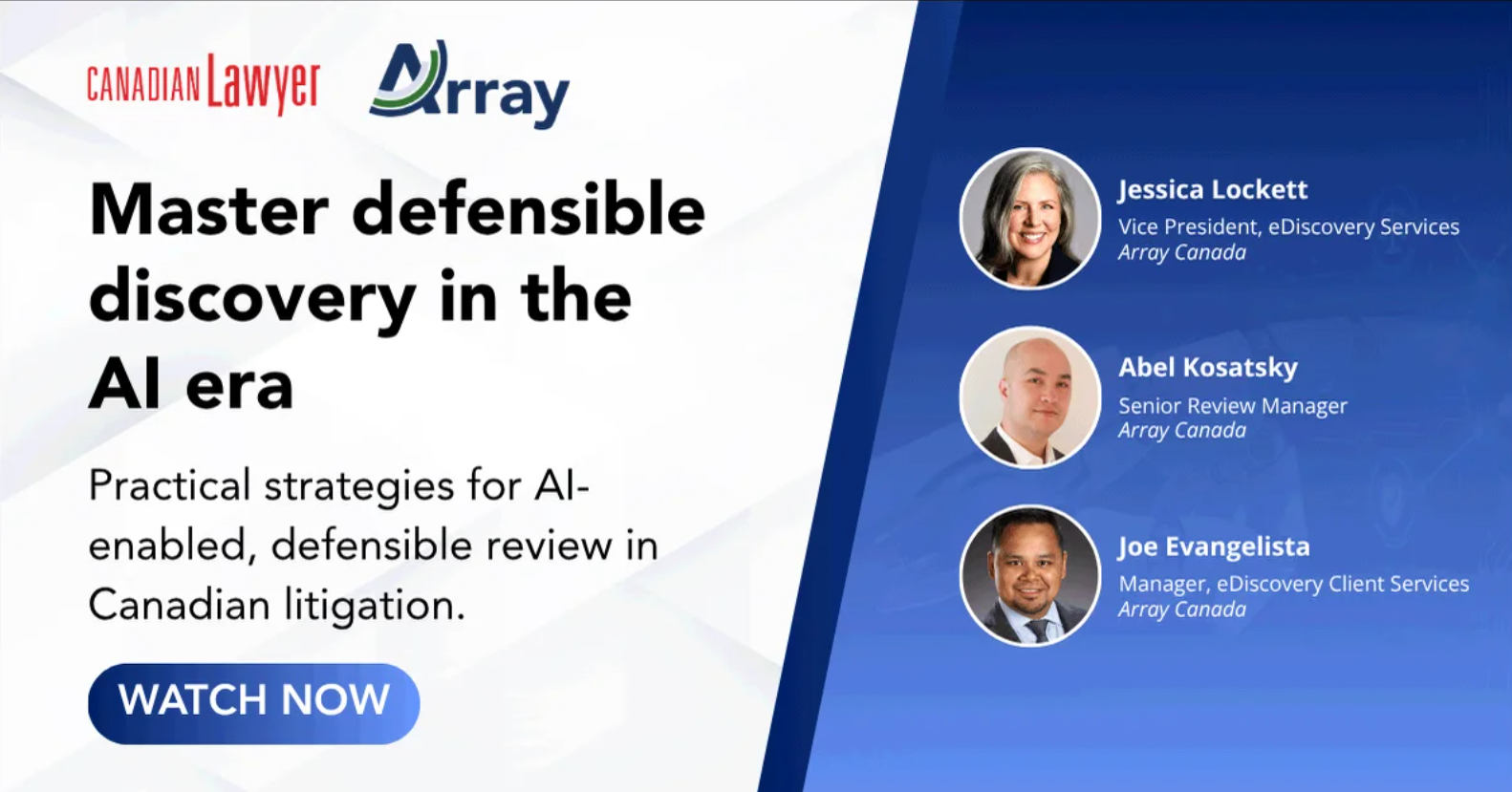
The webinar featured three prominent experts from Array Canada, a global legal services provider that assists law firms and in-house legal teams throughout the entire eDiscovery process. Array, which maintains offices in Canada, the U.S., and the U.K., boasts a deep history in Canadian eDiscovery, spanning over 25 years, with dedicated Canadian leadership and team members serving clients nationwide. The company specializes in collecting and processing electronic information, analyzing and reducing data volumes, and managing document review through to final production. This includes guiding counsel in selecting appropriate workflows, leveraging advanced analytics and AI where suitable, and providing support from experienced eDiscovery professionals and review lawyers.
Legal and Regulatory Context
The current legal landscape in Canada places significant pressure on litigation teams to operate with increased speed and cost-efficiency while simultaneously upholding the integrity of the evidentiary record. Beyond these operational demands, Canadian courts and opposing counsel are increasingly emphasizing the need for greater proportionality and eDiscovery defensibility Canada. This means that legal teams must not only manage vast and fragmented data sets but also demonstrate that their discovery processes are reasonable, transparent, and robust enough to withstand scrutiny.
This environment necessitates a strategic shift in Canadian litigation eDiscovery strategies. Lawyers and compliance officers in Canada must evaluate and integrate advanced analytics, Technology-Assisted Review (TAR), and generative AI into their eDiscovery workflows to efficiently manage fragmented data volumes, meet proportionality demands, and ensure the defensibility of their discovery processes in litigation. The challenge is no longer just about finding information, but about finding it in a defensible, proportionate, and efficient manner across a complex digital ecosystem.
Why Advanced Tools Matter
The integration of advanced analytics, Technology-Assisted Review (TAR) Canada, and generative AI eDiscovery Canada is becoming indispensable for legal teams navigating the complexities of modern litigation. These sophisticated tools offer a pathway to significantly reduce the burden of unnecessary document review, accelerate the identification of critical evidence, and manage large-scale matters with greater efficiency. By adopting defensible AI workflows, legal professionals can maintain the high standards of accuracy and reliability that courts expect, even when dealing with unprecedented volumes of diverse data.
Array Canada's experts, Jessica Lockett, Abel Kozatsky, and Joe Evangelista, bring extensive experience to this critical discussion. Jessica Lockett, Vice President of eDiscovery and Review Services, is an Ontario Barred lawyer with over 16 years in eDiscovery and document review. Abel Kozatsky, Senior Review Manager, also an Ontario Bar lawyer, has a decade of experience in designing review workflows and managing complex eDiscovery projects. Joe Evangelista, Manager of eDiscovery Client Services, is recognized as one of the few Relativity Master Designated designates in Canada, with 20 years of eDiscovery experience. Their collective expertise underscores how combining technology with human insight is vital for legal teams to effectively interpret their data and meet the rigorous demands of litigation, investigations, and regulatory matters.
Practical Implications
Lawyers and compliance officers in Canada must evaluate and integrate advanced analytics, Technology-Assisted Review (TAR), and generative AI into their eDiscovery workflows to efficiently manage fragmented data volumes, meet proportionality demands, and ensure the defensibility of their discovery processes in litigation.
Source
How does this affect you?
Get an AI analysis of this article grounded in your jurisdictions, practice areas, and any policy documents you've uploaded to Wansom.
Finish Reading the Full Story and the Expert Analysis.
Get the latest legal & regulatory intelligence in Canada
Wansom is AI and can make mistakes.