
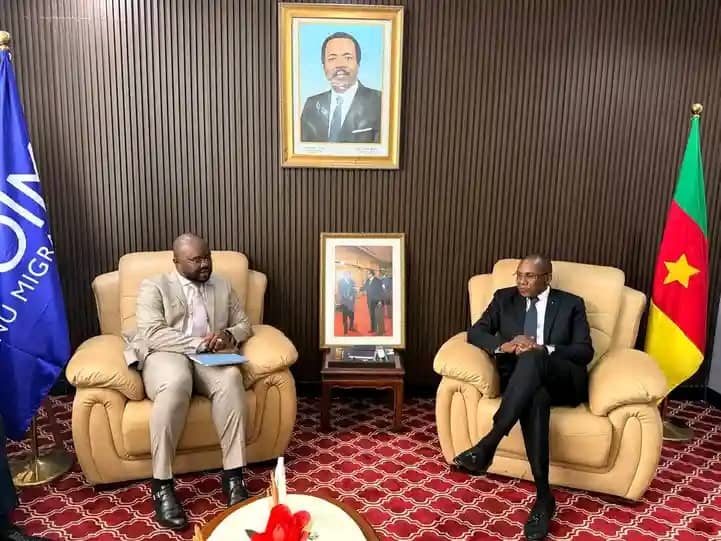
Cameroun OIM: Intégrer Mobilité Humaine dans Politiques Santé
Summary
- On August 10, 2026, Cameroon's Minister of Public Health met with the OIM Head of Mission to discuss integrating human mobility into health policies.
- The meeting aimed to strengthen collaboration between MINSANTÉ and OIM to build a more inclusive health system.
- Key discussion points included enhancing health surveillance at borders, adapting to climate change, and mobilizing the Cameroonian health diaspora.
- The initiative seeks to improve epidemic response capacity and leverage the technical skills of health professionals abroad.
- This dialogue signals potential future legislative or regulatory changes impacting mobile populations and border health security in Cameroon.
Strategic Dialogue on Health and Mobility
For legal professionals, particularly those advising clients in public health, cross-border services, or human resources in Cameroon, these discussions are highly significant.
On August 10, 2026, a pivotal meeting took place in Cameroon between the Minister of Public Health, MANAOUDA Malachie, and the Head of Mission for the International Organization of Migration (OIM) in Cameroon, Abdel Rahmane DIOP. During their discussions, Mr. DIOP strongly advocated for a more comprehensive integration of human mobility considerations into national health policies. The core objective articulated was to cultivate a more inclusive health system, specifically designed to effectively respond to the challenges posed by population displacements.
This high-level engagement underscored a shared commitment to strengthening the collaboration between the Ministry of Public Health (MINSANTÉ) and the OIM. The primary focus was on ensuring that health planning adequately accounts for the complex dynamics associated with population movements. The dialogue centered on several critical areas, including enhancing health surveillance at national borders, developing strategies for adaptation to climate change, and actively engaging the Cameroonian health diaspora.
The overarching aim of these discussions was to ensure that public health frameworks in Cameroon are robust and adaptable, capable of addressing the evolving landscape of human mobility. This proactive approach by the `Organisation Internationale pour les Migrations Cameroun` and `MINSANTÉ Cameroun OIM` signals a strategic shift towards building a more resilient health infrastructure that can better serve all populations, including those on the move.
Key Policy Priorities Identified
A significant portion of the meeting was dedicated to the critical issue of `surveillance sanitaire frontières Cameroun`. Discussions focused on the imperative to bolster the nation's capacity to respond swiftly to potential epidemics and to enhance overall health security along its borders. This is particularly crucial given the substantial migratory flows observed across the sub-region, which necessitate robust preventative and responsive measures to safeguard `santé publique Cameroun migration`.
Another key area of focus was the `mobilisation diaspora santé Cameroun`. Cameroon boasts a considerable number of health professionals residing abroad, and the initiative aims to harness their technical and scientific expertise. The concept involves creating conducive conditions to leverage these skills, thereby providing a significant boost to the national health system. This strategy seeks to tap into a valuable resource pool to enhance healthcare delivery and innovation within the country.
Furthermore, the agenda included discussions on adapting health policies to address the impacts of climate change. These multifaceted priorities highlight a comprehensive approach by `Cameroun OIM politiques santé mobilité` to build a health system that is not only responsive to immediate crises but also forward-looking in its capacity to manage long-term demographic and environmental shifts.
Implications for Future Health Governance
The collaborative efforts between the `Organisation Internationale pour les Migrations Cameroun` and the Ministry of Public Health signal a clear intent to integrate human mobility more deeply into national health policy. This strategic alignment reflects a recognition that effective `santé publique Cameroun migration` management is indispensable for national well-being. The Minister of Public Health, MANAOUDA Malachie, affirmed that this dynamic initiative aligns with the government's broader commitment to strengthening the health sector.
For legal professionals, particularly those advising clients in public health, cross-border services, or human resources in Cameroon, these discussions are highly significant. They foreshadow potential future legislative or regulatory changes stemming from this `MINSANTÉ Cameroun OIM` collaboration. Lawyers should closely monitor developments, especially concerning new policies on `surveillance sanitaire frontières Cameroun` and regulations impacting mobile populations or the reintegration of returning health professionals.
This proactive engagement underscores a national ambition to develop a health system that is not only inclusive but also robust enough to navigate the complexities of modern population movements, ensuring health security and access for all residents and migrants alike.
Practical Implications
Lawyers advising clients in public health, cross-border services, or human resources in Cameroon should monitor potential future legislative or regulatory changes arising from this OIM-MINSANTÉ collaboration, particularly regarding health surveillance at borders and policies impacting mobile populations or returning health professionals.
Source
How does this affect you?
Get an AI analysis of this article grounded in your jurisdictions, practice areas, and any policy documents you've uploaded to Wansom.
Wansom is AI and can make mistakes.