
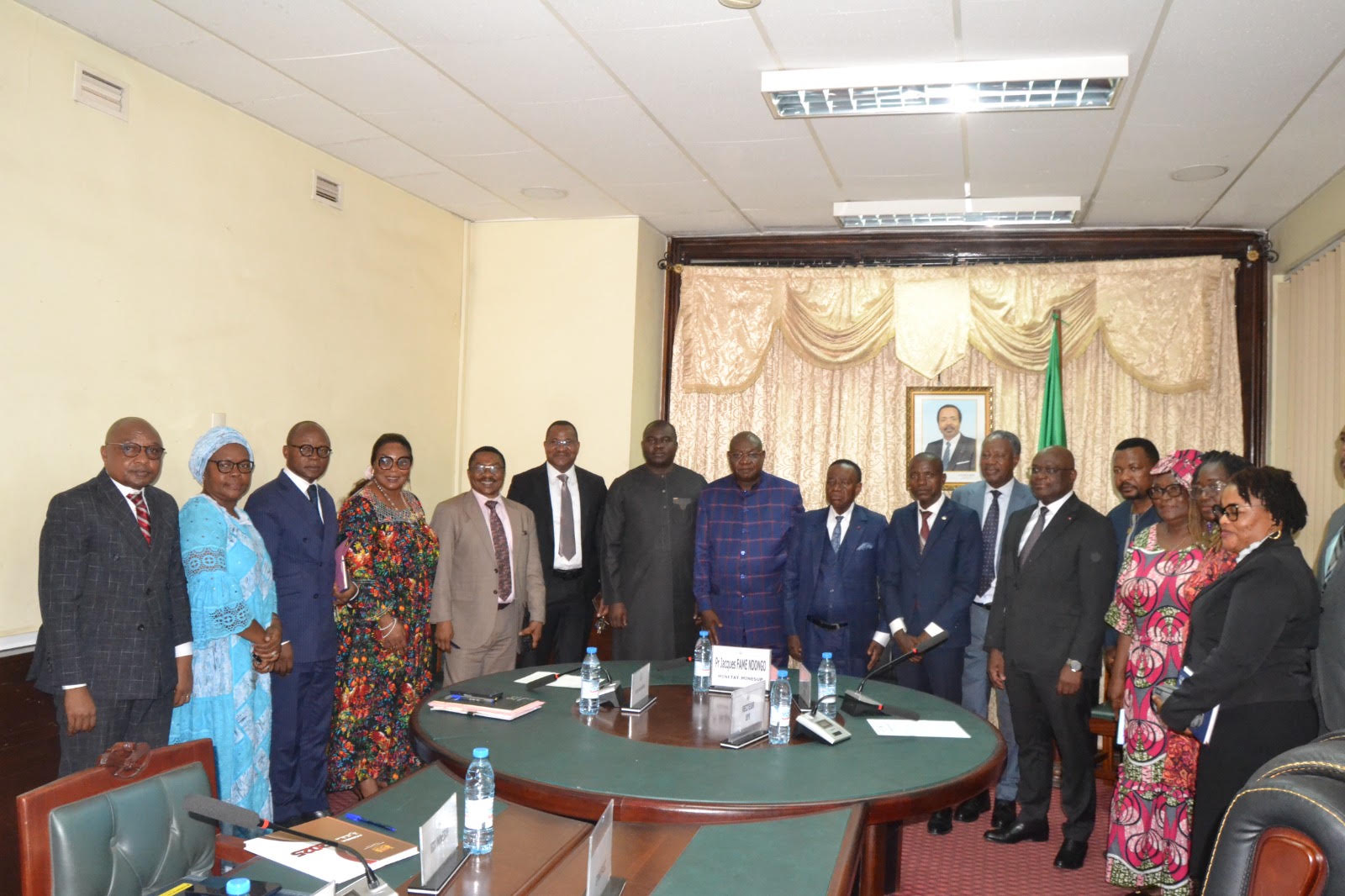
Cameroun Ministre Fame Ndongo: Secures Accord for University Personnels d'Appui
Summary
- Cameroun's Minister of Higher Education, Jacques Fame Ndongo, met with the Synapauc union on September 23 to address staff grievances.
- The meeting, which included representatives from Minfi and university rectors, focused on career profiles, salary grids, blocked advancements, and other staff demands.
- Discussions led to a definitive resolution, with solutions categorized by timeline and responsibility across universities, Minesup, and Minfi.
- An action timeline was adopted, and a follow-up committee was created to oversee the implementation of these agreements.
- Synapauc reaffirmed its loyalty to the government and committed to maintaining social peace on campuses, despite a tense educational context marked by a teachers' strike.
Minister Addresses University Staff Grievances
The comprehensive implementation of the solutions agreed upon, particularly those pertaining to staff career profiles, the revised grille salariale universités Cameroun, and the unblocking of advancements, carries substantial legal and administrative implications for Cameroonian state universities and their employees.
On September 23, at 4 PM, a significant meeting took place involving Cameroun's Minister of State for Higher Education, Jacques Fame Ndongo, and the leadership of the National Union of Support Staff of State Universities (Synapauc). This gathering, a key component of the ongoing dialogue social enseignement supérieur Cameroun, was convened to address long-standing revendications personnels universités Cameroun. Beyond Minister Fame Ndongo and the Synapauc bureau, the discussions also included a representative from the Ministry of Finance (Minfi) and the rectors of Yaoundé I and II universities, underscoring the broad institutional involvement.
The core issues on the agenda, affecting the university personnels d'appui, encompassed their career profiles, the structure of their grille salariale, the resolution of blocked advancements and outstanding back payments, the provision of adequate insurance, and ensuring the consistent and timely flow of salaries. These critical points formed the heart of the exchanges, aiming to resolve historical grievances.
Resolutions and Implementation Framework
The extensive discussions ultimately led to a definitive resolution of these persistent demands. The agreed-upon solutions were strategically categorized, not only by their intended implementation timeframe—spanning both the short and medium term—but also by assigning clear responsibilities to the various stakeholders. These responsibilities were distributed among the individual universities, the Ministry of Higher Education (Minesup), and the Ministry of Finance (Minfi), highlighting a collaborative approach.
To ensure the effective and transparent execution of this Minesup Minfi accord Cameroun, a detailed action timeline was formally adopted, and a dedicated follow-up committee, comprising representatives from all involved parties, was established to oversee its progress and ensure accountability.
Broader Context and Union Commitment
This proactive engagement by Cameroun ministre Fame Ndongo personnels d'appui is set against a backdrop of broader social dialogue within the higher education sector. The Synapauc leadership publicly acknowledged and welcomed the establishment, back in 2012, of the Division for Dialogue and University Solidarity, recognizing its role in fostering constructive engagement. Demonstrating a commitment to institutional stability, the union reaffirmed its loyalty to the Head of State and Prime Minister Joseph Dion Ngute, and pledged to actively work towards preserving a serene social climate across all university campuses.
This important outreach and resolution effort occurred during a particularly sensitive period for the nation's educational system, which was experiencing significant tensions, including an ongoing teachers' strike. The successful dialogue aims to mitigate potential disruptions within the university environment.
Legal and Administrative Implications
The comprehensive implementation of the solutions agreed upon, particularly those pertaining to staff career profiles, the revised grille salariale universités Cameroun, and the unblocking of advancements, carries substantial legal and administrative implications for Cameroonian state universities and their employees. Legal advisors to these institutions, or to the staff they employ, should closely monitor the practical execution of these resolutions.
Such agreements will likely necessitate significant adjustments to existing employment contracts, require revisions to internal institutional regulations, and demand meticulous compliance with the public sector labor laws that govern the higher education sector in Cameroun. This ensures that the agreed changes are not only implemented but also legally sound and consistently applied across all affected entities.
Practical Implications
Lawyers advising Cameroonian state universities or their employees should monitor the implementation of the agreed-upon solutions regarding staff career profiles, salary grids, and advancements. These resolutions may necessitate adjustments to employment contracts, internal regulations, and compliance with public sector labor laws within the higher education sector.
Source
How does this affect you?
Get an AI analysis of this article grounded in your jurisdictions, practice areas, and any policy documents you've uploaded to Wansom.
Finish Reading the Full Story and the Expert Analysis.
Get the latest legal & regulatory intelligence in Cameroon
Wansom is AI and can make mistakes.