
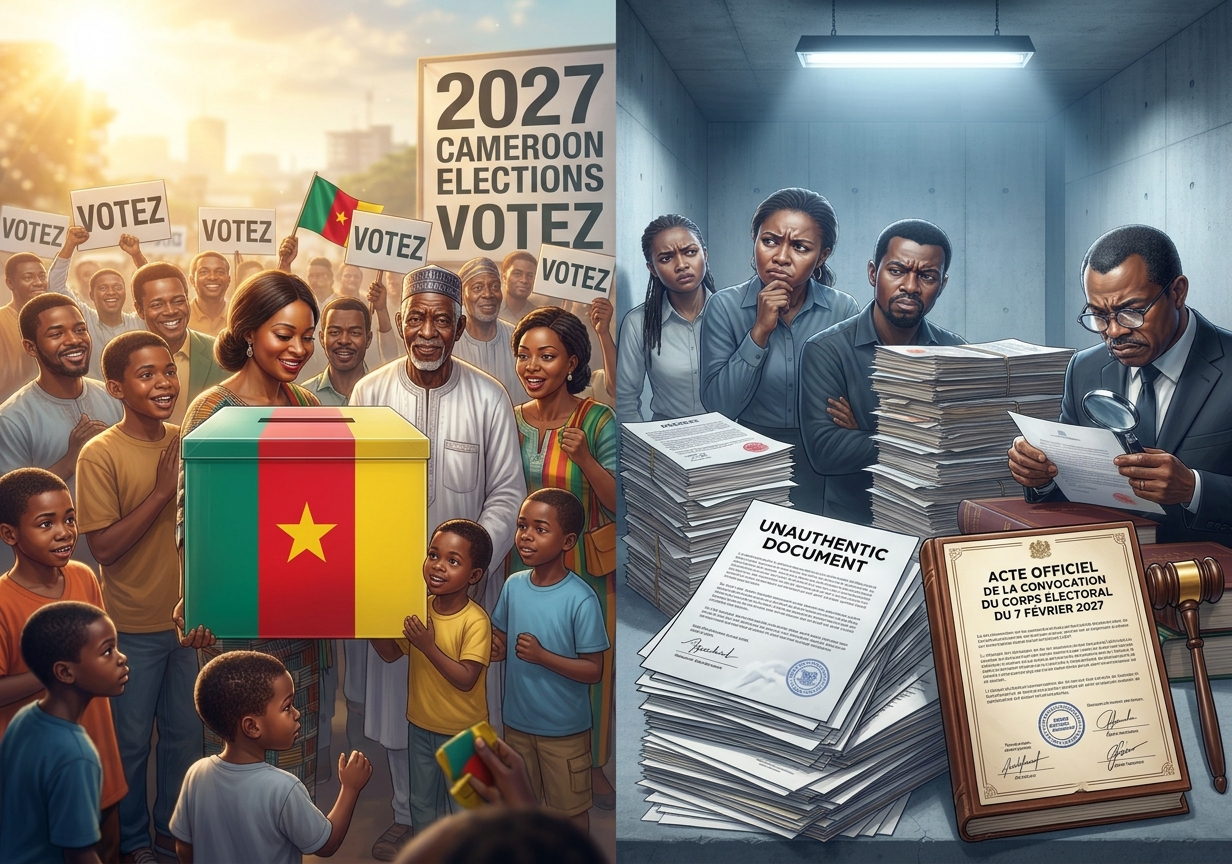
Cameroun: Décret Présidentiel Fixe Élections Municipales Législatives 2027
Summary
- Cameroon's municipal and legislative elections are officially set for February 7, 2027, initiated by a presidential decree.
- The decree triggers a 90-day preparatory period for political parties and the electoral body, ELECAM.
- Public reaction is mixed, with some embracing the opportunity for political renewal while others express deep skepticism about the process's integrity.
- Legal professionals have criticized the method of publishing the presidential decree, questioning the authenticity and legal force of digitally disseminated photocopies.
- ELECAM faces the dual challenge of managing logistics and restoring public trust in the electoral process ahead of the 2027 polls.
Electoral Preparations Underway
He critically questioned the authenticity and probative force of these documents, even in the context of potential contentieux électoral Cameroun before the Constitutional Council, lamenting the perceived erosion of distinction between authentic and apocryphal acts.
Cameroon is gearing up for a significant electoral period, with the double municipal and legislative elections officially scheduled for February 7, 2027. This date was confirmed through a presidential decree, which simultaneously initiated a 90-day preparatory phase for political parties and the national electoral body, ELECAM. The announcement has brought a definitive clarity to the calendrier électoral Cameroun 2027, ending prior speculation regarding the timing of these crucial polls.
The declaration has been met with a range of responses across the country, from enthusiastic political strategizing to profound skepticism. For many observers and political actors, the confirmed date signals the commencement of serious electoral campaigning. Professor Alphonse Bernard Amougou Mbarga noted pragmatically that with the deadlines now established, the electoral battle and political negotiations can fully begin. This sentiment is echoed by those who view the upcoming Cameroun élections municipales législatives 2027 as a vital opportunity for renewal within both local and parliamentary political spheres. Journalist Thiery Gervais Gango, for instance, has publicly declared his intention to campaign for a deep renewal as part of a coalition. Similarly, in Douala, local political dynamics are already intensifying, with figures like Ruben Malick Djoumbissie issuing specific calls to action, such as "Convocation du corps électorale: 7 février 2027 Douala: tout sauf Roger Mbassa Dine."
Public Engagement and Underlying Distrust
Despite the initial flurry of political activity, the announcement of the Cameroun élections municipales législatives 2027 has also highlighted a deep-seated public distrust in the nation's institutions and electoral processes. While some voices are actively calling for widespread citizen participation to counter potential voter apathy, others express significant reservations about the integrity of the upcoming polls. Rev. Dr. Ludovic Lado, S.J., the founding Dean of the School of Arts and Sciences at Hekima University College in Nairobi, Kenya, has passionately urged Cameroonians to engage fully, advising against succumbing to defeatism and encouraging active participation in the February 7 elections, emphasizing that one should not give up without trying.
Conversely, a palpable sense of unease persists among segments of the population regarding the sincerity of the electoral process and whether the outcomes will genuinely reflect the will of the voters. Alice Sadio articulated this concern, questioning the ultimate purpose of going to the polls if there is doubt about the authorities' willingness to accept the verdict of the ballot box. This sentiment underscores a broader challenge for the electoral system to convince a skeptical electorate that their participation will lead to legitimate and respected results.
Legal Scrutiny of the Electoral Decree
The formal announcement of the Cameroun élections municipales législatives 2027 has also drawn sharp criticism from legal professionals concerning the procedural aspects of the décret présidentiel élections Cameroun. Christian Ntimbane Bomo cautioned against premature celebration, emphasizing that the convocation of the electoral body is distinct from the actual holding of elections, highlighting the intricate subtleties embedded within Cameroonian positive law. This distinction suggests that the legal framework surrounding the elections requires careful interpretation and adherence.
More pointedly, the method by which the presidential decree was disseminated has sparked indignation among legal experts. Attorney Me Hippolyte Meli Tiakouang voiced strong objections to the practice of publishing such critical state acts through digital and media channels, often as mere photocopies bearing an official stamp. He critically questioned the authenticity and probative force of these documents, even in the context of potential contentieux électoral Cameroun before the Constitutional Council, lamenting the perceived erosion of distinction between authentic and apocryphal acts. This concern raises significant questions about the legal robustness of the electoral process from its very inception.
Challenges for ELECAM and Future Outlook
As the nation moves towards the February 7, 2027, elections, the electoral management body, ELECAM, faces a multifaceted challenge. Beyond the logistical complexities of managing candidate applications and organizing the polls, a significant hurdle lies in its capacity to rebuild and restore public confidence among a deeply skeptical electorate. The concerns raised by legal professionals regarding the authenticity of official documents and the broader public's distrust in the process add layers of complexity to ELECAM's mandate.
The upcoming period is anticipated to be intense, with political parties and candidates preparing for the Cameroun élections municipales législatives 2027. However, the underlying issues of institutional credibility and procedural transparency remain critical. The ability of ELECAM to navigate these challenges and ensure a process perceived as fair and legitimate will be crucial for the democratic health of Cameroon.
Practical Implications
Lawyers advising political parties or candidates in Cameroon must scrutinize the official legal instruments and their proper promulgation regarding the 2027 elections, particularly the presidential decree convoking the electoral body. Concerns raised by legal professionals in the article about the authenticity and publication method of such decrees highlight potential grounds for electoral disputes or challenges based on procedural irregularities, requiring careful attention to legal deadlines and formal requirements.
Source
How does this affect you?
Get an AI analysis of this article grounded in your jurisdictions, practice areas, and any policy documents you've uploaded to Wansom.
Finish Reading the Full Story and the Expert Analysis.
Get the latest legal & regulatory intelligence in Cameroon
Wansom is AI and can make mistakes.