
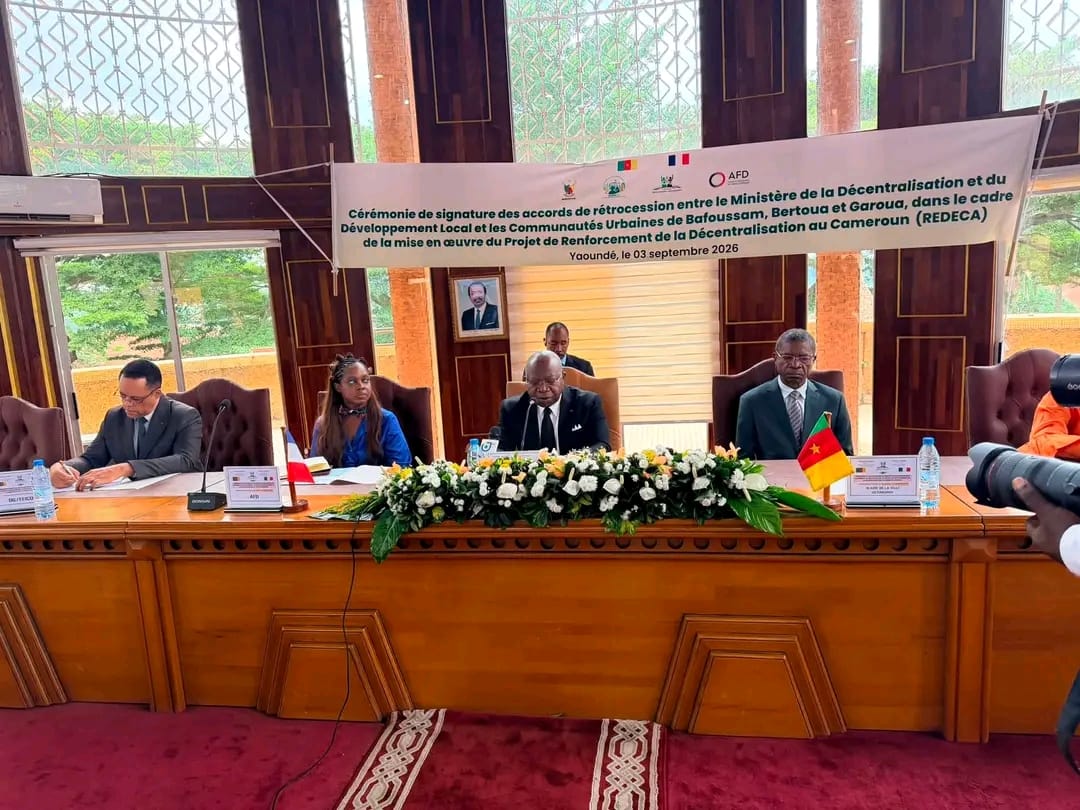
Cameroun: REDECA Accord Rétrocession 2026 Signed for Local Governance
Summary
- On September 3, 2026, a retrocession agreement for the REDECA project was signed in Yaoundé, Cameroon.
- This agreement allocates approximately 827 million FCFA to the Urban Communities of Bafoussam, Bertoua, and Garoua.
- The funds are intended to strengthen institutional capacities, support citizen participation, and improve local activity management.
- The REDECA project, part of the 3rd C2D between Cameroon and France, aims to reinforce local governance and bring decision-making closer to the local level.
- The initiative signifies a substantial financial commitment to empowering local administration in specific Cameroonian urban communities.
Landmark Agreement Bolsters Local Governance in Cameroon
Lawyers advising clients on public procurement, urban development, or local administration in Bafoussam, Bertoua, or Garoua should closely monitor the implementation of the REDECA project for potential tender opportunities, regulatory shifts, or new compliance requirements arising from increased decentralized activities and funding.
A significant stride in Cameroon's decentralization efforts was marked on Thursday, September 3, 2026, with the formal signing of a retrocession agreement for the "Renforcement de la Décentralisation au Cameroun" (REDECA) project. The pivotal ceremony, held in Yaoundé, signifies a new phase in empowering local authorities and enhancing the operational capacities of key urban centers. This accord is designed to channel substantial financial resources directly to the Communautés Urbaines of Bafoussam, Bertoua, and Garoua, fostering a more robust framework for local administration.
The REDECA project, an integral component of the 3rd Contrat de Désendettement et de Développement (C2D) between Cameroon and France, aims to improve local governance and institutional capabilities. The retrocession agreement specifically outlines the partial transfer of activities and credit, ensuring that the designated urban communities receive the necessary support to implement their mandates effectively. This strategic initiative underscores a commitment to bringing decision-making processes and their execution closer to the citizens, thereby enhancing the direct benefits for local populations.
Under the terms of this newly signed agreement, approximately 827 million FCFA has been earmarked for the three beneficiary urban communities. This substantial investment is intended to address critical areas within local administration, including the strengthening of institutional capacities, the promotion of citizen participation in local affairs, and the overall improvement of how local activities are managed and overseen. The Cameroun REDECA accord rétrocession 2026 represents a concrete step towards realizing the broader objectives of the national decentralization policy, with a clear focus on tangible improvements at the municipal level.
Strategic Funding for Decentralization and Capacity Building
The funding mechanism for this initiative is rooted in the 3e C2D Cameroun France framework, a long-standing partnership designed to convert debt relief into development investments. The 827 million FCFA allocated through this retrocession agreement is specifically targeted at bolstering the institutional foundations of Bafoussam, Bertoua, and Garoua. This financial commitment is crucial for these urban communities as they navigate the complexities of increased autonomy and responsibility under Cameroon's evolving decentralization policy.
The strategic allocation of these funds is multifaceted, aiming to empower local structures to better serve their constituents. A primary objective is the reinforcement of institutional capacities, ensuring that local government bodies possess the necessary tools, expertise, and infrastructure to manage public services efficiently. Furthermore, a significant portion of the funding is dedicated to supporting citizen participation, fostering a more inclusive and responsive local governance model where residents have a voice in the development and implementation of local policies. This emphasis on public engagement is vital for democratic accountability and the successful execution of local projects.
Beyond institutional strengthening and citizen involvement, the accord also prioritizes the improvement of local activity management. This encompasses enhancing planning, execution, and oversight mechanisms for various municipal projects and services. The signature accord REDECA Yaoundé therefore represents a comprehensive approach to décentralisation Cameroun financement, ensuring that financial resources are strategically deployed to create lasting improvements in local administration and service delivery across the targeted urban areas.
Implications for Urban Development and Local Administration
The implementation of the REDECA project, particularly through this retrocession agreement, carries significant implications for urban development and local administration in Bafoussam, Bertoua, and Garoua. The enhanced financial autonomy and capacity building initiatives are expected to translate into more effective public service delivery, improved urban infrastructure, and a more responsive local government. This commitment to *gouvernance locale* is poised to transform how these cities operate, fostering environments conducive to sustainable growth and community well-being.
For legal professionals and businesses operating within or looking to engage with these Cameroonian urban communities, the REDECA project signals a period of heightened activity and potential opportunities. The substantial financial injection and the focus on strengthening local administrative capacities will likely lead to an increase in public procurement tenders related to infrastructure development, service provision, and technical assistance. Lawyers advising clients on public procurement, urban development, or local administration in Bafoussam, Bertoua, or Garoua should closely monitor the implementation of the REDECA project for potential tender opportunities, regulatory shifts, or new compliance requirements arising from increased decentralized activities and funding.
This renewed focus on local empowerment, facilitated by the Cameroun REDECA accord rétrocession 2026, underscores a broader national strategy to decentralize power and resources. The project's success in strengthening institutional capacities, supporting citizen participation, and improving local activity management will serve as a crucial benchmark for future decentralization initiatives across Cameroon, ultimately aiming to bring governance closer to the people it serves.
Practical Implications
This agreement signifies a substantial financial commitment to strengthening local governance in specific Cameroonian urban communities. Lawyers advising clients on public procurement, urban development, or local administration in Bafoussam, Bertoua, or Garoua should monitor the implementation of the REDECA project for potential tender opportunities, regulatory shifts, or new compliance requirements arising from increased decentralized activities and funding.
Source
How does this affect you?
Get an AI analysis of this article grounded in your jurisdictions, practice areas, and any policy documents you've uploaded to Wansom.
Finish Reading the Full Story and the Expert Analysis.
Wansom is AI and can make mistakes.