
California Owed Water Users Hearings Before 2021 Drought Cutbacks
What Happened
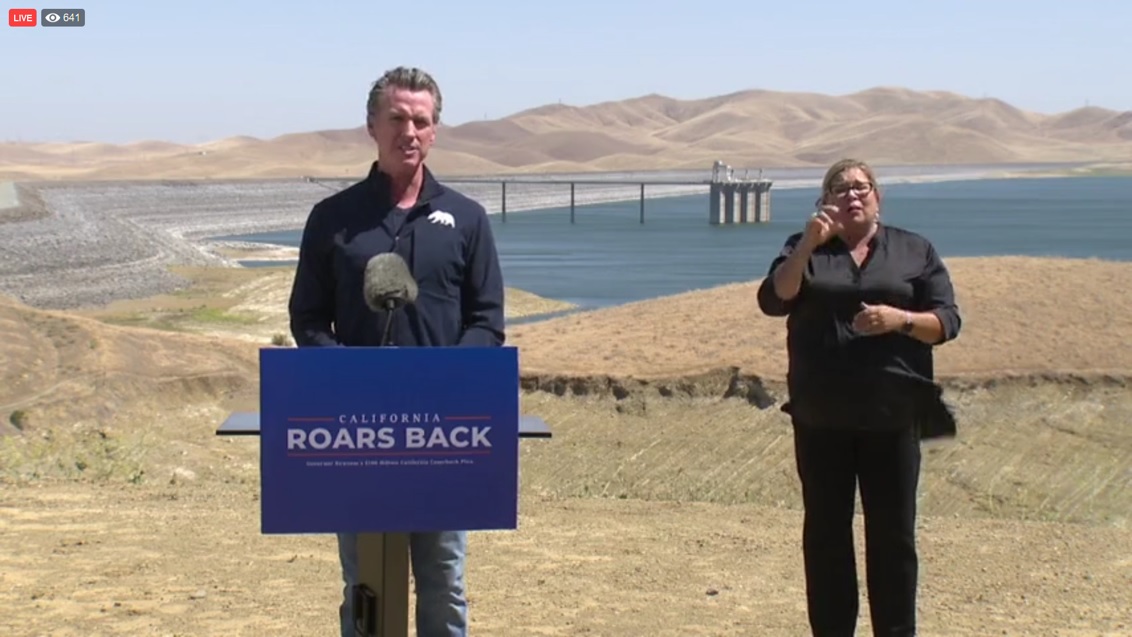
An appellate panel said the water companies weren't given a meaningful hearing before the state ordered them to cut back on diversions in 2021. Standing on dry land that would in a normal year be covered by the waters of the San Luis Reservoir, California Gov. Gavin Newsom extended his drought declaration to most counties on May 10, 2021. The restrictions remain in place despite historic storms that slammed the state to start 2023. (Screenshot via Courthouse News) (CN) — The Ninth Circuit on Tuesday reinstated due process claims from a group of Northern California water rights holders who were ordered to curtail their river water diversions in 2021 during a drought emergency. In a unanimous opinion , the three-judge panel reversed a trial judge’s dismissal of the due process claims by Stanford Vina Ranch Irrigation, Los Molinos Mutual Water and Peyton Pacific, which between them hold the bulk of the water rights along Deer Creek and Mill Creek, two tributaries of the Sacramento River. Whereas the trial judge in Sacramento had agreed with the State Water Resources Control Board that its emergency regulations and curtailment orders were “legislative,” the appellate panel concluded they were “adjudicatory,” meaning the water companies are entitled to a meaningful hearing before being deprived of their right to divert water from the two creeks. “Whether an action is legislative or adjudicatory turns on the character of the action, rather than its label,” U.S. Circuit Judge Lawrence VanDyke wrote. “Actions affecting large areas with undifferentiated populations are considered legislative.” “By contrast, adjudicatory actions target or exceptionally affect a few persons on an individual basis,” the Donald Trump appointee added. While legislative regulations and orders don’t require individualized hearings, due process requires that adjudicative decisions provide notice and predeprivation hearings. “The reason for requiring hearings for adjudicatory but not legislative decisionmaking is fundamentally a practical one: As the Supreme Court explained, hearings become impracticable when the affected group is too large to give a direct voice in the adoption of a challenged regulation,” VanDyke said. In this case, 22 water rights holders along the Deer Creek and Mill Creek were affected by the 2021 emergency order to cut back their diversions, but the plaintiffs claim they were given only a five-minute public comment period, with no opportunity to cross-examine the state’s witnesses supporting the regulations. This, VanDyke said, was not a meaningful hearing. U.S. Circuit Judge John Owens, a Barack Obama appointee, and U.S. Circuit Judge Danielle Forrest, a Trump appointee, joined in the decision. In a separate memorandum disposition, the panel upheld the trial judge’s dismissal of the plaintiffs’ takings claims under the Fifth Amendment because they could have sought compensation for their losses through an inverse condemnation lawsuit in California state court. The appeal focused on water rights held in Mill Creek and Deer Creek in Tehama County. Those rights allow the companies to divert water for some 11,000 acres of land with orchards, pasture and other uses. In April 2021, after a lack of winter storms left the state’s water reservoirs depleted, California Governor Gavin Newsom declared a drought state of emergency, leading state agencies to take action and protect salmon, steelhead and other fish. Jackson Minasian, an attorney for the plaintiffs, argued at a hearing before the Ninth Circuit panel in August that California had stopped the diversions four times in seven years. The state will have future droughts and curtailment orders for the water, and when that happens, the attorney said, the companies should get a due process hearing and compensation for the taking of the water. “The salmon and steelhead come back every year,”
Source
How does this affect you?
Get an AI analysis of this article grounded in your jurisdictions, practice areas, and any policy documents you've uploaded to Wansom.
Finish Reading the Full Story and the Expert Analysis.
Get the latest legal & regulatory intelligence in United States
Wansom is AI and can make mistakes.