
California fails to convince Ninth Circuit on ghost gun issue
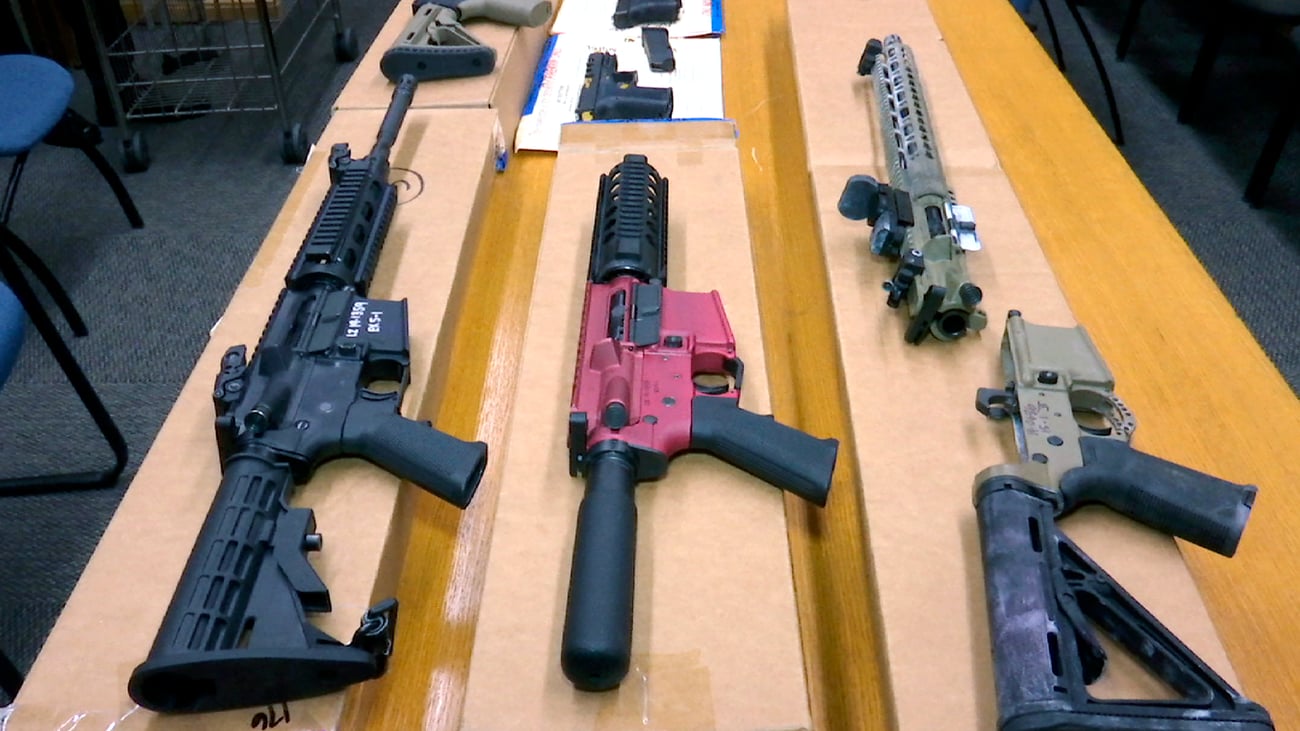
The appeals panel determined the plaintiffs had not experienced any direct injury, which meant they had no standing to bring the case. A display of ghost guns, firearms without serial numbers, that have been linked to a rise in violent crime across the U.S. (Haven Daley/AP) SAN FRANCISCO (CN) — A Ninth Circuit panel on Friday sided with the federal government on an issue involving ghost guns, sending the case back to a lower court with instructions to dismiss it after finding California and a gun prevention organization suffered no injury. The panel found California and the Giffords Law Center to Prevent Gun Violence had no standing to challenge a final rule created by the U.S. Bureau of Alcohol, Tobacco, Firearms and Explosives. At issue was whether parts of ghost guns fell under Gun Control Act regulations, as they lack an essential piece and are considered unfinished. The state argued this forced it to increase funding for its own legislation regulating ghost gun parts and for training officers about them. The center said ATF’s lax regulation of ghost guns hurt its goal and made it divert resources to fight the guns’ spread. “Plaintiffs challenge the regulation’s failure to extend the GCA to even more partially complete firearm receivers that they think should be included,” U.S. Circuit Judge Consuelo Callahan, a George W. Bush appointee, wrote for the panel. “We must decide whether plaintiffs have standing to raise their challenge. They do not.” The Gun Control Act, enacted in 1968, regulates the interstate traffic of firearms and provides a definition for them. The proliferation of ghost guns led ATF in 2022 to tweak that definition, as they didn’t fall under the act. In its updated definition, ATF provided examples of partially complete, disassembled or nonworking frames and receivers — the main part of a weapon. This case centered on “Example 4,” which states that some unfinished receivers don’t fall under the new rule. Those include receivers that haven’t reached a certain point of manufacture at which someone could identify them as parts of a weapon, and aren’t sold or distributed with items enabling completion of a weapon. “Plaintiffs do not seek to vacate the final rule,” Callahan wrote. “To the contrary, they assert that the final rule must cover more early-stage firearm receivers, even if not sold together with any other parts, tools, or related items.” The plaintiffs argued that unfinished receivers are, in fact, within the definition and fall under the law. They also called Example 4 arbitrary and said it contained loopholes easily used to work around the act. A lower court determined the plaintiffs had standing and remanded Example 4 to ATF after finding it unlawful. The bureau appealed . Callahan wrote that standing is more difficult to prove when a harm stems from an indirect effect of the government’s supposedly unlawful rule. California’s argument about having to spend more money and time, and the center’s claim that its core mission is negatively affected, don’t establish the link between Example 4 and the injuries they claim, the panel ruled. “From the start, plaintiffs’ causation arguments face strong headwinds because Example 4 does not directly affect either of them,” Callahan wrote. “Their asserted injuries here arise only indirectly.” The plaintiffs needed to show that Example 4 would increase the spread and illegal use of ghost guns built from partially made receivers. The state offered a Justice Department agent’s declaration, supporting documents and news stories, Callahan wrote. But that information spoke to the issue of ghost guns generally, the judge added, not the specific issue in Example 4. “Additionally, California’s evidence focuses almost exclusively on expenditures that California made to combat the growth of ghost guns from 2016 to 2022, a period predating the final rule,” Callahan wrote. The center’s argument about how it suffered harm, backed up with a declaration by its chief of staf
How does this affect you?
Get an AI analysis of this article grounded in your jurisdictions, practice areas, and any policy documents you've uploaded to Wansom.
Wansom is AI and can make mistakes.