
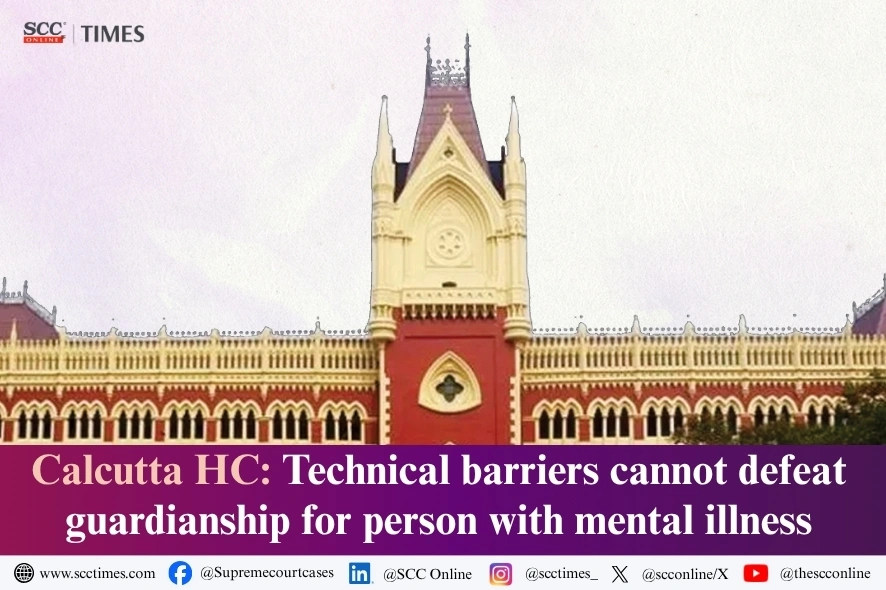
Calcutta High Court: Orders Fix for Mental Illness Guardianship Technical Barriers
Summary
- The Calcutta High Court ruled that technical barriers cannot prevent guardianship for a person with chronic schizophrenia and 65% disability.
- The court directed authorities to expeditiously consider a sister's application, applying both the Rights of Persons with Disabilities Act, 2016, and the National Trust Act, 1999.
- The petitioner faced online system rejections due to alleged invalid ID, incorrect date of birth, or insufficient disability percentage, despite providing accurate information.
- This judgment emphasizes prioritizing the welfare of individuals with mental illness over procedural technicalities in guardianship applications.
Judicial Intervention Overcomes Bureaucratic Hurdles
This judgment clarifies that courts will prioritize the substantive right to guardianship and the welfare of the individual over mere procedural technicalities.
The Calcutta High Court recently intervened in a case where a petitioner faced significant administrative obstacles while attempting to secure legal guardianship for her brother, who suffers from chronic schizophrenia. The individual in question had been medically assessed with a 65 percent temporary disability related to the brain, rendering him incapable of making independent decisions. This assessment was conducted by a Medical Board in accordance with the guidelines stipulated under the Rights of Persons with Disabilities Act, 2016, and resulted in a disability certificate issued on January 8, 2025, valid for nearly a decade until December 22, 2034.
The petitioner initially sought assistance from the District Magistrate and the Social Welfare Officer in Nadia, explaining her brother's profound mental condition necessitated a legally recognized guardian. However, she was advised by the Social Welfare Officer to first obtain a legal guardianship certificate. Her subsequent attempts to register an application through the National Trust's online portal were repeatedly thwarted by technical glitches. The system erroneously flagged her brother's Unique Disability ID as invalid, his date of birth as incorrect, or his disability percentage as below the 40 percent threshold, despite the petitioner providing accurate information and a valid certificate confirming 65 percent disability.
Legal Framework for Disability Rights
Faced with an unresponsive online system and a lack of alternative mechanisms from the authorities, the petitioner escalated the matter to the Calcutta High Court through a writ application. Her legal arguments centered on the statutory provisions of the National Trust Act, 1999, specifically Sections 14, 15, and 16, which delineate the procedures for appointing guardians, their responsibilities, and the requirements for managing the ward's property and finances. She affirmed her readiness to comply with all statutory obligations, including providing an inventory of her brother's immovable property and furnishing accounts as directed by the competent authority.
A crucial aspect of the petitioner's submission involved the interplay between the 1999 Act and the more recent Rights of Persons with Disabilities Act, 2016. She highlighted the definition of mental illness provided in Clause 3 of the Schedule to the 2016 Act, which describes it as a significant disorder impacting cognitive functions such as thinking, mood, perception, orientation, or memory. This disorder, as defined, must severely impair judgment, behavior, the ability to recognize reality, or the capacity to manage daily life demands. The petitioner contended that her brother's chronic schizophrenia unequivocally met this legal definition, underscoring the urgent need for a legal guardian.
Court Upholds Substantive Rights
In a significant ruling, the Single Judge Bench of Krishna Rao, J., at the Calcutta High Court, determined that an individual certified with a 65 percent disability due to chronic schizophrenia cannot be denied consideration for legal guardianship based on procedural or technical impediments. The court's directive mandates that authorities must expeditiously process the sister's guardianship application, applying the principles enshrined in both the Rights of Persons with Disabilities Act, 2016, and the National Trust Act, 1999. This decision provides a strong precedent for lawyers representing clients seeking guardianship for persons with mental illness in India, particularly when encountering administrative or technical hurdles with online application systems.
This judgment clarifies that courts will prioritize the substantive right to guardianship and the welfare of the individual over mere procedural technicalities. It effectively empowers legal challenges against bureaucratic delays or system failures that obstruct access to essential legal protections for vulnerable individuals. The ruling reinforces the notion that technical barriers should not defeat the fundamental right to guardianship, especially in cases involving severe mental health conditions like schizophrenia, thereby strengthening disability rights in India and ensuring that the spirit of protective legislation is upheld.
Practical Implications
This ruling provides a strong precedent for lawyers representing clients seeking guardianship for persons with mental illness in India, particularly when facing administrative or technical hurdles with online application systems. It clarifies that courts will prioritize the substantive right to guardianship and the welfare of the individual over procedural technicalities, empowering legal challenges against bureaucratic delays or system failures.
Source
How does this affect you?
Get an AI analysis of this article grounded in your jurisdictions, practice areas, and any policy documents you've uploaded to Wansom.
Finish Reading the Full Story and the Expert Analysis.
Get the latest legal & regulatory intelligence in India
Wansom is AI and can make mistakes.