
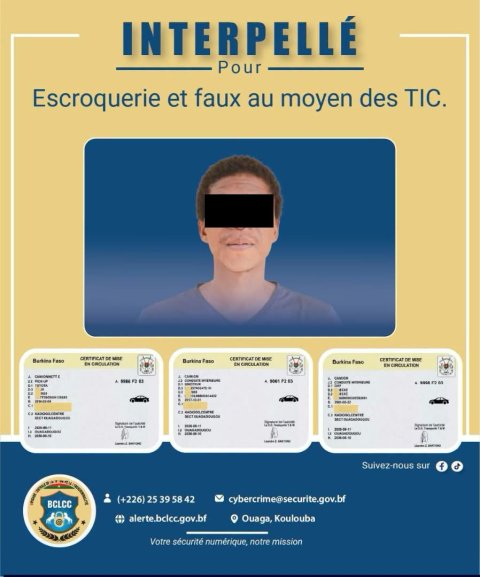
Burkina Faso: AI Forgery Suspect Apprehended for Fake Vehicle Registrations
The Central Brigade for Combating Cybercrime (BCLCC) in Burkina Faso recently arrested a 36-year-old individual, identified as D.R., in Ouagadougou, on suspicion of producing forged vehicle registration cards using artificial intelligence tools.
This incident highlights the growing challenge of cybercrime, particularly the sophisticated use of AI in forgery, within the Burkinabè legal landscape. For practitioners, it underscores the evolving nature of criminal activity and the need for legal frameworks and enforcement agencies to adapt. It also signals a potential increase in cases involving complex digital evidence and the intricacies of proving AI-assisted fraud. Businesses, especially those in vehicle registration, finance, and insurance, face heightened risks of fraud and the imperative for robust verification processes to mitigate these emerging threats.
The legal framework in Burkina Faso addressing such crimes would primarily fall under the Penal Code, specifically provisions related to forgery (faux et usage de faux), fraud (escroquerie), and potentially specialized cybercrime legislation. Burkina Faso has enacted laws to combat cybercrime, such as Law N°023-2009/AN of May 14, 2009, which has likely been updated or supplemented to address technological advancements. The BCLCC operates under the Ministry of Security and is specialized in investigating digital offenses. The Directorate General of Land and Maritime Transport (DGTTM) is the administrative body responsible for issuing legitimate vehicle registration documents. The court hierarchy would involve the Tribunal de Grande Instance (High Court) for initial proceedings, with potential appeals to the Cour d'Appel (Court of Appeal) and ultimately the Cour de Cassation (Supreme Court).
Key parties involved include the Central Brigade for Combating Cybercrime (BCLCC) as the arresting authority, D.R. as the suspect, and the Directorate General of Land and Maritime Transport (DGTTM) as the administrative body whose documents were allegedly forged. The unnamed victims of the alleged fraud are also central to the case. The excerpt does not report on the outcome of this arrest or any subsequent legal proceedings, such as charges filed or a verdict.
Attorneys should be acutely aware of the increasing sophistication of cybercrime, particularly the use of AI in forgery, and prepare for cases involving complex digital evidence and forensic analysis. They should advise clients, especially those in sectors vulnerable to document fraud (e.g., automotive, financial services, insurance), to enhance their due diligence and verification processes, potentially incorporating AI-detection tools. Monitoring developments in cybercrime legislation and judicial interpretations of AI-assisted offenses in Burkina Faso will be crucial, as the outcome of this specific case, once reported, will provide valuable precedent regarding the prosecution and sentencing for such technologically advanced crimes.
How does this affect you?
Get an AI analysis of this article grounded in your jurisdictions, practice areas, and any policy documents you've uploaded to Wansom.
Finish Reading the Full Story and the Expert Analysis.
Wansom is AI and can make mistakes.