
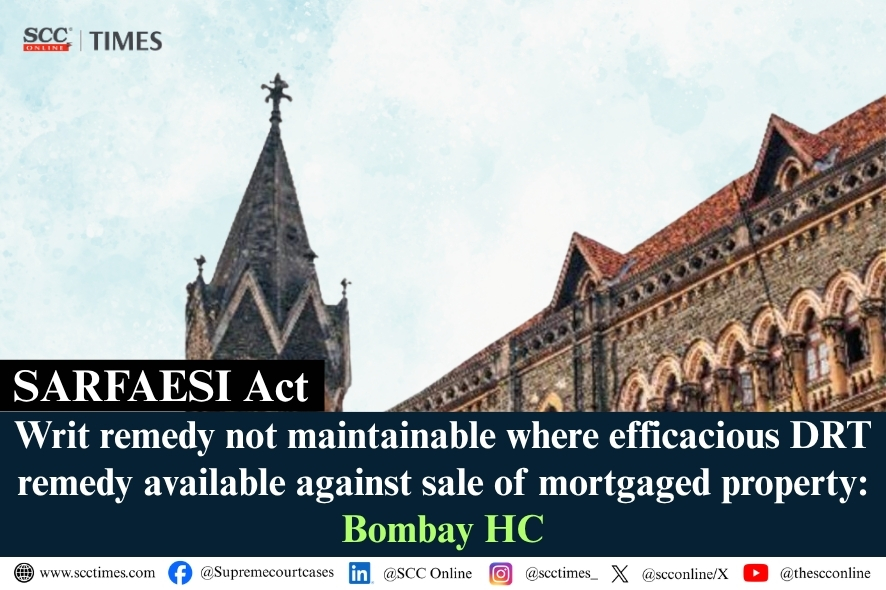
Bombay High Court: Writ Remedy Not Maintainable Under SARFAESI Act
Summary
- The Bombay High Court has ruled that a writ remedy is not maintainable where an efficacious DRT remedy is available.
- The decision may impact lawyers' strategies for recovering debts secured by mortgaged properties.
- Lenders and borrowers must comply with the provisions of the SARFAESI Act and the IBC to avoid disputes and legal challenges.
- Statutory remedies, such as the DRT remedy under the SARFAESI Act, can provide a more efficient and efficacious means of resolving debt recovery disputes.
What Happened
The court held that in view of the alternative, efficacious statutory remedy under the SARFAESI Act, the writ petition was not maintainable.
The Bombay High Court has delivered a significant judgment in the context of debt recovery, ruling that a writ remedy is not maintainable where an efficacious Debt Recovery Tribunal (DRT) remedy is available. This decision may have far-reaching implications for lawyers and their clients who are involved in recovering debts secured by mortgaged properties.
The court's verdict came on a writ petition filed against the sale of a mortgaged property, which was initiated under the Securitisation and Reconstruction of Financial Assets and Enforcement of Security Interest (SARFAESI) Act. The petitioners sought to challenge the sale of the property, citing alleged irregularities in the process.
However, the court held that the writ petition was not maintainable due to the availability of an efficacious DRT remedy under the SARFAESI Act.
Legal Context
The SARFAESI Act provides a statutory framework for debt recovery by secured creditors. Under this law, a secured creditor can take possession and sale of a mortgaged property without the intervention of the court, subject to certain conditions. The DRT remedy is an alternative to the writ petition, offering a more efficacious and efficient means of resolving disputes related to debt recovery.
The court's decision in this case highlights the importance of considering the availability of statutory remedies before resorting to writ petitions. Lawyers should be aware that the Bombay High Court has ruled that a writ remedy is not maintainable where an efficacious DRT remedy is available, which may impact their clients' strategies for recovering debts secured by mortgaged properties.
The court's verdict also underscores the need for lenders and borrowers to comply with the provisions of the SARFAESI Act and the Insolvency and Bankruptcy Code (IBC). Non-compliance can lead to disputes and legal challenges, which may be avoided by following the prescribed procedures.
Why It Matters
The Bombay High Court's decision has significant implications for the debt recovery landscape in India. The ruling emphasizes the importance of statutory remedies, such as the DRT remedy under the SARFAESI Act, which can provide a more efficient and efficacious means of resolving disputes related to debt recovery.
Lawyers should take note of this judgment and advise their clients accordingly. By understanding the availability of statutory remedies, lenders and borrowers can navigate the debt recovery process more effectively, reducing the likelihood of disputes and legal challenges.
The court's decision also highlights the need for lenders and borrowers to comply with the provisions of the SARFAESI Act and the IBC. Compliance with these laws can help prevent disputes and ensure a smoother debt recovery process.
Practical Implications
Lawyers should be aware that the Bombay High Court has ruled that a writ remedy is not maintainable where an efficacious DRT remedy is available, which may impact their clients' strategies for recovering debts secured by mortgaged properties.
Source
Source: Original reporting via SCC Times
How does this affect you?
Get an AI analysis of this article grounded in your jurisdictions, practice areas, and any policy documents you've uploaded to Wansom.
Wansom is AI and can make mistakes.