
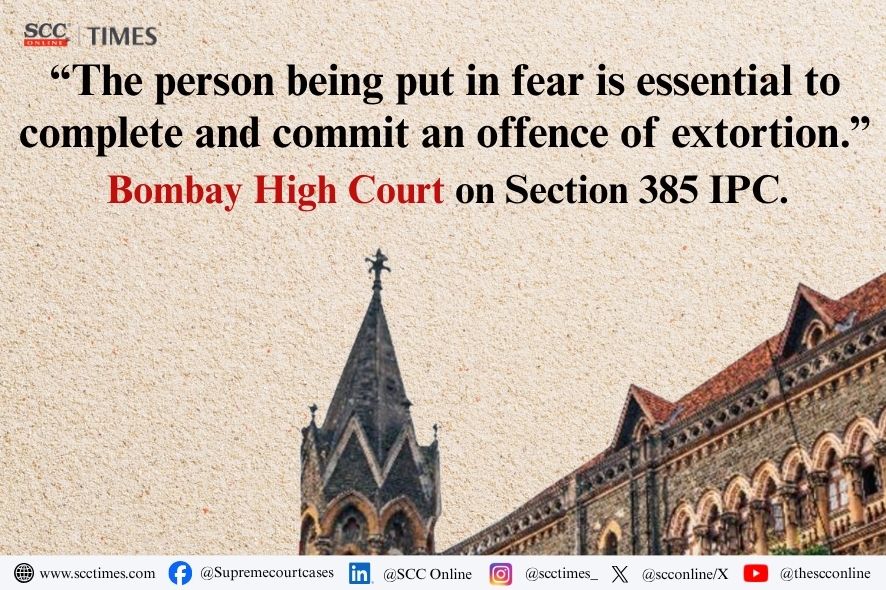
Bombay HC: Quashes Extortion FIR Over Settlement Talks
Summary
- The Bombay High Court quashed an extortion FIR against flat purchasers accused of demanding ₹25 lakhs each from a builder.
- The court found that meeting transcripts indicated settlement talks, not threats or the creation of fear of injury.
- It clarified that a general threat or demanding an exorbitant amount does not constitute extortion under Section 308 of the Bharatiya Nyaya Sanhita, 2023.
- Pursuing pending litigation as an alternative to settlement was also deemed not to be an act of extortion.
- The ruling emphasizes that for extortion, a threat must be intentional and severe enough to remove a person's free will.
What Transpired
The ruling underscored that a mere general or unsubstantiated threat, without additional aggravating factors, does not meet the threshold for extortion.
The Bombay High Court recently intervened in a dispute between flat purchasers and a builder, ultimately quashing an FIR and its subsequent charge-sheet that alleged extortion. The case, heard by a Single Judge Bench comprising Justice Ranjitsinha Raja Bhonsale, centered on accusations that flat purchasers had demanded ₹25 lakhs each from the developer, threatening to impede construction and cause further issues if their demands were not met. This application was brought under Section 482 of the Criminal Procedure Code, 1973, a provision now mirrored in Section 528 of the Nagarik Suraksha Sanhita, 2023, which allows for the quashing of criminal proceedings.
The background to the dispute involved a building project with five wings, where four were complete and 'A' Wing was still under construction. The applicants, who resided in 'B' Wing, had previously raised concerns regarding the 'A' Wing's construction and various building amenities. This led to a history of legal and complaint proceedings between the parties, including actions before the State Consumer Disputes Redressal Commission. The builder, identified as Respondent 2, had also initiated a civil suit for damages and a criminal complaint under Section 500 IPC against the flat purchasers, setting the stage for contentious interactions.
Amidst these ongoing legal battles, meetings were convened on May 9, 2017, and June 12, 2017, with the aim of reaching an amicable resolution. The builder contended that during these discussions, the flat purchasers explicitly demanded ₹25 lakhs per person to settle the disagreements, allegedly coupling this demand with threats of creating further obstacles to the completion of 'A' Wing if their financial terms were not accepted. The flat purchasers, however, maintained that these were legitimate settlement talks, devoid of any coercive threats, and presented transcripts of the meetings to support their claim, arguing that the criminal proceedings were a retaliatory measure designed to pressure them into withdrawing their existing legal actions.
Defining Extortion in Legal Terms
In its examination of the case, the Bombay High Court provided crucial clarification on the legal definition of extortion, particularly under Section 308 of the Bharatiya Nyaya Sanhita, 2023. The court referenced Section 308 of the Bharatiya Nyaya Sanhita, 2023, which outlines the core elements of extortion: intentionally placing a person in fear of injury to themselves or another, and then dishonestly inducing that person, who is thus put in fear, to deliver property or valuable security. Justice Bhonsale emphasized that for an act to constitute extortion, it must be intentional, and the individual must genuinely be placed in fear of injury.
The ruling underscored that a mere general or unsubstantiated threat, without additional aggravating factors, does not meet the threshold for extortion. Furthermore, the court explicitly stated that simply demanding an exorbitant or disproportionate sum of money during negotiations does not, by itself, trigger the provisions of Section 308 of the Bharatiya Nyaya Sanhita, 2023. This distinction is vital in settlement negotiation threats in India, where parties often make robust demands. The court further clarified that pursuing existing litigation in accordance with legal procedures, even as an alternative to a settlement, cannot be construed as an act of extortion.
The judgment highlighted that the nature of the threat is paramount; it must possess sufficient gravity and intensity to mentally destabilize the threatened individual, thereby compromising their capacity for free and voluntary action. The court reviewed the transcripts of the meetings and found that, prima facie, they reflected genuine settlement discussions rather than indicating that the builder was subjected to threats or placed in fear of injury. This careful analysis led the Bombay High Court to quash the extortion FIR, concluding that the essential ingredients for the offense were not present.
Implications for Settlement Negotiations
This Bombay High Court settlement ruling offers significant guidance for parties engaged in dispute resolution, particularly in high-stakes builder flat purchaser dispute extortion scenarios. The decision provides critical clarity on the distinction between legitimate, albeit robust, settlement demands and criminal extortion under Section 308 of the Bharatiya Nyaya Sanhita, 2023. It establishes a strong precedent for challenging allegations of extortion when the underlying conduct involves aggressive bargaining or the pursuit of legal remedies, rather than actual threats designed to induce fear and remove free will.
The ruling reinforces the principle that the mere act of demanding a substantial or even disproportionate amount of money during negotiations, or the continuation of existing legal proceedings, does not automatically transform a civil dispute into a criminal matter. This is particularly relevant for lawyers advising clients in complex negotiations, as it clarifies that advocating for a client's maximum possible outcome, even if perceived as aggressive, remains within the bounds of legitimate legal strategy, provided it does not cross into the realm of intentional threats causing fear of injury.
By quashing the FIR, the Bombay High Court has affirmed that the threshold for criminal extortion is high, requiring a specific intent to cause fear of injury and a threat of such magnitude that it compromises a person's voluntary action. This decision is a crucial reminder that while settlement talks can be intense, they are generally protected from criminalization unless the strict legal requirements for offenses like extortion are unequivocally met. This Bombay HC quashes extortion FIR settlement talks decision will likely influence future cases involving similar allegations.
Practical Implications
This ruling provides critical clarity on the distinction between legitimate, albeit robust, settlement demands and criminal extortion under Section 385 IPC. Lawyers advising clients in dispute resolution, particularly those involving high-stakes negotiations, should note that demanding an exorbitant amount or pursuing legal remedies does not automatically constitute extortion, offering a strong precedent to challenge such allegations.
Source
How does this affect you?
Get an AI analysis of this article grounded in your jurisdictions, practice areas, and any policy documents you've uploaded to Wansom.
Finish Reading the Full Story and the Expert Analysis.
Get the latest legal & regulatory intelligence in India
Wansom is AI and can make mistakes.