
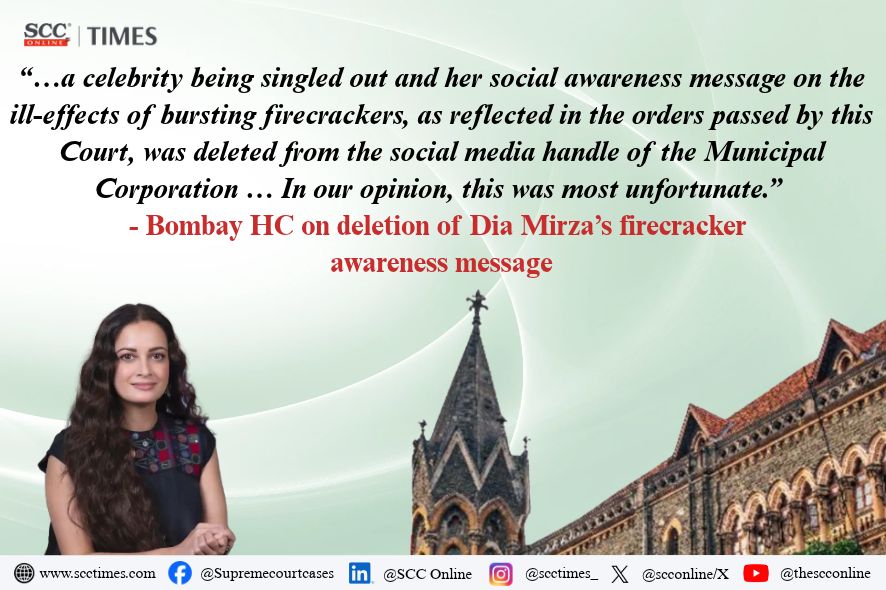
Bombay High Court: Firecracker Campaign Deletion Violates Secularism
Summary
- The Bombay High Court deemed the deletion of Dia Mirza's firecracker awareness message from BMC's social media as highly regrettable.
- The court stated this deletion overlooked the broader intent and object of its previous orders.
- The message highlighted the negative effects of bursting firecrackers as part of a social awareness campaign.
- The judiciary emphasized that backlash against celebrities involved in such campaigns contradicts constitutional principles of secularism.
- This observation reinforces judicial protection for social awareness initiatives and freedom of speech in India.
Judicial Endorsement of Awareness Campaigns
The judiciary emphasized that backlash against celebrities involved in such campaigns contradicts constitutional principles of secularism.
The Bombay High Court recently voiced its strong disapproval regarding the removal of a social awareness message from the Brihanmumbai Municipal Corporation's (BMC) official social media channels. This message, featuring celebrity Dia Mirza, aimed to highlight the detrimental effects associated with bursting firecrackers, forming part of a broader firecracker awareness campaign in India. The court characterized the deletion of this important public service announcement as "most unfortunate," underscoring its concern over the incident.
This judicial observation came in the context of the court's ongoing efforts to promote public health and environmental consciousness. The message, which was intended to educate the public about the ill-effects of bursting firecrackers, was seen by the court as a legitimate and necessary public awareness initiative. The court's remarks indicate a clear stance against actions that undermine such campaigns, especially when they align with public interest and previous judicial directives.
Upholding Constitutional Secularism
In its critical assessment, the Bombay High Court explicitly stated that the BMC's action of deleting the post overlooked the fundamental "overarching intent and object of the Court’s orders." This implies that the deletion was not merely an administrative oversight but a move that potentially contradicted the spirit of judicial pronouncements aimed at public welfare. More significantly, the court articulated that any backlash directed at celebrities for participating in such public service initiatives runs contrary to the constitutional principles of secularism.
This strong statement from the Bombay High Court on the firecracker campaign and secularism reinforces the judiciary's role in protecting freedom of speech and expression, particularly when it pertains to social awareness. By linking the backlash against celebrity free speech to a violation of constitutional principles of secularism, the court underscored the importance of maintaining a neutral and inclusive public discourse, free from religious or cultural biases that might impede public health messages. The court's observation serves as a crucial reminder that public bodies and individuals must respect the secular fabric of the nation when engaging with social campaigns.
Implications for Public Advocacy
The Bombay High Court's observation carries significant weight for future social awareness campaigns in India, particularly those involving public figures and sensitive cultural practices. It signals that the judiciary is prepared to protect initiatives like the firecracker awareness campaign India, even when they face public resistance or are perceived to challenge traditional customs. The court's stance on the BMC social media deletion highlights the responsibility of public entities to support, rather than suppress, messages that serve the greater public good and align with constitutional values.
This ruling provides a vital precedent for lawyers advising clients on public advocacy, celebrity endorsements, and freedom of speech issues. It emphasizes that judicial protection extends to campaigns that might generate public backlash, especially when such backlash infringes upon the constitutional principles of secularism. The court's firm position reinforces the idea that public discourse, even on culturally sensitive topics, must be guided by constitutional tenets, ensuring that awareness efforts, such as those championed by Dia Mirza, can proceed without undue censorship or pressure.
Practical Implications
This Bombay High Court observation reinforces the judiciary's protection of social awareness campaigns, even those touching on cultural practices, under the constitutional principle of secularism. Lawyers should note this precedent when advising clients on public advocacy, celebrity endorsements, or freedom of speech issues, particularly where public backlash or censorship attempts are anticipated.
Source
How does this affect you?
Get an AI analysis of this article grounded in your jurisdictions, practice areas, and any policy documents you've uploaded to Wansom.
Wansom is AI and can make mistakes.