
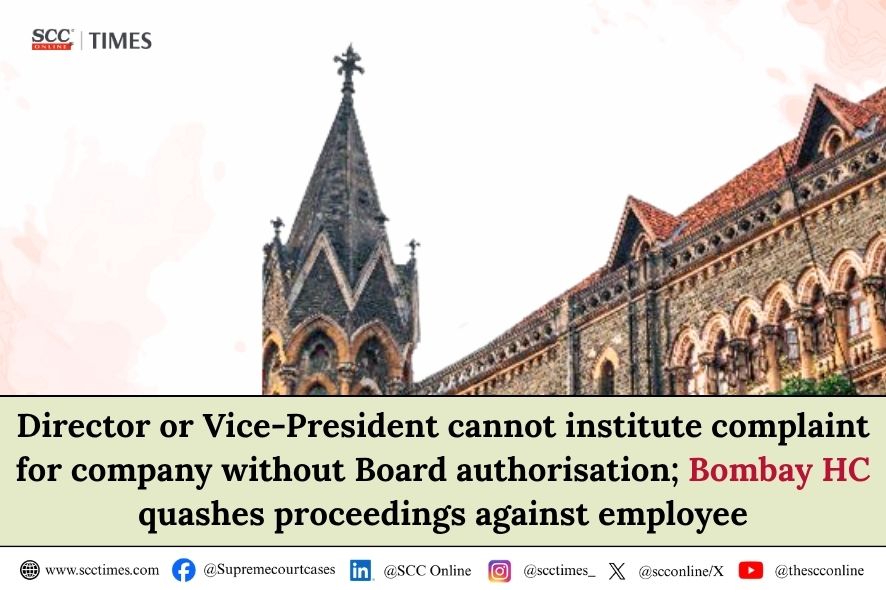
Bombay HC: Company Complaint Requires Board Resolution
Summary
- The Bombay High Court quashed criminal proceedings against an employee in a copyright infringement case involving source codes.
- The court found no evidence of the employee's active role beyond carrying out assigned duties.
- The court ruled that a company cannot maintain a criminal complaint through a Vice-President or individual Director without a Board resolution.
- Proper authorization via a Board resolution is mandatory for a company to validly institute a criminal complaint.
- Lack of a valid Board resolution can lead to company proceedings being quashed due to procedural deficiencies.
Bombay High Court Clarifies Authority for Company Complaints
For a company to validly institute a criminal complaint, it must be duly authorized through a formal Board resolution.
The Bombay High Court recently delivered a significant ruling, quashing criminal proceedings initiated against an employee in a copyright infringement case. The core of the dispute involved allegations of unauthorized use of source codes. The court found that there was insufficient evidence to demonstrate the employee's active involvement beyond the scope of duties assigned by their employer, leading to the dismissal of the charges against the individual.
Beyond the specific employee liability, the court also issued a broader directive concerning corporate legal action. It firmly established that a company is precluded from maintaining a criminal complaint if it is instituted solely by a Vice-President or an individual Director. This critical aspect of the judgment underscores the necessity for proper corporate governance in legal matters.
The court's decision emphasizes that for a company to validly institute a criminal complaint, it must be duly authorized through a formal Board resolution. This requirement ensures that legal actions taken on behalf of the entity reflect the collective will and approval of its governing body, rather than the unilateral decision of an individual officer. The absence of such a resolution can render the entire proceeding invalid, as demonstrated by the implications of this ruling.
Procedural Mandate for Corporate Legal Action
This ruling from the Bombay High Court sets a clear precedent regarding the procedural requirements for companies seeking to file criminal complaints in India. It unequivocally states that a company complaint, particularly one involving serious allegations like copyright infringement, must be backed by a specific Board resolution authorizing such action. This legal mandate serves as a crucial safeguard, preventing arbitrary or unauthorized legal proceedings from being initiated in the company's name.
The court's stance highlights that the authority of a Director or Vice-President to institute a complaint for a company is not inherent but must be explicitly delegated by the Board. Without this formal authorization, any criminal complaint brought forth by these individual officers on behalf of the company risks being challenged and ultimately quashed due to a lack of proper legal standing. This reinforces the principle that corporate entities, as legal persons, must act through their designated decision-making bodies.
Therefore, the judgment effectively means that any company proceedings quashed lack authorization if the initial complaint was not sanctioned by the Board. This applies broadly to criminal complaints, ensuring that the decision to pursue such serious legal avenues is a considered corporate decision, not merely an executive one. The requirement for a Board resolution criminal complaint company India is now a firmly established principle.
Implications for Employee Liability and Corporate Compliance
The Bombay High Court's decision carries significant implications for both employees and corporate compliance frameworks. For employees, the quashing of proceedings against the individual in the copyright infringement case provides a measure of protection, indicating that merely carrying out assigned duties, without an active role in the alleged wrongdoing, may not automatically lead to criminal liability. This aspect of the ruling offers clarity on copyright infringement employee liability India, suggesting that a higher bar of direct involvement is required for prosecution.
For companies, the judgment serves as a critical reminder of the importance of robust internal protocols for initiating legal action. Legal departments and compliance officers must ensure that every criminal complaint is instituted with a valid Board resolution, as the absence of proper authorization can lead to the entire proceedings being quashed. This procedural deficiency can result in wasted resources, reputational damage, and the inability to pursue legitimate grievances.
In essence, the Bombay HC company complaint Board resolution requirement underscores the need for meticulous adherence to corporate governance standards when engaging with the legal system. Companies must review their internal policies to confirm that the authority to file criminal complaints is clearly defined and that the necessary Board approvals are obtained and documented before any such action is taken, thereby preventing challenges based on procedural irregularities.
Practical Implications
Lawyers advising companies must ensure that any criminal complaint is instituted with a valid Board resolution, as lack of proper authorization can lead to proceedings being quashed. Compliance officers should review internal protocols for initiating legal action to prevent challenges based on procedural deficiencies, and also note the limited liability for employees merely carrying out assigned duties in infringement cases.
Source
Source: Original reporting via SCC Times
How does this affect you?
Get an AI analysis of this article grounded in your jurisdictions, practice areas, and any policy documents you've uploaded to Wansom.
Finish Reading the Full Story and the Expert Analysis.
Get the latest legal & regulatory intelligence in India
Wansom is AI and can make mistakes.