
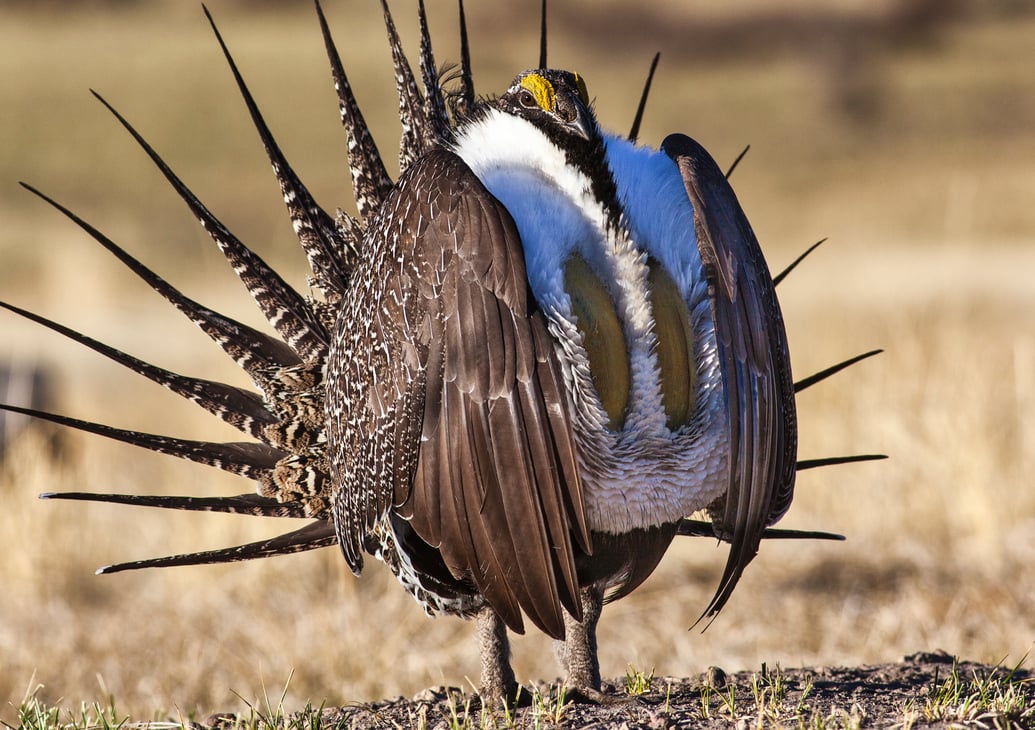
BLM Montana Grazing Permits Sage-Grouse: Court Directs Enhanced EA
Summary
- A federal judge ordered the Bureau of Land Management to revise a 2024 environmental assessment for Montana grazing permits.
- The assessment must include more complete data on the vulnerable greater sage-grouse population in the Grasshopper Watershed.
- The judge found the BLM's exclusion of forb data without explanation to be an arbitrary and capricious agency action.
- The ruling stems from a 2025 lawsuit filed by the Alliance for the Wild Rockies and other environmental groups.
- This decision reinforces the National Environmental Policy Act's requirement for thorough, data-supported environmental reviews for federal projects.
Judicial Mandate for Environmental Review
The overall ruling reinforces that federal agencies like the BLM must conduct thorough and data-supported environmental assessments under NEPA, especially when vulnerable species are involved.
A federal court has directed the U.S. Bureau of Land Management (BLM) to enhance a 2024 environmental assessment (EA) concerning renewed BLM Montana grazing permits sage-grouse habitat in the state's Grasshopper Watershed. Chief U.S. District Judge Brian Morris issued an order on Friday, requiring the agency to address deficiencies in its analysis of the impact on the vulnerable greater sage-grouse population. While the judge, an appointee of former President Barack Obama, did not invalidate the entire environmental assessment, his ruling mandates significant revisions to ensure a comprehensive evaluation of the species' status.
The decision stems from a lawsuit initiated in 2025 by three environmental advocacy organizations: the Alliance for the Wild Rockies, Native Ecosystems Council, and Council on Wildlife and Fish. These groups challenged the BLM's authorization of grazing, livestock management, and range improvement projects within the Grasshopper Watershed, arguing that the agency had not adequately assessed the potential harm to the sage-grouse and its critical habitat. Judge Morris partially granted and partially denied the cross motions for summary judgment presented by the environmental groups and the government, signaling a nuanced legal outcome.
Upholding NEPA Standards
Central to Judge Morris's ruling was the finding that the BLM's environmental assessment failed to meet the standards set by the National Environmental Policy Act (NEPA). The court determined that the agency must incorporate all available data necessary to fully understand the population trends and current status of sage-grouse within the Grasshopper Watershed. Judge Morris explicitly noted that the defendants "seemingly did know, or at least knew better than disclosed, the status and trend of the sage-grouse populations in the watershed," underscoring the requirement for transparency and thoroughness in federal environmental reviews.
Furthermore, the judge concluded that the BLM's decision to omit data regarding forb height from its habitat assessment, without providing a clear justification, constituted an arbitrary capricious agency action. Forbs, which include plants like sunflowers, clovers, dandelions, and milkweed, are crucial for sage-grouse as they provide both food and shelter for nesting. Consequently, the BLM is now compelled to either include an analysis of forb height data in the revised environmental assessment or present a robust explanation for why this metric is not relevant to assessing the habitat in question. This aspect of the ruling highlights the court's insistence on data-driven decision-making and accountability from federal agencies.
Implications for Conservation
The court's directive carries significant implications for the conservation of the greater sage-grouse, a species native to the western United States and Canada that has experienced a decades-long decline primarily due to habitat loss. Environmental groups, including the Alliance for Wild Rockies lawsuit participants, have consistently highlighted the precarious state of these birds. Mike Garrity, executive director of the Alliance for the Wild Rockies, expressed satisfaction with the court's decision, emphasizing the scarcity of pristine sagebrush ecosystems and the continuous, steep decline in sage-grouse populations across their historical range.
The environmental organizations had previously sought to block the grazing projects, which typically commence on April 1, but their request was denied by Judge Morris earlier in the year. Their core argument centered on the BLM's alleged failure to disclose vital baseline information about the sage-grouse population. Data presented indicated a substantial decline in Montana's sage-grouse numbers, with approximately a 30% reduction between 2021 and 2024, and nearly a 50% decrease from 2002 to 2024. While the court rejected some of the nonprofits' arguments, such as the need for a cumulative analysis of past spring grazing specifically for sage-grouse, deeming it an attempt to "micromanage" the agency's approach to cumulative impact analysis, the overall ruling reinforces that federal agencies like the BLM must conduct thorough and data-supported environmental assessments under NEPA, especially when vulnerable species are involved.
Practical Implications
This ruling reinforces that federal agencies like the BLM must conduct thorough and data-supported environmental assessments under NEPA, especially when vulnerable species are involved. Lawyers advising clients on federal land use or development permits should ensure EAs are robust and justify all data inclusions/exclusions to mitigate risks of legal challenge based on arbitrary and capricious agency action.
Source
How does this affect you?
Get an AI analysis of this article grounded in your jurisdictions, practice areas, and any policy documents you've uploaded to Wansom.
Finish Reading the Full Story and the Expert Analysis.
Get the latest legal & regulatory intelligence in United States
Wansom is AI and can make mistakes.