
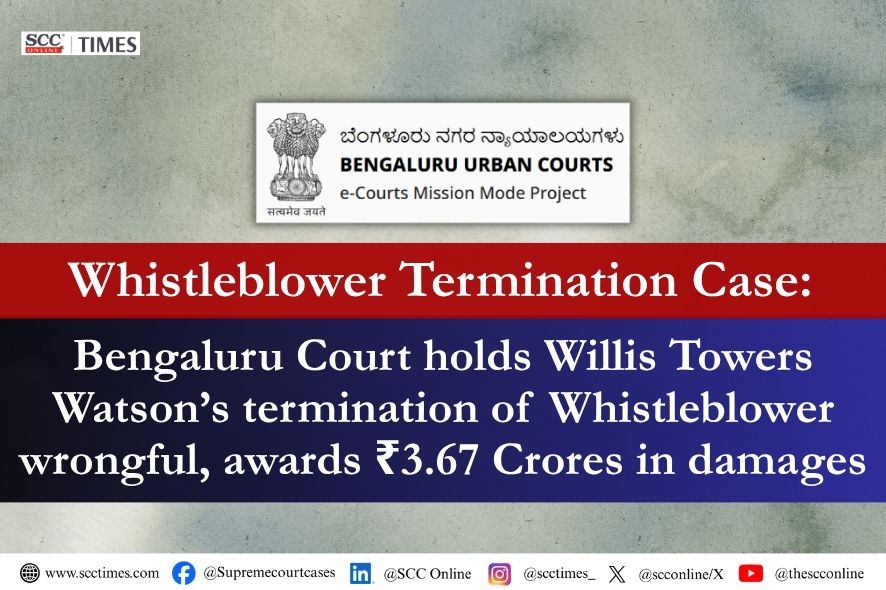
Bengaluru Court: Willis Towers Watson Whistleblower Termination Wrongful, Awards ₹3.67 Crore
Summary
- The Bengaluru Court ruled that Willis Towers Watson's termination of a whistleblower was wrongful.
- The court awarded ₹3,67,97,082 in special damages to the plaintiff.
- An additional ₹10 lakh was granted for mental agony, anguish, and harassment.
- Compensation of ₹2 lakh was also awarded against each liable defendant for injury to the plaintiff's professional life.
- This judgment sets a significant precedent for whistleblower protection and employee rights in India.
What Happened
This ruling sets a significant precedent for whistleblower protection in India, compelling companies to review their internal grievance mechanisms and termination policies to mitigate substantial financial and reputational risks associated with wrongful dismissal claims.
The Bengaluru Court has issued a significant ruling concerning a whistleblower's termination, finding Willis Towers Watson's actions to be wrongful. This decision, which involved a former employee of the global advisory firm, underscores the judiciary's stance on protecting individuals who report misconduct within organizations. The court's judgment specifically addressed the circumstances surrounding the whistleblower's dismissal, concluding that the termination was not justified.
As a result of its finding of wrongful dismissal, the court mandated substantial compensation. The plaintiff was awarded ₹3,67,97,082 in special damages. Beyond this, the court recognized the non-pecuniary harm suffered, granting an additional ₹10 lakh to cover mental agony, anguish, and harassment endured by the individual. Furthermore, the ruling included an award of ₹2 lakh in compensation against each defendant found liable for the injury inflicted upon the plaintiff's professional life, highlighting the court's consideration of the broader impact of such a termination. This comprehensive award by the Bengaluru court underscores the severe financial consequences for companies found to have engaged in wrongful termination.
Legal Context
This particular judgment from the Bengaluru Court contributes notably to India employee protection case law, particularly in the realm of whistleblower compensation India precedent. The ruling against Willis Towers Watson for wrongful dismissal in India reinforces the legal framework designed to safeguard employees who come forward with information about corporate malfeasance. Such cases are critical in shaping the interpretation and application of labor laws and corporate governance standards across the country.
The detailed breakdown of damages, including specific amounts for special damages, mental distress, and professional harm, provides a clear benchmark for future claims of wrongful termination damages India. It signals to corporations operating within India that courts are prepared to impose significant financial penalties when internal policies or actions contravene established employee protection principles. This case serves as a reminder that robust internal grievance mechanisms and fair termination practices are not merely good corporate citizenship but a legal imperative to avoid substantial liabilities.
Why It Matters
The Bengaluru court's decision regarding the Willis Towers Watson whistleblower termination in Bengaluru carries profound implications, establishing a significant precedent for whistleblower protection in India. This ruling sets a significant precedent for whistleblower protection in India, compelling companies to review their internal grievance mechanisms and termination policies to mitigate substantial financial and reputational risks associated with wrongful dismissal claims. The substantial damages awarded, including specific compensation for mental anguish and professional harm, highlight the court's intent to fully compensate individuals for the multifaceted impact of such dismissals.
This outcome compels companies to undertake a thorough review of their internal grievance mechanisms and termination policies. The financial and reputational risks associated with wrongful dismissal claims, as demonstrated by this case, are considerable. Companies must ensure their procedures for handling whistleblower complaints are transparent, fair, and compliant with Indian law, thereby mitigating the potential for similar costly litigation. The judgment reinforces the growing importance of a strong ethical culture and robust legal compliance in corporate operations across India, emphasizing that protecting whistleblowers is not just an ethical consideration but a legal and financial necessity.
Practical Implications
This ruling sets a significant precedent for whistleblower protection in India, compelling companies to review their internal grievance mechanisms and termination policies to mitigate substantial financial and reputational risks associated with wrongful dismissal claims.
Source
Source: Original reporting via SCC Times
How does this affect you?
Get an AI analysis of this article grounded in your jurisdictions, practice areas, and any policy documents you've uploaded to Wansom.
Finish Reading the Full Story and the Expert Analysis.
Get the latest legal & regulatory intelligence in India
Wansom is AI and can make mistakes.