
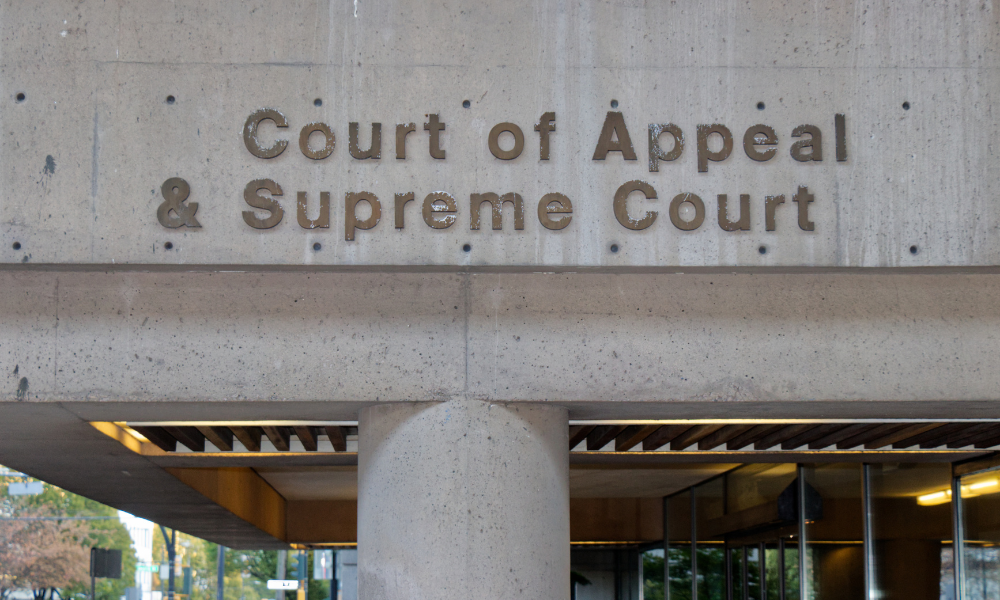
BCCA: Denies Reopening Common Employer Appeal After Democracy Watch
Summary
- The BC Court of Appeal (BCCA) initially dismissed appeals challenging a common employer declaration involving Sobeys Capital and its franchisees, upholding the application of a highly deferential standard of review under Section 58 of the BC Administrative Tribunals Act.
- Six days later, the Supreme Court of Canada (SCC) ruled in *Democracy Watch v. Canada (Attorney General)* that a partial privative clause unconstitutionally limited judicial review, though it did not define a minimum constitutionally guaranteed standard of review.
- Citing *Democracy Watch*, one of the appellants, 1315949 B.C. Ltd., sought to reopen the BCCA appeal, arguing the SCC ruling cast doubt on the constitutionality of Section 58 ATA's patently unreasonable standard.
- The BCCA denied the application to reopen, stating it was not the appropriate case to address a new constitutional question that should first be heard by a trial court.
- The court found no serious injustice to the appellant but noted the unfairness to the union, which had prevailed through extensive prior litigation, if forced to confront a new constitutional argument at this late stage.
Background to the Common Employer Appeal
The court emphasized that a constitutional issue of this nature should ideally be first considered by a trial court, a process that would likely attract applications from various interveners.
The British Columbia Court of Appeal recently declined to reopen a previously decided appeal concerning a common employer application under Section 38 of the BC Labour Relations Code, 1996. The original dispute involved Sobeys Capital Incorporated and four of its franchisees, where the British Columbia Labour Relations Board had declared them a common employer. This decision was subsequently upheld by the board's reconsideration panel, which dismissed a petition for judicial review.
Five separate appeals challenged the board's ruling, arguing it was patently unreasonable because it allegedly failed to require a finding of common control or direction among all franchisees. On July 24, 2026, in *1197785 B.C. Ltd. v. 1315949 B.C. Ltd.*, 2026 BCCA 310, the BC Court of Appeal dismissed these appeals. The court determined that Section 38 did not mandate a finding of common control or direction between franchisees. Furthermore, the appellate court found that the judge's decision was not patently unreasonable, nor did they err in applying the highly deferential standard of review required by Section 58 of BC's Administrative Tribunals Act, 2004 (ATA).
The Impact of *Democracy Watch*
Just six days after the BCCA's initial ruling, on July 30, 2026, the Supreme Court of Canada (SCC) issued a significant decision in an unrelated case, *Democracy Watch v. Canada (Attorney General)*, 2026 SCC 28. This SCC ruling examined the constitutionality of a partial privative clause that restricted judicial review on factual and legal matters. The Supreme Court concluded that such a clause unconstitutionally limited the courts' supervisory jurisdiction, which is essential to ensure that public power is exercised within the boundaries of a tribunal's delegated authority.
While the SCC affirmed that legislated review standards remain valid if they uphold the rule of law, as established in *Canada (Minister of Citizenship and Immigration) v. Vavilov*, 2019 SCC 65, it deliberately left open the question of what minimum standard of review is constitutionally guaranteed. This specific issue was not before the court in *Democracy Watch*. This new SCC precedent, however, quickly became central to an application seeking to revisit the BCCA's earlier common employer decision.
BCCA Denies Reopening Appeal
Following the *Democracy Watch* decision, 1315949 B.C. Ltd., with the backing of the four other appellants, applied to the BC Court of Appeal for a reopening and reconsideration of its appeal. The appellant contended that the SCC's ruling cast serious doubt on the constitutionality of the patently unreasonable standard of review mandated by Section 58 of the ATA. They argued that allowing the board's decision to stand, should Section 58 of the ATA ultimately be found unconstitutional, would result in a serious injustice.
The respondent union opposed this application, while the Labour Relations Board chose not to take a position. In a supplementary judgment issued on September 3, 2026, indexed at *1197785 B.C. Ltd. v. 1315949 B.C. Ltd.*, 2026 BCCA 365, the BC Court of Appeal found no adequate basis to reopen the appeal. The court characterized the appellant's request as overly broad, exceeding the appropriate grounds for reopening and reconsidering a concluded appeal.
Rationale for the Court's Decision
The appellate court acknowledged that certain aspects of the *Democracy Watch* reasoning might potentially open the door for the constitutional argument proposed by 1315949 B.C. Ltd. However, the BCCA determined that this particular case was not the appropriate forum to address such a significant constitutional question. The court emphasized that a constitutional issue of this nature should ideally be first considered by a trial court, a process that would likely attract applications from various interveners.
Crucially, the BCCA found no serious injustice to the appellant in denying the reopening. Conversely, it identified potential unfairness to the union, which had successfully navigated years of litigation, including two board hearings, the judicial review, and the initial appeals, only to face a new constitutional issue not raised during the original proceedings. The court also highlighted its prior confirmations of the constitutionality of the standard in Section 58 of the ATA, which has been effective for an extended period, reinforcing its decision to deny the BCCA denies reopening common employer appeal Democracy Watch application.
Practical Implications
This ruling signals that the BC Court of Appeal will not easily reopen concluded appeals based on new constitutional arguments, even in light of significant SCC decisions like *Democracy Watch*. Lawyers should advise clients that while *Democracy Watch* may open avenues for challenging judicial review standards in future cases, it does not provide a straightforward path to overturn settled matters, emphasizing the importance of raising constitutional issues at the earliest appropriate stage.
Source
How does this affect you?
Get an AI analysis of this article grounded in your jurisdictions, practice areas, and any policy documents you've uploaded to Wansom.
Finish Reading the Full Story and the Expert Analysis.
Wansom is AI and can make mistakes.