
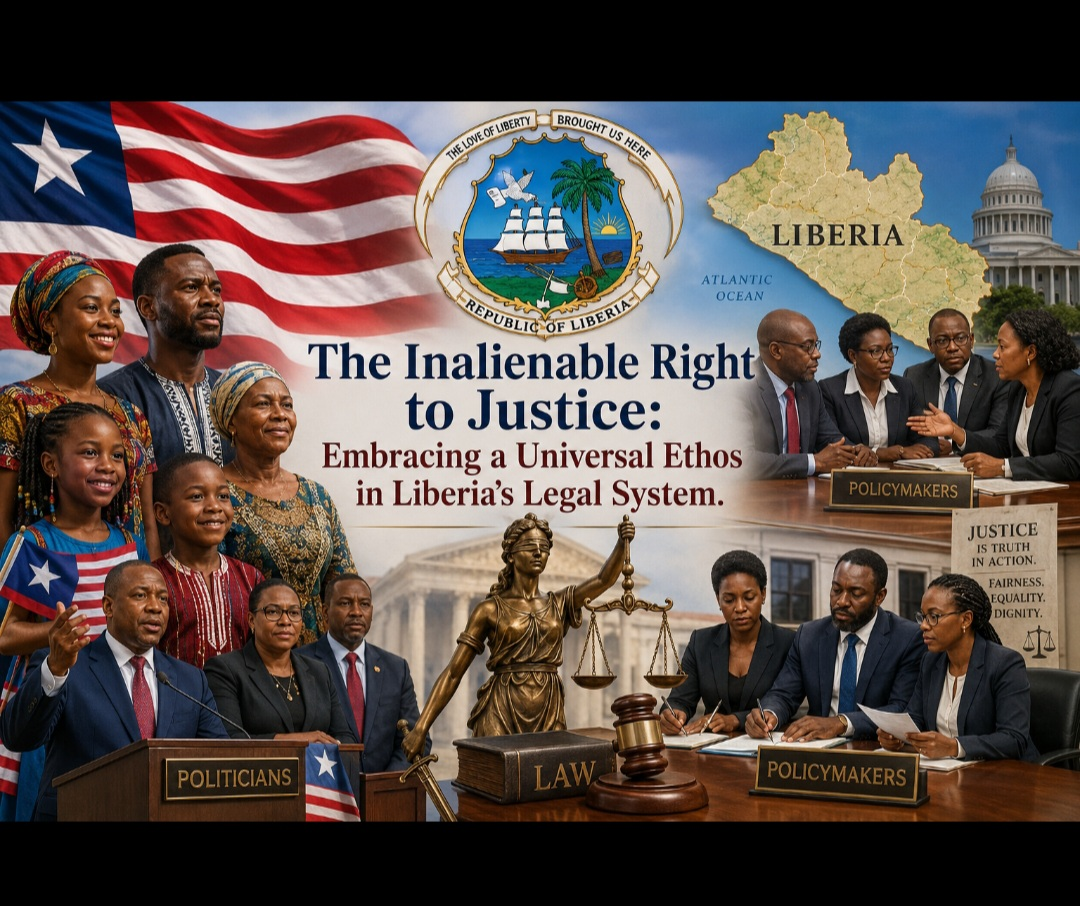
Austin S Fallah: Liberia Legal System Is Principled Justice
Summary
- Austin S Fallah asserts that justice in Liberia is a principled process, not a political tool or slogan.
- He specifies that true justice requires patience, reliance on evidence, adherence to due process, and respect for the courts.
- Fallah emphasizes that in a nation governed by law, Liberia must ensure legal principles prevail over political rhetoric.
- His statements highlight the importance of an impartial and independent legal system for the nation's stability and fairness.
Austin S Fallah's Vision for Liberian Justice
For Liberia to truly operate as a nation governed by law, the legal framework must unequivocally speak louder than any transient political discourse.
Austin S Fallah has articulated a profound perspective on the nature of justice within the Liberian legal system, emphasizing its fundamental role as a structured, principled process rather than a tool for political maneuvering. His statements underscore a critical distinction between genuine legal adjudication and the often-superficial realm of political discourse, urging a re-evaluation of how justice is perceived and administered across the nation.
Fallah firmly posits that the pursuit of justice is not a mere slogan to be vociferously proclaimed in public spaces, nor should it ever be weaponized against political adversaries. This stance highlights a concern for the potential misuse of legal frameworks for partisan ends, advocating instead for an approach rooted in impartiality and adherence to established legal norms. His commentary serves as a call for the Liberian legal system to uphold its integrity, ensuring that its operations remain distinct from the ebb and flow of political contention.
The Foundational Pillars of Equitable Justice
According to Fallah, the true essence of justice, particularly within a nation governed by law like Liberia, is contingent upon several indispensable elements. He identifies patience as a crucial virtue, acknowledging that legal processes often require time to unfold thoroughly and fairly, resisting pressures for hasty resolutions. This patience is intrinsically linked to the meticulous gathering and presentation of evidence, which Fallah stresses as the bedrock upon which all sound legal decisions must rest.
Furthermore, Fallah highlights the non-negotiable requirement of due process, a fundamental safeguard ensuring fairness and impartiality in all legal proceedings. This principle guarantees that every individual's rights are protected throughout the judicial journey, from investigation to judgment. Complementing these requirements is an unwavering respect for the courts themselves, recognizing their pivotal role as impartial arbiters of law. Fallah's emphasis on these pillars collectively defines a robust and trustworthy legal system, one that prioritizes procedural integrity and factual accuracy over expediency or external pressures.
Elevating Law Above Political Rhetoric
A central tenet of Austin S Fallah's message is the imperative for Liberia to cultivate an environment where the law's authority unequivocally transcends empty political rhetoric. He asserts that in a society committed to the rule of law, the pronouncements and principles enshrined in legal statutes must carry greater weight and influence than any transient political statements or public pronouncements. This perspective calls for a conscious effort to depoliticize the application of justice, ensuring that legal outcomes are determined by legal merits rather than political expediency or popular sentiment.
This shift is vital for solidifying the independence and credibility of the Liberian legal system. By prioritizing the law's voice, the nation can foster a more predictable and equitable legal landscape, where citizens and institutions alike can trust that decisions are made based on established legal frameworks. Fallah's insistence on this principle underscores the necessity of a judiciary that operates free from undue influence, allowing legal professionals to interpret and apply the law without external interference.
Implications for Liberia's Legal Future
Austin S Fallah's insights carry significant implications for the ongoing development and public perception of the Austin S Fallah Liberia legal system. His articulation of justice as a disciplined, evidence-based, and process-driven endeavor provides a clear roadmap for strengthening judicial institutions and enhancing public trust. By advocating for patience, adherence to evidence, robust due process, and profound respect for the courts, Fallah outlines the essential characteristics of a legal system capable of delivering genuine equity.
Ultimately, Fallah's vision for Liberia is one where the rule of law is not merely an abstract concept but a lived reality, where legal principles consistently guide national conduct and resolve disputes. His call for the law to speak louder than political rhetoric is a powerful reminder of the continuous effort required to maintain a just society, ensuring that the legal system serves as a steadfast guardian of rights and fairness for all citizens within Liberia.
Source
How does this affect you?
Get an AI analysis of this article grounded in your jurisdictions, practice areas, and any policy documents you've uploaded to Wansom.
Wansom is AI and can make mistakes.