
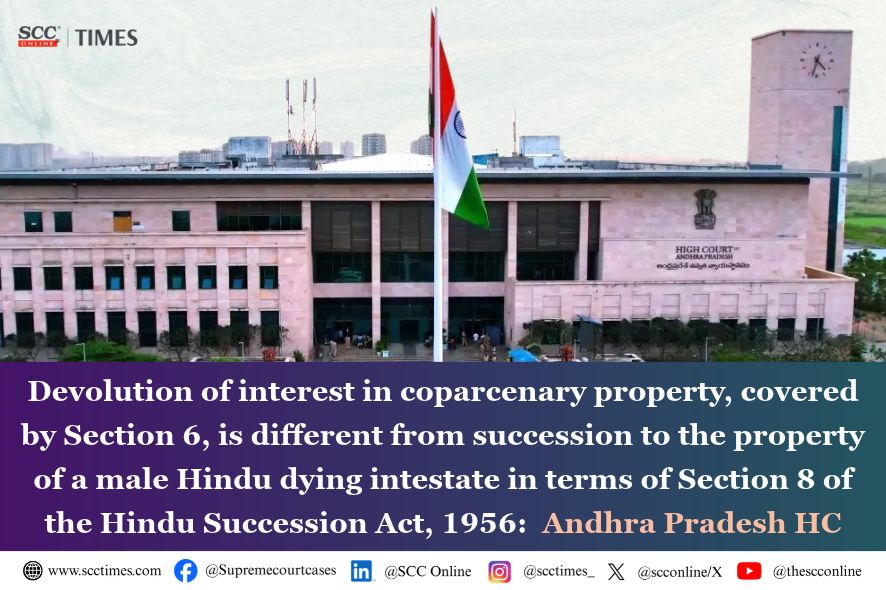
Andhra Pradesh High Court: Order 47 Rule 1 Review Scope Limited; Property Not Coparcenary
Summary
- The Andhra Pradesh High Court dismissed a review petition in a partition dispute concerning self-acquired property.
- The Court reiterated that review jurisdiction under Order 47 Rule 1 CPC cannot be exercised as an appeal in disguise.
- It clarified that property inherited by a son under Section 8 of the Hindu Succession Act, 1956, does not become coparcenary property without a joint family nucleus.
- This decision provides important guidance on the scope of review and the classification of property in Hindu inheritance cases.
Court's Recent Decision
The Andhra Pradesh High Court has reinforced the strict limits of review jurisdiction under Order 47 Rule 1 CPC, emphasizing it is not an appellate mechanism.
The Andhra Pradesh High Court recently issued a significant ruling, dismissing a review petition that arose from a partition dispute. This decision underscored two critical legal principles: the constrained scope of review jurisdiction under the Code of Civil Procedure and the nature of property inherited by a son under specific provisions of the Hindu Succession Act, 1956.
The case centered on a dispute over property that the court ultimately classified as self-acquired. In its judgment, the High Court firmly stated that property inherited by a son pursuant to Section 8 of the Hindu Succession Act, 1956, does not automatically transform into coparcenary property, particularly when there is no established joint family nucleus. This clarification is crucial for understanding property inheritance in Hindu law.
Legal Framework and Interpretation
Central to the court's decision was the interpretation of Order 47 Rule 1 of the Code of Civil Procedure (CPC), which governs the grounds for seeking a review of a judgment or order. The Andhra Pradesh High Court reiterated that the power of review is not to be exercised as if it were an appellate mechanism. Instead, its application is strictly limited to specific circumstances, such as the discovery of new and important matter or evidence, an error apparent on the face of the record, or any other sufficient reason of a similar nature.
Furthermore, the ruling provided important clarity on Section 8 of the Hindu Succession Act, 1956, and its implications for property classification. This section dictates the general rules of succession in the case of a male Hindu dying intestate. The High Court's pronouncement reinforces the established legal position that property inherited under Section 8 typically constitutes the individual's separate or self-acquired property, rather than ancestral or coparcenary property, unless a pre-existing joint family nucleus can be demonstrably proven. This distinction is fundamental in Hindu partition dispute review cases.
Why This Ruling Matters
This judgment from the Andhra Pradesh High Court offers vital guidance for legal practitioners and litigants involved in property inheritance and partition disputes. The Andhra Pradesh High Court has reinforced the strict limits of review jurisdiction under Order 47 Rule 1 CPC, emphasizing it is not an appellate mechanism. This serves as a reminder that review petitions are not a substitute for filing an appeal and should only be pursued on the narrow grounds explicitly provided by law.
Moreover, the ruling's clarification regarding the nature of property inherited under Section 8 of the Hindu Succession Act, 1956, holds significant weight. It underscores the importance of accurately classifying property as either self-acquired or coparcenary property, which directly impacts the rights of various family members in a partition scenario. Lawyers advising on Hindu succession and property division must consider this interpretation to formulate effective strategies, especially when dealing with property inherited by a son in the absence of a joint family nucleus, ensuring that the nuances of coparcenary property under Section 8 of the Hindu Succession Act are correctly applied.
Practical Implications
Lawyers should note that the Andhra Pradesh High Court has reinforced the strict limits of review jurisdiction under Order 47 Rule 1 CPC, emphasizing it is not an appellate mechanism. Furthermore, practitioners advising on Hindu succession and partition disputes must understand that property inherited under Section 8 of the Hindu Succession Act, 1956, is typically self-acquired, not coparcenary, absent specific circumstances, which is crucial for property division strategies.
Source
How does this affect you?
Get an AI analysis of this article grounded in your jurisdictions, practice areas, and any policy documents you've uploaded to Wansom.
Wansom is AI and can make mistakes.