
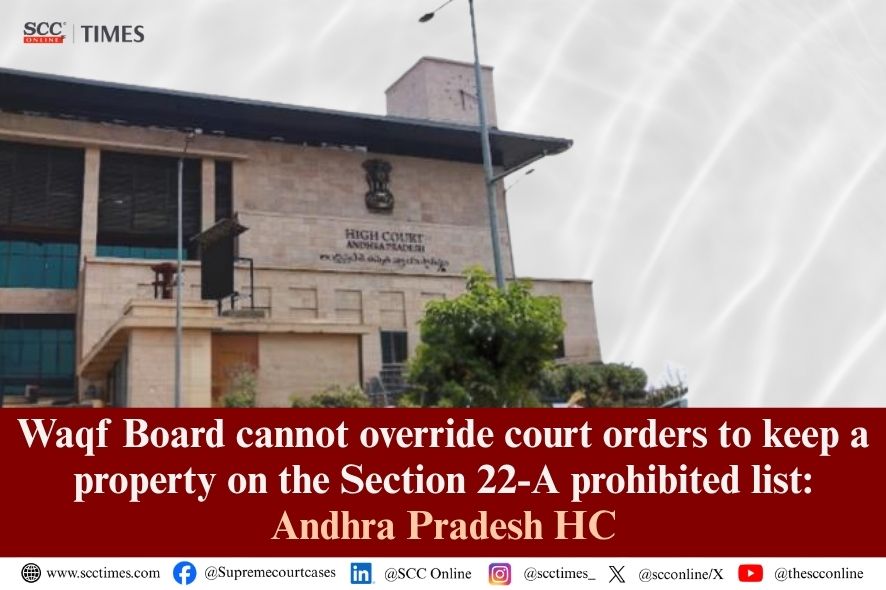
Andhra Pradesh HC: Waqf Board Section 22-A Power Limited by Court Decrees
Summary
- The Andhra Pradesh High Court directed registration authorities to remove a property from the Section 22-A prohibited properties list.
- The court mandated the property's registration under the Registration Act and Stamp Act, 1899.
- This decision was based on the Waqf Board's claim contradicting existing court orders.
- The High Court emphasized that the Waqf Board cannot disregard a final judicial decree.
Andhra Pradesh High Court's Directive
The Andhra Pradesh High Court's decision firmly establishes the paramountcy of judicial decrees over the claims and designations made by the Waqf Board concerning property status.
The Andhra Pradesh High Court recently issued a significant ruling, directing registration authorities to remove a specific property from the list of prohibited properties maintained under Section 22-A of the Registration Act, 1908. This directive mandates that the property in question must now be registered in accordance with the established procedures outlined in the Registration Act and the Stamp Act, 1899. The court's decision effectively overrides the Waqf Board's previous claim on the property, which had led to its inclusion on the restricted list.
The High Court's judgment was predicated on the finding that the Waqf Board's assertion regarding the property directly contradicted existing court orders. It explicitly stated that the Waqf Board does not possess the authority to disregard a final decree that has been passed by a competent court. This ruling underscores a fundamental principle of judicial supremacy, ensuring that administrative bodies cannot unilaterally negate the outcomes of legal proceedings.
Legal Framework and Waqf Board's Role
Section 22-A of the Registration Act, 1908, grants powers to authorities to identify and list certain properties as non-registrable, effectively prohibiting their transfer or sale. This provision is frequently invoked by entities such as the Waqf Board to designate properties as Waqf, thereby aiming to safeguard religious or charitable endowments from alienation. The inclusion of a property on this prohibited properties list can significantly impact its marketability and the rights of its purported owners.
However, the recent pronouncement from the Andhra Pradesh High Court introduces a critical clarification regarding the scope of these powers. While the Waqf Board plays a vital role in protecting endowments, its authority under Section 22-A is not absolute, especially when a property's status has been definitively resolved through a judicial process. The court's order to proceed with property registration also brings into play the Stamp Act, 1899, which governs the necessary fiscal requirements for property transactions, ensuring legal validity.
Upholding Judicial Authority
This landmark decision by the Andhra Pradesh High Court firmly establishes the paramountcy of judicial decrees over the claims and designations made by the Waqf Board concerning property status. By explicitly ordering the removal of the property from the Section 22-A prohibited properties list and compelling its registration, the court has reinforced the principle that a final judicial determination cannot be circumvented or ignored by administrative bodies. This ruling provides a clear legal precedent for future cases where Waqf Board claims might conflict with established court orders.
The judgment is particularly significant for property owners and legal practitioners in Andhra Pradesh, as it clarifies that a final court order regarding property ownership or status must be honored by all relevant authorities. It underscores that the Waqf Board, despite its important mandate to protect endowments, cannot act in a manner that contravenes definitive legal judgments. This ensures greater certainty and predictability in property registration Andhra Pradesh Waqf related matters, especially when properties have been subject to prior litigation and a final decree has been issued.
Practical Implications
Lawyers and compliance officers in Andhra Pradesh should note that this ruling clarifies the supremacy of judicial decrees over Waqf Board claims regarding property status under Section 22-A of the Registration Act, 1908. This provides a clear precedent for challenging Waqf Board's attempts to list properties as prohibited when a final court order dictates otherwise, ensuring registrability for clients.
Source
How does this affect you?
Get an AI analysis of this article grounded in your jurisdictions, practice areas, and any policy documents you've uploaded to Wansom.
Finish Reading the Full Story and the Expert Analysis.
Wansom is AI and can make mistakes.