
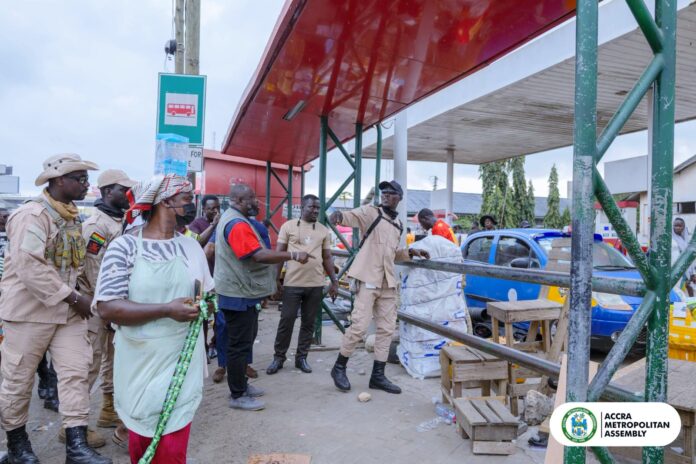
AMA: Evicts Traders From Accra BRT Shelters, Restores Public Order
Summary
- The Accra Metropolitan Assembly has intensified efforts to remove traders from Bus Rapid Transit (BRT) shelters across the city.
- Mayor Michael Kpakpo Allotey led an operation on October 5, 2026, targeting the Aayalolo BRT shelter near the Kwame Nkrumah Interchange.
- The enforcement aims to restore public infrastructure to its intended use, improve pedestrian and vehicular movement, and enhance public safety.
- Unauthorized trading had previously forced commuters onto roads, leading to a past incident where a pedestrian was knocked down.
- The AMA emphasizes that the action is not against legitimate trade but targets the misuse of public facilities for private commercial activities.
Enforcement Action Targets Accra's BRT Shelters
The Mayor emphasized that this exercise was not an attack on individuals or an attempt to deprive anyone of their livelihood, but rather a necessary step to re-establish order, safeguard commuters, and ensure that public amenities serve the community as designed.
The Accra Metropolitan Assembly (AMA) has significantly stepped up its enforcement efforts, moving to reclaim Bus Rapid Transit (BRT) shelters across the city from unauthorized commercial activities. This intensified campaign, aimed at restoring public infrastructure to its intended purpose and enhancing both pedestrian and vehicular flow, saw a major operation on Monday, October 5, 2026. The action specifically targeted the Aayalolo BRT bus shelter situated near the former Telecel office at the Kwame Nkrumah Interchange, where various traders had encroached upon the facility.
Led by Accra Mayor Michael Kpakpo Allotey, the enforcement team, which included the Coordinating and Finance Directors, proceeded with the operation despite prevailing rainfall. Their objective was clear: to remove tables and other commercial items that had occupied the shelter, thereby obstructing access for commuters. The Mayor emphasized that this exercise was not an attack on individuals or an attempt to deprive anyone of their livelihood, but rather a necessary step to re-establish order, safeguard commuters, and ensure that public amenities serve the community as designed.
Prioritizing Public Safety and Order in Urban Spaces
Mayor Allotey underscored the critical need for these enforcement actions by highlighting the immediate positive impact observed after the area was cleared, noting a rapid improvement in movement. He explained that unauthorized trading activities had previously forced commuters, who should have been using the designated bus stop, onto the main road, creating substantial risks for both pedestrians and motorists. This precarious situation had tragically resulted in a pedestrian being struck by a vehicle in the vicinity on a prior occasion, an incident the Assembly could not overlook given its commitment to preventing avoidable dangers.
The Mayor reiterated that the overarching goal of these operations aligns with broader urban planning Accra bylaws, aiming to restore functionality to the city. He stressed that achieving discipline within public spaces, particularly concerning Ghana public space regulations, requires collective cooperation from all stakeholders, including residents, traders, motorists, and city authorities. The Aayalolo public transport system, he reminded, was established to provide accessible transportation, especially for vulnerable populations, and he would not permit facilities meant for public transit to be co-opted for private commercial ventures.
Balancing Livelihoods with Regulatory Compliance
While firm on the need for compliance, Mayor Allotey also sought to clarify that the AMA's actions were not inherently against legitimate trading. He cited personal instances where he had provided financial assistance to struggling traders, such as a woman selling meat in Accra whose business subsequently improved, to illustrate his administration's support for lawful economic activities. This distinction is crucial for businesses operating in public spaces, signaling that while the AMA evicts traders BRT shelters Accra, it is primarily focused on the misuse of designated public infrastructure rather than a blanket ban on commerce.
The Mayor's message was a call for shared responsibility, urging citizens to support elected leaders in their efforts to ensure the city operates effectively. This intensified Accra Metropolitan Assembly enforcement, particularly under Michael Kpakpo Allotey enforcement, serves as a clear indicator of the municipality's commitment to upholding urban planning principles and public safety standards. Businesses and individuals utilizing public areas are thus advised to review their operations against municipal bylaws to avoid similar interventions.
Practical Implications
Lawyers advising businesses, particularly those operating in public spaces or informal sectors within Accra, should note the intensified enforcement by the AMA. This signals increased regulatory risk and the need for clients to review compliance with municipal bylaws regarding public infrastructure use, potentially impacting business operations and requiring legal counsel on permits and spatial planning.
Source
How does this affect you?
Get an AI analysis of this article grounded in your jurisdictions, practice areas, and any policy documents you've uploaded to Wansom.
Finish Reading the Full Story and the Expert Analysis.
Get the latest legal & regulatory intelligence in Ghana
Wansom is AI and can make mistakes.