
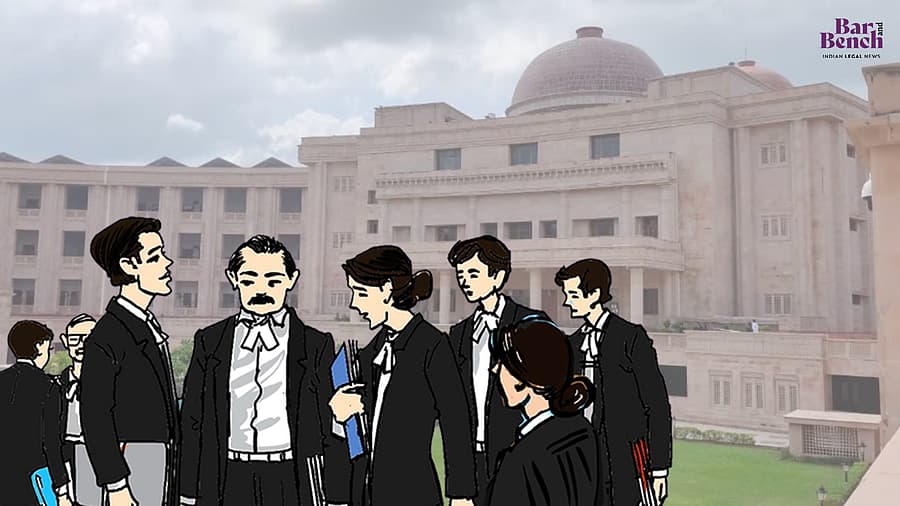
Allahabad High Court: Rejects Lawyer Fee Plea for ₹4.8 Cr from UP Govt
Summary
- The Allahabad High Court rejected four petitions from an advocate seeking ₹4.8 crore in professional fees from the Uttar Pradesh government.
- The advocate had represented the State as a special counsel for 16 years, primarily for the Basic Education Department.
- The court deprecated the State's conduct for compelling litigation but emphasized that fee disputes should be resolved privately through mediation or conciliation.
- The bench stated that litigation between a counsel and client damages the fundamental trust and faith essential to their relationship.
- The judgment advises counsel to show restraint in dragging clients to court for fee recovery.
Court Rejects Advocate's Fee Claim
A litigation between a counsel and their client would effectively 'defeat the very bedrock of trust and faith,' which forms the essential foundation of the advocate-client relationship.
The Allahabad High Court recently dismissed four petitions filed by an advocate seeking payment of ₹4.8 crore in outstanding professional fees from the Uttar Pradesh government. The counsel had claimed this substantial sum for his services as a special counsel, representing the State in various appeals over a period of 16 years. His role specifically involved handling matters for the Basic Education Department, where he was authorized to receive notices and appear in all special appeals.
The petitions were heard by a Division Bench comprising Justice Shekhar B Saraf and Justice Abdhesh Kumar Chaudhary at the Lucknow bench. The advocate asserted that despite his long-standing engagement and specific authorization, the Uttar Pradesh government had failed to disburse the claimed professional fees, compelling him to seek judicial intervention for recovery.
Judicial Disapproval of Litigation in Fee Disputes
At the outset of its judgment, delivered on August 14, the Allahabad High Court expressed strong disapproval of the State government's conduct, noting that it had compelled the counsel to approach the court for fee recovery. However, the bench also articulated a broader principle regarding the nature of advocate-client financial arrangements, observing that the payment of professional fees should remain a highly privileged and private affair between the parties involved.
The court firmly stated that such disputes, particularly those concerning advocate client fee disputes India, ought not to be brought before judicial forums. Instead, the bench emphasized that these matters must be resolved through alternative mechanisms such as mediation or conciliation, underscoring a clear preference for out-of-court settlements in professional fee recovery lawyer cases.
The Imperative of Professional Trust
Further elaborating on its stance, the Division Bench stressed that counsel should exercise considerable restraint before resorting to litigation against a client for the payment of fees. The court highlighted the profound impact such legal battles have on the fundamental relationship between an advocate and their client, regardless of the outcome of the case.
In its ruling, the bench powerfully articulated that while one party might technically 'win' a fee dispute in court, it is ultimately 'the trust and faith which always loses.' This erosion of confidence, the court explained, is detrimental to the dispensation of justice itself. A litigation between a counsel and their client, the judges concluded, would effectively 'defeat the very bedrock of trust and faith,' which forms the essential foundation of the advocate-client relationship.
Guiding Principles for Indian Legal Practice
This ruling from the Allahabad High Court provides significant guidance for lawyers across India on the appropriate avenues for resolving fee disputes, particularly when dealing with government entities like the Uttar Pradesh government advocate fees. It strongly advocates for mediation and conciliation over litigation as the preferred methods, aiming to preserve the integrity of the professional relationship.
The court's reluctance to entertain such disputes underscores a judicial expectation that legal professionals will prioritize maintaining trust and faith with their clients. The judgment serves as a reminder that escalating fee disagreements to formal litigation can lead to potential reputational damage and undermine the essential bond between an advocate and their client, reinforcing the importance of alternative dispute resolution, including Allahabad High Court mediation counsel fees, in such sensitive matters.
Practical Implications
This ruling provides guidance for lawyers in India on the appropriate avenues for resolving fee disputes with clients, particularly government entities, strongly advocating for mediation and conciliation over litigation to maintain professional trust. It underscores the court's reluctance to entertain such disputes and the potential for reputational damage to the advocate-client relationship.
Source
How does this affect you?
Get an AI analysis of this article grounded in your jurisdictions, practice areas, and any policy documents you've uploaded to Wansom.
Wansom is AI and can make mistakes.