
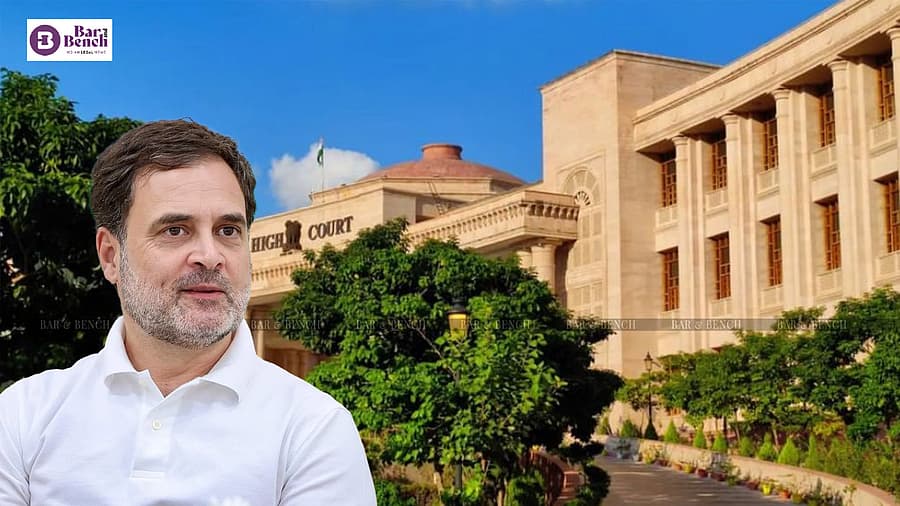
Allahabad HC Dismisses Rahul Gandhi Citizenship Plea
Summary
- The Allahabad High Court dismissed a petition challenging Rahul Gandhi's Indian citizenship and his eligibility as a Member of Parliament.
- The court found that the petitioner failed to produce any document proving Gandhi's alleged United Kingdom citizenship.
- Allegations included Gandhi declaring himself a British national and a director of the UK-based company M/s Backops Limited in 2003.
- Initially hesitant due to a pending central government inquiry, the court heard the matter at the petitioner's insistence.
- Following the court's observations on the lack of evidence, the petitioner chose to withdraw the writ petition, which was formally granted.
The Court's Decision
The ruling underscores the critical importance of concrete evidence over mere allegations when challenging the citizenship and eligibility of public figures for elected office in India.
The Allahabad High Court recently rejected a petition that sought to question the eligibility of Rahul Gandhi to serve as a Member of Parliament, based on allegations that he was not an Indian citizen. The ruling, issued on August 31 by a bench comprising Justice Shekhar B Saraf and Justice Abdhesh Kumar Chaudhary, found that the petitioner presented no substantive evidence to support the claims. This outcome effectively dismissed the challenge against the prominent political figure.
The core of the court's decision hinged on the petitioner's inability to substantiate the central accusation. During proceedings for the case, formally titled Ashok Pandey and Another v Sri Rahul Gandhi @ Raul Vinci New Delhi and 2 Others, the judicial panel observed a complete absence of documentation proving Mr. Gandhi's alleged United Kingdom citizenship. This critical lack of evidentiary support led the court to refuse to entertain the plea further.
In light of the court's findings and observations regarding the evidentiary vacuum, the petitioner ultimately chose to withdraw the writ petition. The Allahabad High Court subsequently granted this request, formally dismissing the case as withdrawn. The court's order explicitly stated, "In light of the submission made above, the petitioner is permitted to withdraw the present writ petition. The present writ petition as such is dismissed as withdrawn," concluding the legal challenge.
Allegations and Evidentiary Shortcomings
The petition, which aimed to initiate a Rahul Gandhi UK citizenship challenge, was predicated on specific allegations concerning his business dealings abroad. The petitioner asserted that in 2003, Mr. Gandhi had incorporated a company named M/s Backops Limited in the United Kingdom. Furthermore, it was claimed that he had declared himself a director and a major shareholder of this entity, simultaneously identifying as a British national. These assertions formed the basis of the challenge to his Indian MP citizenship eligibility.
Despite these detailed allegations, the Allahabad High Court citizenship case ultimately faltered due to a fundamental deficiency: the complete absence of proof. The court meticulously examined the documents presented by the petitioner but found no corroborating evidence. Specifically, the petitioner could not produce even a single document to demonstrate that Rahul Gandhi had ever declared himself to be a British citizen, which was a cornerstone of the entire legal argument.
This failure to provide any tangible evidence directly contradicted the petitioner's claims. The judicial panel underscored that without concrete documentation, the allegations remained unsubstantiated. The court's observations highlighted that the burden of proof lay squarely with the petitioner, and that burden was not met in this instance.
Judicial Scrutiny and Precedent
Initially, the Allahabad High Court expressed reservations about hearing the writ petition, noting that the matter of Mr. Gandhi's citizenship was already under consideration by the Central government. The court's initial skepticism reflected a general judicial reluctance to intervene in issues that are concurrently being addressed by other appropriate authorities. However, the court ultimately proceeded with the hearing due to the petitioner's persistent insistence, agreeing to review the documents that had been submitted.
This Allahabad HC Rahul Gandhi citizenship plea dismissed ruling reinforces the high evidentiary standard required to challenge a public figure's citizenship and eligibility for office in India. The court's thorough examination of the presented material, despite its initial reservations, and its subsequent dismissal based on a lack of proof, sets a clear precedent. The ruling underscores the critical importance of concrete evidence over mere allegations when challenging the citizenship and eligibility of public figures for elected office in India.
The outcome of this case serves as an important reminder for legal practitioners handling similar politically charged petitions. It emphasizes that concrete proof, rather than speculative claims or unsubstantiated accusations, is paramount when seeking to question fundamental aspects like citizenship and the right to hold public office. The judiciary demands robust evidence, ensuring that the legal process is not used to advance claims without a factual basis.
Practical Implications
This ruling reinforces the high evidentiary standard required to challenge a public figure's citizenship and eligibility for office in India, serving as a precedent for lawyers handling similar politically charged petitions where concrete proof, not just allegations, is paramount.
Source
How does this affect you?
Get an AI analysis of this article grounded in your jurisdictions, practice areas, and any policy documents you've uploaded to Wansom.
Finish Reading the Full Story and the Expert Analysis.
Wansom is AI and can make mistakes.