
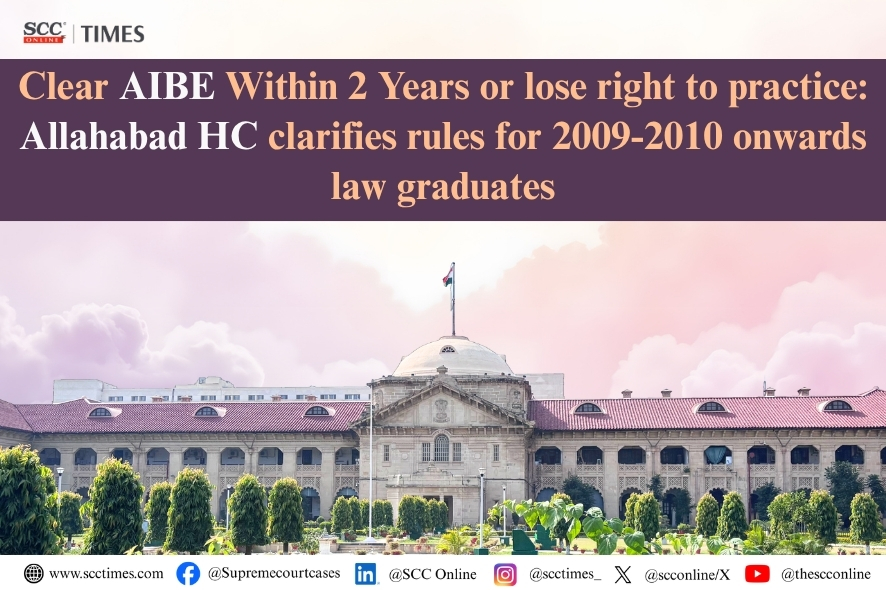
Allahabad High Court: Clarifies AIBE 2-Year Practice Rule for Graduates
Summary
- The Allahabad High Court has clarified that law graduates from 2009-2010 onwards must clear the All India Bar Examination (AIBE) within two years of provisional enrollment.
- Failure to pass the AIBE within this two-year period will result in the loss of the advocate's right to practice law in India.
- This ruling establishes a critical compliance deadline for a specific cohort of legal professionals.
- Advocates with a provisional enrollment from the Bar Council of U.P. who wish to practice in the High Court must also possess a provisional advocate roll from the Allahabad or Lucknow bench.
A Critical Mandate from Allahabad High Court
The Allahabad High Court has issued a significant clarification regarding the requirements for legal practice in India, particularly impacting a specific cohort of law graduates.
The Allahabad High Court has issued a significant clarification regarding the requirements for legal practice in India, particularly impacting a specific cohort of law graduates. This ruling establishes a firm deadline for advocates to clear the All India Bar Examination (AIBE), reinforcing the necessity of this qualification for maintaining professional standing. The court's pronouncement centers on the **Allahabad HC AIBE 2-year practice rule**, which dictates a strict timeframe for compliance.
Specifically, the High Court has clarified that law graduates who commenced their provisional enrollment from the academic years 2009-2010 onwards are subject to this critical stipulation. These individuals must successfully pass the AIBE within two years of their initial enrollment to retain their eligibility to practice law. Failure to meet this **AIBE clearance deadline India** will result in the forfeiture of their right to practice, underscoring the gravity of the court's directive.
The All India Bar Examination Requirement
The All India Bar Examination serves as a crucial gateway for law graduates seeking to establish their professional careers across the country. It is a mandatory assessment designed to ensure that aspiring advocates possess the fundamental knowledge and skills required for legal practice. The Allahabad High Court's recent clarification reiterates the non-negotiable nature of this examination, particularly for those provisionally enrolled from the 2009-2010 academic year forward.
This ruling directly impacts the **All India Bar Examination practice requirement**, making it clear that provisional status is time-bound. The consequence of not clearing the AIBE within the stipulated two-year period is severe: the advocate will lose their fundamental **advocate right to practice India**. This emphasizes the importance for all affected legal professionals to verify their AIBE status and ensure timely compliance with this essential regulatory benchmark.
Specifics for Uttar Pradesh Practitioners
Beyond the general AIBE requirement, the Allahabad High Court's clarification also addresses a specific procedural detail for advocates intending to practice within the High Court in Uttar Pradesh. For such practitioners, an additional layer of compliance is mandated. Advocates who hold a provisional enrollment certificate issued by the **Bar Council UP provisional enrolment** must fulfill a further condition.
These individuals are also required to possess a provisional advocate roll specifically from the High Court, whether it be the Allahabad bench or the Lucknow bench. This dual requirement ensures that those seeking to appear before the High Court in Uttar Pradesh meet both the statewide provisional enrollment criteria and the specific High Court registration protocols, adding another dimension to the overall compliance framework.
Ensuring Compliance and Professional Standing
The **Allahabad High Court AIBE clarification** serves as a vital reminder to the legal fraternity about the ongoing commitment to professional standards and regulatory adherence. The two-year window for clearing the AIBE is not merely an administrative formality but a foundational requirement for all **law graduates 2009-2010 AIBE** onwards to solidify their standing in the profession. This ruling ensures that only those who have demonstrated foundational competence through the AIBE can continue to exercise their right to practice.
For advocates who fall within the specified cohort, understanding and acting upon this directive is paramount. It necessitates a proactive approach to ensure that all necessary qualifications, including the AIBE clearance and, where applicable, the specific High Court provisional roll, are in order. Adherence to these rules is crucial for maintaining one's professional license and the integrity of the legal profession in India.
Practical Implications
This ruling establishes a critical compliance deadline for lawyers who provisionally enrolled from 2009-2010 onwards, particularly those in Uttar Pradesh, requiring them to clear the AIBE within two years to maintain their right to practice. Lawyers must verify their AIBE status to avoid potential disbarment.
Source
Source: Original reporting via SCC Times
How does this affect you?
Get an AI analysis of this article grounded in your jurisdictions, practice areas, and any policy documents you've uploaded to Wansom.
Wansom is AI and can make mistakes.