
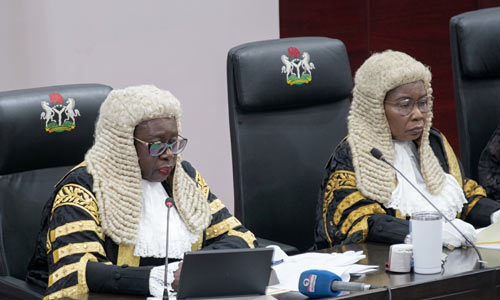
Abba Aji: US Travel Ban on Nigerian Supreme Court Justices
Summary
- Retiring Justice Uwani Musa Abba Aji disclosed that the United States government imposed a travel restriction on seven Nigerian Supreme Court justices.
- Justice Abba Aji stated that this US travel ban resulted from a misinterpretation of a Supreme Court judgment.
- The travel restrictions on these Nigerian Supreme Court justices remain in effect.
- Justice Abba Aji also revealed she was a regular visitor to the EFCC concerning allegations she knew nothing about.
What Happened
The sustained US travel ban on several Nigerian Supreme Court justices, as detailed by Justice Abba Aji, carries profound implications for Nigeria's judicial independence and its international relations.
Retiring Justice Uwani Musa Abba Aji of Nigeria's Supreme Court recently revealed that the United States government imposed travel restrictions on seven justices of the nation's highest judicial body. This significant disclosure highlights the international ramifications that can stem from judicial proceedings within Nigeria. According to Justice Abba Aji, the US travel ban was a direct consequence of what she characterized as a misinterpretation of a judgment delivered by the Supreme Court.
The travel restrictions, which specifically target Nigerian Supreme Court justices, remain in effect, as confirmed by Justice Abba Aji during her recent statements. This ongoing US visa ban on members of the Nigerian judiciary underscores a persistent point of contention and concern regarding the perceived integrity and independence of the country's legal system on the global stage. The revelation from a departing justice provides a rare insight into the direct impact of international scrutiny on high-ranking judicial officials.
Judicial Scrutiny and International Repercussions
The imposition of a US travel ban on Nigerian Supreme Court justices represents a serious form of diplomatic pressure, often reserved for individuals perceived to be involved in corruption or undermining democratic processes. Justice Uwani Musa Abba Aji's assertion that the ban arose from a "misinterpretation of a court judgment Nigeria" suggests a complex interplay between judicial decisions and international perceptions. Such actions by foreign governments can significantly impact the personal and professional lives of affected judges, limiting their ability to travel and potentially affecting their international standing.
This incident also brings to light the broader context of accountability within the Nigerian judiciary. Justice Abba Aji herself recounted facing intense personal scrutiny, disclosing that she was a "regular visitor" to the Economic and Financial Crimes Commission (EFCC) to address allegations about which she claimed to have no knowledge. This personal experience with investigative bodies, coupled with the collective travel restrictions on her peers, paints a picture of a judiciary operating under considerable domestic and international pressure.
Why It Matters
The sustained US travel ban on several Nigerian Supreme Court justices, as detailed by Justice Abba Aji, carries profound implications for Nigeria's judicial independence and its international relations. The fact that such a significant sanction was reportedly triggered by a "misinterpretation" of a court judgment raises questions about the clarity and transparency of judicial pronouncements, as well as how these are perceived and understood by international observers. This situation can erode public and international confidence in the Nigerian legal system, suggesting that judicial outcomes can lead to direct consequences for individual judges.
Furthermore, the personal account of Justice Abba Aji regarding her frequent visits to the EFCC over unsubstantiated allegations underscores the vulnerabilities faced by judges in politically sensitive environments. This dual pressure—from international sanctions on the one hand and domestic investigative bodies on the other—can create an atmosphere where judges might feel constrained in their decision-making, potentially compromising the impartiality essential for a robust judiciary. The ongoing nature of the travel restrictions serves as a stark reminder of the global community's watchful eye on judicial conduct in Nigeria.
Practical Implications
This incident highlights the significant international scrutiny on judicial decisions in Nigeria, particularly those perceived as politically motivated. Lawyers should be aware of the potential for such judgments to attract international sanctions or reputational damage, which could impact the judiciary's perceived independence and the enforceability of judgments abroad. It also underscores the personal risks faced by judges in politically charged cases.
Source
How does this affect you?
Get an AI analysis of this article grounded in your jurisdictions, practice areas, and any policy documents you've uploaded to Wansom.
Wansom is AI and can make mistakes.