
8am Report: Billable Hour Dominates US Law Firms, Flat Fee Use Stalls
Summary
- The "8am SMB Law Billing and Payments Report" indicates the billable hour remains dominant among small and mid-sized law firms, with flat fees not gaining ground.
- Firms billing exclusively by the hour outnumber those using only flat fees by nearly 5 to 1, with flat fees comprising 15% of all invoices in H1 2026.
- Flat fee adoption is primarily driven by the predictable nature of specific practice areas, such as traffic and immigration law.
- Monthly billings at firms grew by 5% to 8% over the year, primarily due to improved legal billing realization rates rather than increased hourly rates.
- Large firms notably increased their billed hours by nearly 12% while logging slightly fewer, enhancing the share of recorded time that was billed.
Key Findings from the 8am Report
Lawyers at small and mid-sized firms should benchmark their billing practices against the 8am report's findings, particularly evaluating whether their use of hourly versus flat fees aligns with their specific practice area's predictability and market trends.
The "8am SMB Law Billing and Payments Report" reveals that the billable hour remains a dominant force within small and mid-sized law firms, challenging widespread predictions of its decline. This comprehensive analysis, conducted by 8am (formerly AffiniPay), draws on aggregated billing and payment data from over 60,000 law firms, primarily located in the United States, utilizing its MyCase practice management and LawPay payment platforms. The report specifically compares billing practices and trends between the first half of 2025 and the first half of 2026, with 8am committing to bi-annual publications of these insights.
Contrary to the prevailing industry narrative suggesting a significant shift towards alternative fee arrangements, the 8am report indicates that firms relying exclusively on hourly billing substantially outnumber those operating solely on a flat fee model by nearly a five-to-one margin. Moreover, the adoption of flat fees did not expand over the past year; instead, it experienced a slight contraction. The report categorizes firm sizes based on employee count: solo (one), small (2-5), medium (6-10), and large (11 or more), with this data derived from either firm-reported information or platform user counts.
Billing Model Trends and Adoption
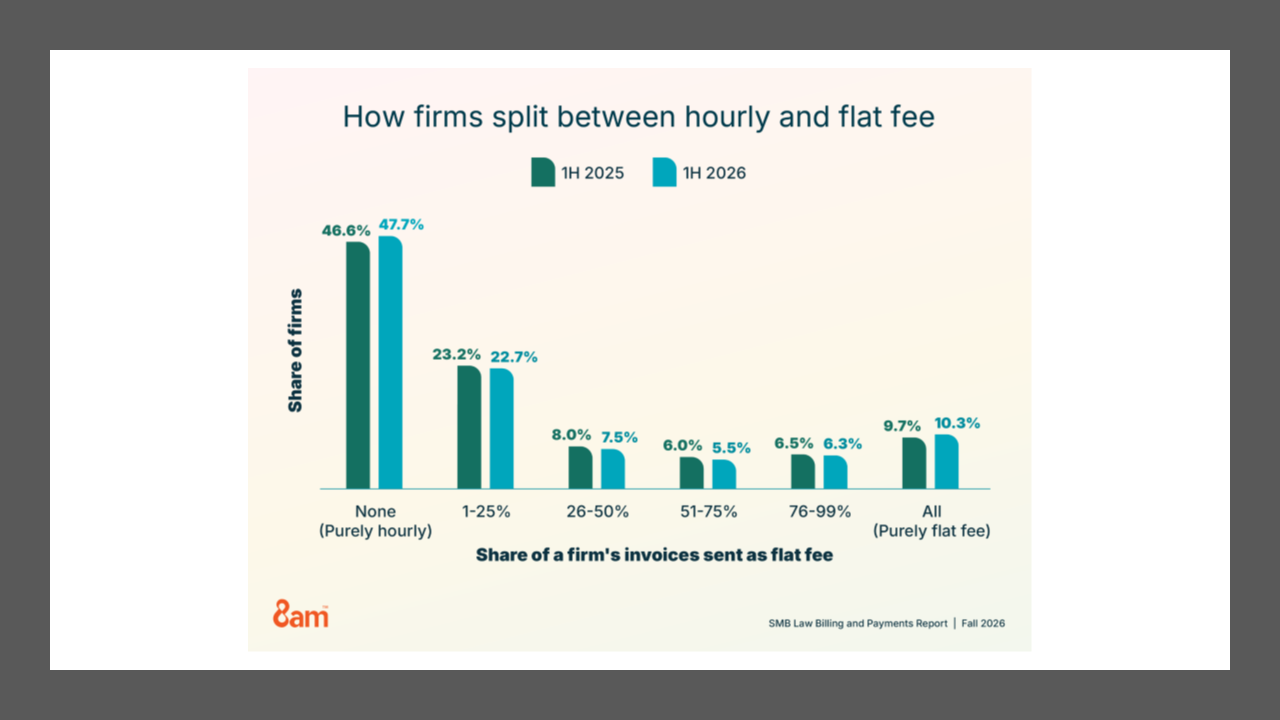
The detailed findings from the 8am report underscore the continued prevalence of traditional hourly billing among SMB law firms. In the first half of 2026, 47.7% of the surveyed firms billed entirely by the hour, representing a slight increase from 46.6% in the previous year. Conversely, only 10.3% of firms exclusively utilized flat fees, a modest rise from 9.7%. The remaining 42% of firms employed a hybrid billing approach, yet even within this group, flat fees constituted a quarter or less of their total invoices.
When examining the overall volume of invoices, flat fees accounted for 15% of all bills issued in the first half of 2026, marking a decrease from 16% a year prior. This trend was most pronounced among larger firms, where the share of flat fee invoices dropped from approximately 16% to 14%. Solo firms presented an exception to this pattern, showing a marginal increase in their flat fee share, reaching 17%. Tanya Hendricks, Chief Product Officer at 8am, highlighted this disparity, noting that while the industry often discusses a movement towards flat fees, the MyCase LawPay billing data demonstrates that most SMB firms have not followed suit, often making crucial billing decisions without adequate benchmarks.
Practice Area Influence on Flat Fees
The 8am report emphasizes that the choice between flat fee and hourly billing is predominantly dictated by the nature of the legal work itself, rather than a philosophical preference. Flat fees are most prevalent in practice areas characterized by predictable and bounded matters. For instance, traffic law firms issued 87.7% of their invoices as flat fees, while immigration firms utilized flat fees for 64% of their bills. Bankruptcy and criminal defense firms also showed significant flat fee adoption, with roughly half of their invoices structured this way.
In contrast, practice areas involving less predictable or more complex work exhibit minimal flat fee usage. Business and corporate firms saw flat fees comprise only 10% of their invoices, civil litigation firms 6.7%, family law firms 2.8%, and workers' compensation firms a mere 0.8%. Notably, even within high flat-fee areas, shifts occurred; immigration firms, despite their high adoption rate, experienced a more than four-point decline in their flat fee share, moving from 68.4% to 64%. This data suggests that lawyers at small and mid-sized firms should benchmark their billing practices against the 8am report's findings, particularly evaluating whether their use of hourly versus flat fees aligns with their specific practice area's predictability and market trends.
Revenue Growth Through Realization
Despite the stability in billing models, the 8am report indicates that firms achieved substantial growth in their monthly billings, ranging from 5% to 8% over the past year. This increase was not primarily driven by higher hourly rates, as the report found that hourly rates remained unchanged across three of the four firm size categories tracked. Only medium-sized firms reported a rate increase, specifically 4.3%. Instead, the growth in revenue is attributed to improved legal billing realization rates.
Firms are effectively converting more of the time they record into billable invoices. For example, large firms managed to bill nearly 12% more hours while logging slightly fewer overall, boosting the proportion of recorded hours that were ultimately billed from 44% to 49%. Furthermore, the amount firms earned per hour billed saw an increase of between 3% and 5% across all firm sizes. This data can inform strategic decisions on optimizing revenue through improved realization rather than just rate increases, highlighting a critical area for SMB law firm billing practices to focus on.
Practical Implications
Lawyers at small and mid-sized firms should benchmark their billing practices against the 8am report's findings, particularly evaluating whether their use of hourly versus flat fees aligns with their specific practice area's predictability and market trends. This data can inform strategic decisions on optimizing revenue through improved realization rather than just rate increases.
Source
How does this affect you?
Get an AI analysis of this article grounded in your jurisdictions, practice areas, and any policy documents you've uploaded to Wansom.
Finish Reading the Full Story and the Expert Analysis.
Wansom is AI and can make mistakes.