
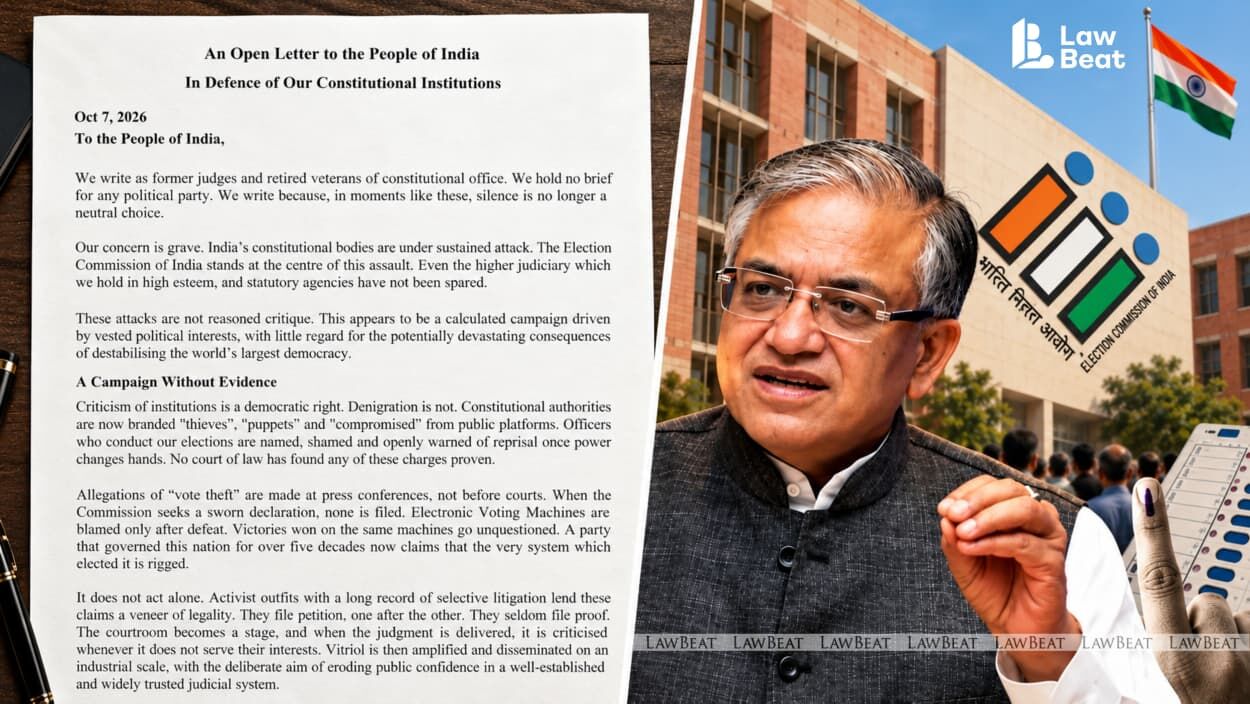
42 Former Judges Defend ECI Constitutional Bodies in Open Letter
Summary
- Forty-two former Indian judges have issued an open letter defending the Election Commission of India, the judiciary, and other constitutional bodies.
- They differentiate between legitimate criticism, which is a democratic right, and denigration, which they argue undermines the nation's institutions.
- The judges expressed concern over a "calculated campaign" driven by political interests, warning of destabilizing consequences for India's democracy.
- The letter highlights that allegations of "vote theft" and issues with EVMs are often made publicly without being substantiated in judicial proceedings.
- They affirmed the ECI's constitutional authority under Article 324 and the Representation of the People Act, 1950, for conducting Special Intensive Revision of electoral rolls.
Former Judges Issue Strong Defense of Constitutional Bodies
While legitimate criticism of institutions is a cornerstone of democracy, the deliberate denigration of constitutional bodies undermines the very foundations of the nation's governance.
Forty-two retired judges from India's Supreme Court and various High Courts have collectively voiced alarm over what they describe as a concerted effort to undermine the nation's constitutional institutions. In an open letter released on October 7, titled "An Open Letter to the People of India: In Defence of Our Constitutional Institutions," these judicial veterans specifically defended the Election Commission of India (ECI), the judiciary, and other statutory agencies against ongoing public and political allegations.
The signatories, including former Supreme Court Justices Hemant Gupta and Pankaj Mittal, alongside numerous former Chief Justices and judges of High Courts such as S.N. Dhingra, Vinod Goel, G.P. Mittal, V.B. Gupta, and Deepa Sharma from the Delhi High Court, emphasized their non-partisan stance. They clarified that their intervention stems from their experience as former constitutional office holders, asserting that in the current climate, remaining silent is no longer a neutral option. Their primary concern is the sustained attack on India's constitutional bodies, with the ECI identified as being at the epicenter of this assault.
Distinguishing Criticism from Denigration
The former judges' open letter directly addresses the nature of public discourse surrounding constitutional authorities, drawing a clear line between permissible criticism and unacceptable denigration. They specifically cited instances where public figures have described constitutional authorities using terms like "thieves," "puppets," and "compromised." The letter also noted that election officials have been publicly identified, criticized, and even threatened with reprisals should there be a change in government.
Furthermore, the judicial veterans pointed out that allegations of "vote theft" are frequently made at press conferences rather than being substantiated through proper judicial proceedings. They highlighted that when the Election Commission has requested sworn declarations or supporting evidence for such claims, these materials have not been provided. The letter also touched upon the recurring questions raised about Electronic Voting Machines (EVMs), observing that such concerns typically emerge after electoral defeats, while victories achieved through the same system do not face similar challenges. The judges underscored that no court has found these allegations against officials to be proven.
Upholding the Constitutional Mandate for Electoral Rolls
A significant portion of the open letter is dedicated to defending the Election Commission's role in the Special Intensive Revision (SIR) of electoral rolls. The former judges underscored that the ECI derives its authority directly from Article 324 of the Indian Constitution, which empowers it to oversee elections. Additionally, they cited Section 21(3) of the Representation of the People Act, 1950, as the specific legal provision enabling the ECI to revise electoral rolls.
The letter clarifies that the SIR is an integral component of the constitutional framework designed to maintain accurate and updated electoral rolls. It notes that intensive revisions have been a consistent practice since India's first general elections. The primary objectives of this exercise are to remove the names of deceased individuals, eliminate duplicate entries, update records for those who have changed residences, and ensure that all eligible voters are included, thereby upholding the integrity of the electoral process in India.
Practical Implications
Lawyers advising clients on public statements, particularly in political or electoral contexts in India, should note the distinction drawn by former judges between legitimate criticism and denigration of constitutional bodies. This perspective reinforces the importance of adhering to legal avenues for challenging institutional actions rather than resorting to unsubstantiated public allegations, which could have legal ramifications or impact public perception of legal challenges.
Source
How does this affect you?
Get an AI analysis of this article grounded in your jurisdictions, practice areas, and any policy documents you've uploaded to Wansom.
Finish Reading the Full Story and the Expert Analysis.
Get the latest legal & regulatory intelligence in India
Wansom is AI and can make mistakes.