Legal professionals, whether writing internal firm documents or for external clients, know that producing accurate, strategic documents is non-negotiable. But drafting legal documents manually is often an inefficient process, full of repetition, formatting inconsistencies, and avoidable errors. Generative AI can significantly streamline this workflow, especially when paired with thoughtfully designed custom templates.
Why Legal Drafting Still Needs Optimization
Legal drafting is core to law practice, from contracts and NDAs to pleadings and briefs. Yet the process remains time-intensive and heavily manual for many teams. Lawyers must not only understand the law but also communicate it precisely and consistently across documents. That level of precision requires more than just legal knowledge; it demands the right tools.
Even with the rise of GenAI tools, many firms are still navigating how to strike the right balance between speed and accuracy. Automating the drafting process alone is not enough. You need to optimize how automation is used to guarantee quality, consistency, and strategic alignment.
The Power of Custom Templates in Legal AI
Custom templates serve as the backbone for high-quality AI-assisted drafting. Rather than starting from scratch or repurposing outdated documents, legal teams can build a library of standard templates tailored to their practice areas, jurisdictions, and client requirements.
Here is how custom templates enhance AI-drafted legal work:
1. Faster, Smarter Starts
Starting a document with a template eliminates blank-page paralysis. AI models trained on firm-specific templates can generate first drafts that reflect the firm's tone, clause preferences, and formatting rules. This delivers drafts that are 80% complete in a fraction of the time.
Instead of writing from memory or piecing together clauses from older files, your AI assistant can use custom templates as a launching pad. This ensures continuity and alignment from the very first line, allowing lawyers to focus immediately on matter-specific nuances rather than document structure.
2. Enforcing Consistency Across Teams
Templates standardize the structure and language of your documents, reducing inconsistencies that can cause regulatory or reputational issues. When combined with AI, they ensure junior lawyers or support staff are using approved language and structure every time, regardless of experience level.
Built-in playbooks can provide guidance on preferred terms and fallback positions, which the AI references during drafting. This allows legal teams to scale high-quality output without compromising on legal rigor, presenting a unified and professional front to every client.
3. Clause Libraries at Your Fingertips
Clauses are the DNA of any legal document. AI tools integrated with clause libraries, especially those drawn from your own templates, make it easy to find, insert, or rewrite clauses with just a prompt.
Whether referencing firm-approved content or adapting public clauses to your specific needs, AI ensures quick and reliable access to the right provisions. This turns the drafting process into a strategic selection of vetted building blocks rather than a search-and-paste exercise.
4. Automated Reviews with Template Intelligence
Custom templates do not just help with drafting. They also improve document review. AI tools can automatically redline drafts against standard templates, flag missing clauses, and suggest corrections based on predefined rules. This reduces the risk of human oversight and accelerates turnaround times.
The AI acts as a first-line reviewer, catching deviations from the firm's standard form before a senior lawyer spends time on it. This creates a powerful quality control layer that protects the firm from errors and omissions.
From Drafting to Delivery: Unlocking Strategic Capacity
By combining AI with custom templates, law firms move away from reactive drafting toward proactive legal service delivery. Lawyers can spend less time fixing formatting issues or rewriting standard clauses, and more time advising clients, negotiating better outcomes, or building new business.
This shift transforms the lawyer's role from document producer to strategic counselor. The efficiency gained is not just about doing the same work faster. It is about reallocating the most valuable resource, lawyer time, to the highest-value activities that drive client success and firm growth.
"With Wansom AI, our team reduced contract drafting time by over 50% using our own templates. It is not just faster. It is smarter," says Susan Mwango from CM Advocates LLP.
Why It Matters
Optimizing legal drafting is not just about operational efficiency. It is about delivering better client outcomes, protecting your firm's reputation, and creating room for higher-value legal work. In a competitive market, the ability to produce precise, consistent, and strategically sound documents rapidly is a significant differentiator.
If your team is still drafting documents manually or using one-size-fits-all AI tools, it may be time to rethink your process. The combination of tailored custom templates and a dedicated legal AI platform represents the next evolution in legal practice, where technology amplifies expertise rather than replacing it.
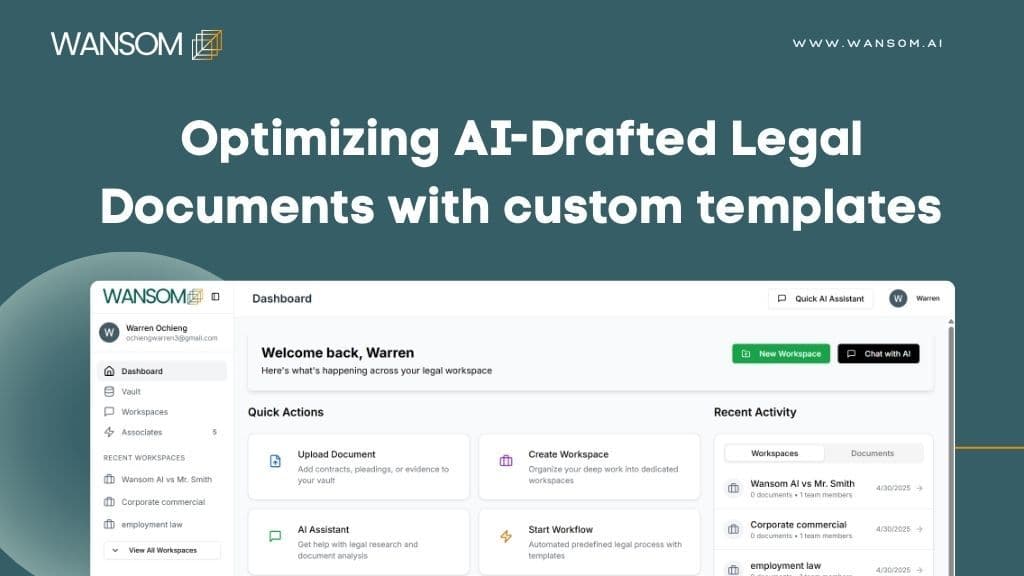
Explore how Wansom AI helps law firms transform document drafting with the power of AI and custom templates.