
Zimbabwe's New Mining Law Is Stuck, So the Ministry Rules by Notice
Summary
The stalled bill: the Mines and Minerals Bill [H.B. 1, 2025], to replace the 1961 Act, received an adverse report from the Parliamentary Legal Committee, which flagged 21 constitutional concerns. On 3 June 2026, six remained, with 14 days given to fix them. No Second Reading has followed.
Parliament's complaint: mines portfolio committee chair Remigius Matangira said the minister was operating as if the bill were already law.
Strategic minerals: under the bill, mining a declared strategic mineral would require a prior agreement with the State that may include at least US$1 million of investment and a company with State participation. On 22 May, the Ministry already declared gold, lithium, diamonds and other minerals strategic by policy statement.
Rule by notice: the February export suspension; the 22 May reservation of small and medium-scale gold mining for citizens (up to 20 kg a month and/or US$15 million capital), with a 1 January 2027 transition deadline; the 2 October title-regularisation notice, with a 31 December deadline; and a crackdown on illegal chrome mining.
Communities: a 15 September investigation reported residents' accounts linking new lithium projects around Mutare and Buhera to ZANU-PF-connected interests, and fears of displacement echoing earlier documented removals in Buhera.
The legal risk: policy statements and notices rest on narrower legal ground than an Act, raising rule-of-law, property and administrative-justice questions.
A Decade-Long Bill, Stuck Again
The law it would replace. Zimbabwe's mining sector is still governed by the Mines and Minerals Act [Chapter 21:05], which dates from 1961. Successive governments have tried to replace it for more than a decade.
Year | Attempt |
|---|---|
2015 | First draft of a replacement bill |
2018 | President Emmerson Mnangagwa declines to sign an amendment bill, citing concerns including property rights |
2022–2023 | A new bill is examined by Parliament's Legal Committee, found unconstitutional in several respects, and lapses when Parliament is dissolved before the 2023 election |
25 June 2025 | Mines and Minerals Bill [H.B. 1, 2025] gazetted (General Notice 1243A) and given its first reading |
1 October 2025 | Parliamentary Legal Committee (PLC) meets on the bill and issues an adverse report, flagging 21 concerns of a constitutional nature |
3 June 2026 | Mines Minister Polite Kambamura says the PLC has narrowed its concerns to six items and given the government 14 days to address them, after which it would withdraw the adverse report |
June–July 2026 | Parliament's order papers list continued consideration of the PLC's adverse report |
September 2026 | No public sign that the adverse report has been withdrawn or the bill has moved to its Second Reading |
How the process works. Under section 152 of the Constitution, the PLC examines every bill for constitutional compliance. An adverse report blocks progress until the government amends the bill to the committee's satisfaction, or the National Assembly rejects the report. Only then can the bill proceed to Second Reading, the Senate and presidential assent.
Frustration in Parliament. On 3 June, the chair of the Parliamentary Portfolio Committee on Mines and Mining Development, Remigius Matangira, urged the government to expedite the bill. He said the existing situation was already affecting miners, and that the Minister was operating as if the new bill were already law when it is not.
What the PLC objected to. The adverse report covered issues including:
the treatment of landholders' rights when mining is authorised on their land, which the committee saw as constructive deprivation of property;
the governance of a proposed Mining Industry Environmental Protection Fund, with the Minister as trustee; and
a clause transferring expropriated mining locations to the Minister personally rather than to the State.
The six remaining issues have not been published in detail.
What the Bill Would Do
The Mines and Minerals Bill, 2025 would repeal and replace the 1961 Act. Its main reforms:
Area | Proposed change |
|---|---|
Strategic minerals | The Minister may declare a mineral "strategic" because of its importance to Zimbabwe's economic, social, industrial or security interests; some minerals are designated in advance in a schedule |
Mining cadastre | A Mining Cadastre Register to document and manage all mining rights |
Use it or lose it | Stricter rules against holding undeveloped claims speculatively |
Small-scale mining | Reserved for Zimbabweans: only citizens, permanent residents or wholly owned local companies may hold prospecting rights; foreigners only for large-scale operations |
Special grants | Grants by the Secretary for Mines abolished and folded into mining leases; presidential special grants expanded |
Environment | Environmental impact assessments retained; civil penalties for non-compliance; an environmental protection fund |
Miner–farmer conflicts | New rules on mining on farmland and compensation for landholders |
The strategic minerals clause. Under clause 6, once a mineral is declared strategic, anyone wishing to mine it must first enter into an agreement with the State. According to the bill's explanatory memorandum, that agreement may require any or all of:
a commitment to invest at least US$1 million; and
the formation of a company or other special investment vehicle in which the State holds an interest, effectively a joint venture with the State.
The declaration can apply nationally or to a defined area.
A constitutional concern that carried over. The PLC found the previous bill's equivalent clause unconstitutional. That clause required at least US$100 million or another amount set by the Minister, and the committee found it discriminated on economic grounds and gave the Minister an open-ended power that undermined legal certainty. In the 2025 bill, clause 6(4)(a) requires an ability to invest "such minimum sum as the Minister may prescribe", with no figure in the bill itself. The US$1 million appears only in the memorandum. The legal-information service Veritas argued in 2025 that this does not cure the earlier defect, because the Minister's discretion remains open-ended.
Why it matters for critical minerals. Lithium, rare earths and other battery minerals are obvious candidates for designation. A strategic-minerals regime would give the State a legal route to equity in every new project for those minerals, on terms negotiated case by case with the Minister.
Governing by Notice: Four Measures Without a New Law
While the bill waits, the Ministry of Mines and Mining Development has made major policy through policy statements, directives and public notices.
Date | Measure | Instrument | What it does |
|---|---|---|---|
26 February 2026 | Export suspension | Government directive | Suspended exports of lithium concentrate and other unprocessed minerals, citing malpractices and leakages; exports later resumed under quotas and conditions |
22 May 2026 | Small-scale gold reservation | Ministerial policy statement | Reserved small- and medium-scale gold mining for citizens and wholly citizen-owned entities, with immediate effect |
22 May 2026 | Strategic minerals list | Same announcement | Declared gold, diamonds, lithium and other minerals strategic or critical, with prior ministerial approval required for mining-rights applications over them |
July / 2 October 2026 | Title regularisation | Directive (July), then public notice by the Permanent Secretary (2 October) | All mining-rights holders with outstanding statutory obligations must regularise by 31 December 2026 or risk losing their titles |
October 2026 | Chrome crackdown | Enforcement action, linked to the regularisation notice | Crackdown on illegal alluvial chrome mining by operators without valid rights |
The gold reservation in detail
Announced by Minister Kambamura on 22 May 2026:
Who is barred: no foreign individual, foreign-controlled company or foreign beneficial owner may acquire, hold or control a small-scale gold title, or take part in operating or managing one.
Arrangements caught: tribute agreements, joint ventures, syndicates and partnerships that give foreigners economic or operational control.
Threshold: small and medium-scale means production of up to 20 kg of gold a month and/or capital investment of up to US$15 million.
Transition: foreign operators in the segment must regularise by 1 January 2027, by moving above the small-scale thresholds. Their rights will be sustained on the basis of demonstrated production, evidenced by gold deliveries through official channels.
Sanction: titles not re-registered within the period are liable to cancellation or other regulatory action.
The minister cited widespread conflicts between foreign investors, communities, miners and farmers. The measure mirrors the bill's proposal to reserve small-scale mining for Zimbabweans, but takes effect through a policy statement, not an Act.
Regularisation and the chrome crackdown
In July 2026, the government directed all mining title holders to regularise outstanding statutory obligations by 30 August. On 2 October 2026, a public notice signed by Permanent Secretary Dr Thomas Utete Wushe extended the deadline to 31 December 2026. Rights holders, regardless of scale, must engage their provincial mining offices, settle arrears or agree payment plans, secure surveyed coordinates, and complete regularisation applications. The notice came as the government stepped up action against illegal alluvial chrome mining.
The pattern. The bill's core ideas, including reservation of small-scale mining for locals, a strategic-minerals regime and "use it or lose it" enforcement, are being applied administratively before Parliament has approved them. That is the substance of the portfolio committee chair's complaint that the Minister is acting as if the bill were already law.
The Social Cost: Communities in the Lithium Belt
The September investigation. On 15 September 2026, an investigation by environmental journalist Andrew Mambondiyani, published by The Revelator and republished by The Zimbabwean, examined new lithium projects in eastern Zimbabwe, including areas around Mutare and Buhera. Farmers interviewed said the projects are linked to powerful people in the ruling ZANU-PF party, and described fear of losing land, pastures, rivers and water. Some said communities are afraid to speak openly because the projects are associated with senior government figures.
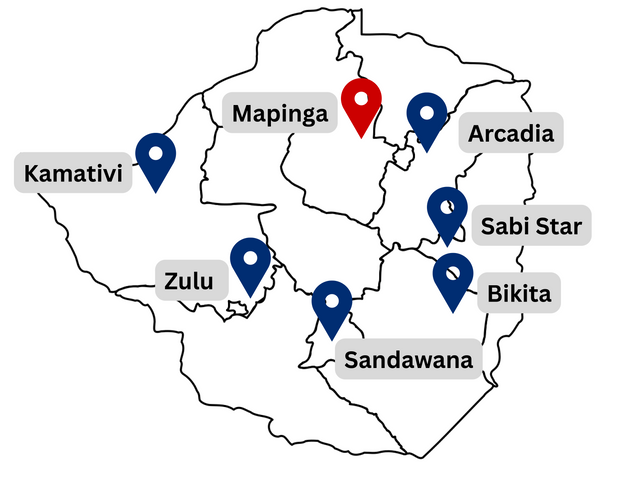
A documented precedent in Buhera. The fears are grounded in earlier experience. Academic research published in 2024 traced how 41 families from Mukwasi village in Buhera were displaced to make way for the Sabi Star lithium mine, operated by a Chinese company. Affected families were moved to smaller, lower-quality homes than promised, lost access to water, grazing land and fruit trees, and received less compensation than they had sought. Researchers also documented economic displacement, restricted access to land and water, at lithium sites in Buhera, Bikita and Mberengwa.
Why the law matters here. The 1961 Act and the stalled bill both govern how mining rights interact with communal and agricultural land, and what compensation is owed. The PLC's adverse report itself flagged the bill's treatment of landholders as a potential constructive deprivation of property. Parliament's order papers have also listed motions on consultation with communities before mining claims are pegged in communal lands. When policy is made by notice rather than through a debated statute, communities have fewer formal points at which to raise their concerns.
The just-transition argument. Civil society voices quoted in the investigation argue that lithium extraction must be tied to human rights protection, environmental accountability, transparent supply chains and real community benefit, so that host communities share in the value of a mineral prized for the global energy transition rather than bearing its costs.
The Legal Analysis: Rule by Notice
1. Policy statements versus law
Under Zimbabwe's Constitution, legislative authority rests with Parliament, and subsidiary legislation must be authorised by an Act of Parliament and published as a statutory instrument. A ministerial policy statement or public notice is neither. It can announce how the Ministry will exercise powers it already has under the 1961 Act, but it cannot by itself create new rights, prohibitions or penalties.
That distinction is central to the current measures:
Measure | Legal question |
|---|---|
Small-scale gold reservation | Which provision of the 1961 Act, or other statute, authorises excluding foreign nationals from a category of mining title, and the cancellation of non-compliant titles? |
Strategic minerals declaration | The bill would create the strategic-minerals regime. Without it, what legal basis supports special conditions and prior ministerial approval for those minerals? |
Title regularisation | Collection of statutory arrears and forfeiture for non-compliance rest on existing law, so this is the most firmly grounded of the measures |
Export suspension | Export controls on minerals can be grounded in existing export and exchange-control legislation, depending on the instrument used |
2. The rule of law and legal certainty
Section 3 of the Constitution enshrines the rule of law, which the PLC has cited when criticising open-ended ministerial discretion in the bill. Making major policy by announcement raises the same concern. Rules can change overnight, often with "immediate effect", without parliamentary debate or published statutory text. For investors and miners, that means less certainty about what the law requires and how decisions can be challenged.
3. Constitutional rights at stake
The PLC's concerns about the bill point to rights that also apply to administrative measures:
Property (section 71): cancelling titles or restricting how holders may deal with them must comply with constitutional protections against arbitrary deprivation.
Non-discrimination (section 56): reservations based on nationality must be justified as permitted limitations, while thresholds such as minimum investment amounts can raise economic-discrimination concerns.
Administrative justice (section 68): decisions affecting rights must be lawful, reasonable and procedurally fair, with reasons given.
4. Investment protection
Foreign investors in small-scale gold who must restructure or exit by 1 January 2027, under a policy statement rather than an Act, may look to bilateral investment treaties and the investment protections in Zimbabwean law. The more a measure rests on discretion rather than statute, the greater the legal-certainty risk for both the investor and the State.
5. Why passing the bill matters
Enacting the bill, after resolving the PLC's six remaining concerns, would give the strategic-minerals regime, the small-scale reservation and the cadastre a clear statutory basis. It would also subject them to parliamentary scrutiny and court review on defined grounds. Until then, the Ministry's measures sit on a narrower and more contestable legal footing.
What It Means for Each Stakeholder
Foreign investors in small-scale gold
The deadline: by 1 January 2027, foreign-controlled operations in the small and medium-scale segment (up to 20 kg a month and/or US$15 million capital) must move above the thresholds or exit. Tribute agreements, joint ventures and syndicates that give foreigners control are caught. What to do: assess whether the operation can scale up and prove production through official gold deliveries, or plan an orderly exit or restructuring. Take legal advice on the measure's statutory basis and any treaty protections before acting.
Large-scale and strategic-mineral investors
The uncertainty: lithium, gold, diamonds and other minerals have been declared strategic by policy statement, with prior ministerial approval needed for mining-rights applications. The bill would add state participation and a minimum investment commitment, but its final terms are unsettled. What to do: build state-participation scenarios into project models, engage early with the Ministry on approvals, and watch the bill's Second Reading for the final wording of clause 6.
All mining title holders
The deadline: regularise outstanding statutory obligations by 31 December 2026, or risk losing titles. What to do: contact the provincial mining office now, settle arrears or agree a payment plan, secure surveyed coordinates and submit regularisation applications well before the deadline.
Chrome miners and buyers
The crackdown on illegal alluvial chrome mining means buyers face greater scrutiny of where chrome comes from. Ensure all suppliers hold valid, regularised titles.
Zimbabwean small-scale miners
The gold reservation protects a segment of the market for citizens. The bill would also bring formalisation through a cadastre, "use it or lose it" rules and stronger enforcement. Regularising titles now positions miners to benefit.
Communities and landholders
New lithium and other projects continue to advance under the 1961 Act's weaker protections. Communities facing projects should document land use, seek legal assistance on compensation and consultation, and engage Parliament, where motions on consulting communities before mining claims are pegged in communal lands have been listed for debate.
Parliament
The portfolio committee has pressed for the bill to be expedited and criticised the Ministry for acting ahead of the law. Its leverage lies in pressing for the PLC's six remaining issues to be resolved and the bill brought to Second Reading.
Lawyers and advisers
The work includes advising foreign gold operators on the 2027 transition, testing the legal basis of policy-statement measures, regularising titles, structuring state participation for strategic minerals, and representing communities in land and compensation disputes.
Key Dates
Date | Event |
|---|---|
25 June 2025 | Mines and Minerals Bill [H.B. 1, 2025] gazetted |
1 October 2025 | Parliamentary Legal Committee considers the bill; adverse report follows, flagging 21 concerns |
26 February 2026 | Export suspension on lithium concentrate and other unprocessed minerals |
22 May 2026 | Policy statement reserves small and medium-scale gold mining for citizens and declares a strategic minerals list |
3 June 2026 | Government given 14 days to resolve six remaining constitutional issues |
June–July 2026 | Parliament continues to consider the PLC's adverse report |
September 2026 | No public sign of the adverse report being withdrawn or a Second Reading |
15 September 2026 | Investigation links new lithium projects to ZANU-PF-connected interests and describes community fears |
2 October 2026 | Public notice extends the title-regularisation deadline to 31 December 2026 |
31 December 2026 | Deadline for title regularisation |
1 January 2027 | Deadline for foreign operators to exit or scale up from small-scale gold |
What to Watch
Milestone | Why it matters |
|---|---|
Withdrawal of the PLC's adverse report | Clears the way for the bill to proceed |
Second Reading in the National Assembly | The first full parliamentary debate on the bill's substance |
Further strategic-mineral designations or conditions | Whether the strategic-minerals regime is extended before the bill passes |
Enforcement of the gold reservation after 1 January 2027 | Title cancellations and any legal challenges by foreign operators |
Regularisation outcomes after 31 December 2026 | Scale of title forfeitures |
Community responses in the lithium belt | Disputes over land, consultation and compensation |
Frequently Asked Questions
What is the Mines and Minerals Bill? A bill to replace Zimbabwe's 1961 Mines and Minerals Act, gazetted in June 2025. It is held up by an adverse report from Parliament's Legal Committee.
Why is the bill stuck? The Parliamentary Legal Committee found provisions inconsistent with the Constitution. On 3 June 2026, the government was given 14 days to resolve six remaining issues, but there has been no public sign since of the report's withdrawal or a Second Reading.
What are strategic minerals under the bill? Minerals the Minister declares strategic because of their importance to Zimbabwe's economy or security. Mining them would require a prior agreement with the State that may include a commitment to invest at least US$1 million and a company in which the State holds an interest.
Can foreigners do small-scale gold mining in Zimbabwe? Not under the 22 May 2026 policy statement, which reserves operations of up to 20 kg a month and/or US$15 million capital for citizens and wholly citizen-owned entities, with a transition deadline of 1 January 2027.
What is the title regularisation deadline? 31 December 2026, under a public notice dated 2 October 2026, for all mining-rights holders with outstanding statutory obligations.
Citations
- 1.• Mines and Minerals Bill clears major hurdle as committee demands final revisions, Mining Zimbabwe (3 June 2026)
- 2.• Adverse Report of the Parliamentary Legal Committee on the Mines and Minerals Bill, Veritas
- 3.• Mines and Minerals Bill, 2025 (H.B. 1, 2025), Veritas
- 4.• Bill Watch 24-2025: The Mines and Minerals Bill, Unconstitutional Clauses Remain, Veritas (2 August 2025)
- 5.• Bill Watch 24-2026 of 14 July 2026, Veritas
- 6.• Overview of the provisions of the Mines and Minerals Bill, 2025, MMM Law Firm
- 7.• Zimbabwe exclusively reserves small-scale gold mining for locals, Xinhua (22 May 2026)
- 8.• Zimbabwe bans foreigners from small-scale gold mining, declares strategic minerals list, ZimLive (26 May 2026)
- 9.• Zimbabwe Announces Reservation of Small and Medium Scale Gold Mining Sector for Zimbabweans, Lex Africa (15 June 2026)
- 10.• Crackdown on illegal chrome mining intensifies, The Herald via Zimbabwe Situation (6 October 2026)
- 11.• How Zimbabwe's Regime Is Fueling a Dirty Lithium Boom, The Revelator via The Zimbabwean (15 September 2026)
- 12.• Lithium mining in Zimbabwe: a story of loss for one community, The Conversation
Finish Reading the Full Story and Expert Analysis.
Get the latest legal & regulatory intelligence in Zimbabwe
Wansom is AI and can make mistakes.