
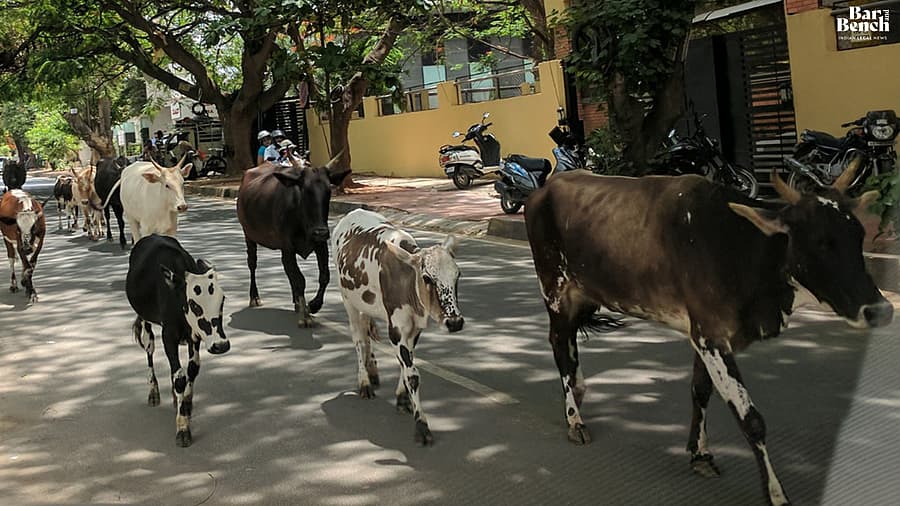
Supreme Court: Compensation Policy for Stray Cattle Accident Victims
Summary
- The Supreme Court has directed the Centre and State governments to establish a compensation mechanism for victims of stray cattle accidents.
- Animal attacks killed 1,130 people across India in 2018, 1,425 in 2019, and 1,305 in 2020, according to government data.
- The court's order includes mandating cattle tagging and ensuring better implementation of laws governing stray animals.
- Companies operating in India may be impacted by a compensation policy for stray cattle accident victims, affecting liability and insurance claims.
What Happened
Stray cattle on highways are a constant invitation to death. After all, they are not meant to be natural speed breakers, placed willy-nilly on the National Highways, roads and streets.
The Supreme Court has directed the Central and State governments to establish a compensation mechanism for victims of stray cattle accidents. This directive was issued in response to an appeal filed by Nisha, whose husband Vijay Kumar was hit by a stray animal while driving on a highway. The court's order is a significant development in addressing the issue of stray cattle on highways, which pose a constant threat to human and animal life.
The bench of Justices Sanjay Karol and NK Singh noted that stray cattle accidents often result in fatal consequences for motorists and pedestrians alike. In fact, government data reveals that animal attacks killed 1,130 people across India in 2018, 1,425 in 2019, and 1,305 in 2020.
The court's order is a call to action for the Centre and States to frame a mechanism to compensate victims of stray cattle accidents. This includes mandating cattle tagging and ensuring better implementation of laws governing stray animals.
Legal Context
The Supreme Court's directive is rooted in existing laws and regulations governing stray cattle in India. The court cited the case of Nisha v Municipal Council Sangrur & Ors, which highlights the need for effective implementation of laws to prevent stray animal accidents.
In recent years, there have been several instances of stray cattle causing accidents on highways and roads. These incidents often result in serious injuries or fatalities, and can have a significant impact on the lives of victims and their families.
The court's order is also significant in light of the growing concern over animal attacks on highways. With increasing numbers of vehicles on the road, the risk of collisions with stray animals is higher than ever before.
Why It Matters
The Supreme Court's directive has far-reaching implications for companies operating in India, particularly those involved in transportation and logistics.
A compensation policy for stray cattle accident victims could impact liability and insurance claims for these companies. As such, lawyers and compliance officers should closely monitor the implementation of this policy and its potential effects on their clients' operations.
Furthermore, the court's order highlights the need for effective regulation and enforcement of laws governing stray animals in India. This includes ensuring that cattle tagging laws are implemented consistently across states and territories.
Practical Implications
Lawyers and compliance officers should watch for the potential implementation of a compensation policy for stray cattle accident victims, which could impact liability and insurance claims for companies operating in India.
Source
Source: Original reporting via The Hindu
How does this affect your business?
Get an AI analysis of this article grounded in your jurisdictions, practice areas, and any policy documents you've uploaded to Wansom.
Wansom is AI and can make mistakes.