
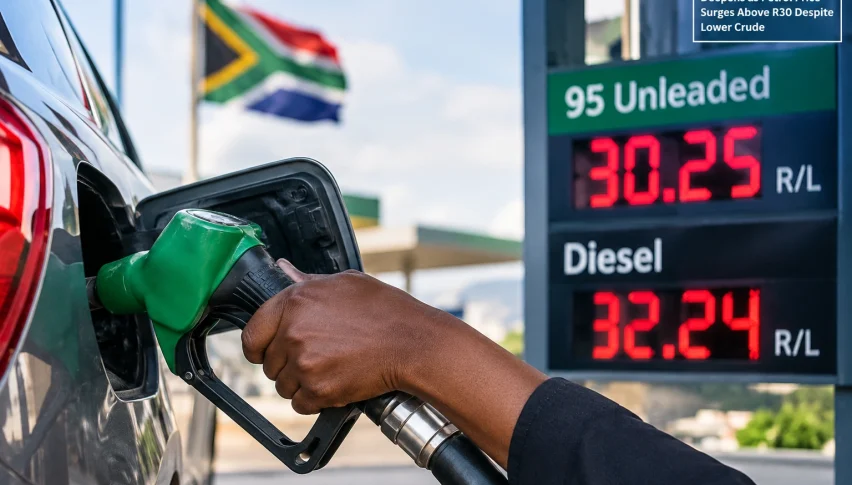
South Africa’s Record October Fuel Hike: How Oil, Shipping Risks and a R10.45 Billion Fuel Debt Pushed Petrol Above R30
South African motorists entered October facing a price milestone that had once seemed distant: petrol 95 in Gauteng crossed R30 per litre. Effective 7 October, the price rose by R3.33 per litre, from R26.92 to R30.25. Petrol 93 increased by R3.12 to R29.88, while diesel prices rose by R2.84 to R3.24 per litre, depending on sulphur grade.
The adjustment was not limited to motorists. Wholesale illuminating paraffin increased by R3.58 per litre, while its single maximum national retail price rose by R4.77 to R31.82. Liquefied petroleum gas prices also increased. The breadth of the adjustment matters because fuel is not simply a household purchase: it is an input into transport, agriculture, mining, distribution and many other parts of the economy. [Sources: Department of Mineral and Petroleum Resources; Mail & Guardian.]
The Department of Mineral and Petroleum Resources attributed the increases to rising crude-oil prices, higher international prices for refined petroleum products, supply concerns and shipping costs. But the size of the adjustment also reflects the way South Africa calculates domestic fuel prices and carries forward accumulated fuel-price under-recoveries.
The October increase therefore raises three distinct questions: what changed in global markets, how those changes passed through the domestic pricing system, and who is likely to bear the economic consequences.
The international shock behind the increase
The government’s announcement points to a sharp movement in Brent crude during the relevant review period. The average price rose from US$87.89 to US$101 per barrel as geopolitical tensions involving the United States and Iran increased uncertainty about oil flows through the Strait of Hormuz. The department also cited higher shipping costs and declining inventories.
The period under review ran from 28 August to 1 October. That timing is important: the October pump-price adjustment largely reflects market conditions during this earlier window, rather than oil prices on the day motorists filled their tanks.
Crude oil, however, is only part of the calculation. South Africa’s Basic Fuel Price (BFP) is linked to the international prices of refined products, including petrol and diesel, in overseas refining centres. A rise in crude prices can raise refinery input costs, but refined-product prices can also move because of product-specific supply shortages, refinery availability, inventories and transport costs.
The department reported that international product-price movements added approximately 329.07 cents per litre to the petrol BFP and 280.17 cents per litre to the diesel BFP during the review period. Illuminating paraffin’s BFP contribution increased by approximately 357.23 cents per litre.
These figures help explain why the increase was so large. The immediate pressure was not simply that oil became more expensive; the international cost of the finished fuels South Africa prices against also rose sharply.
Why the Strait of Hormuz matters to South African motorists
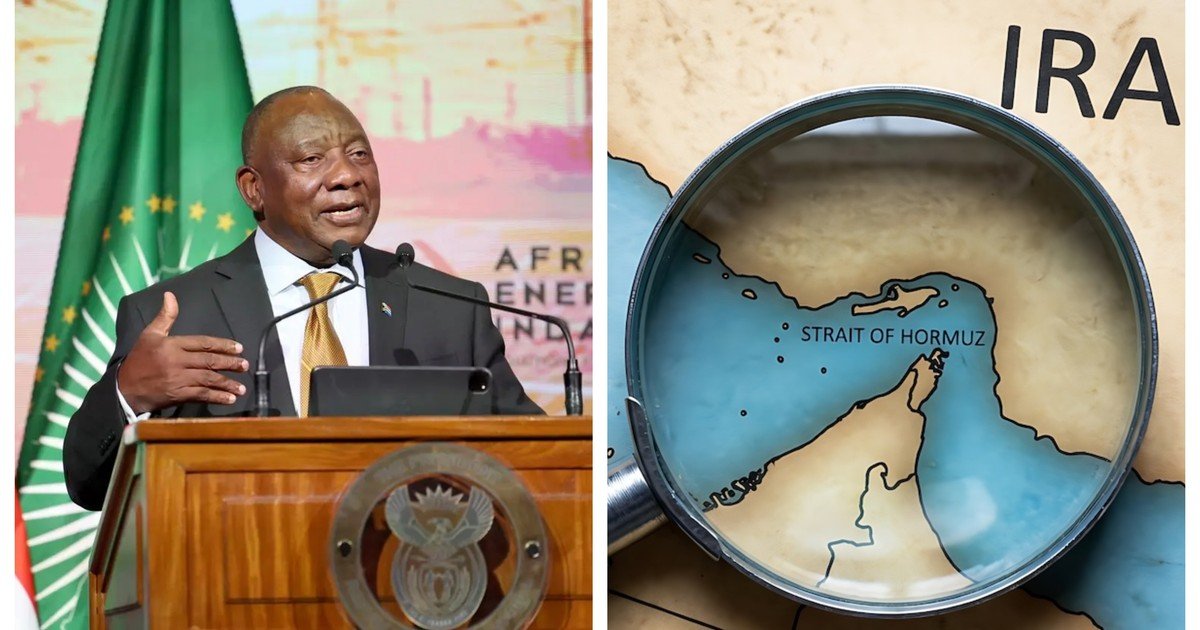
The Strait of Hormuz is a major route for internationally traded oil. Uncertainty about safe and reliable flows through the strait can cause markets to price in supply risks before a physical shortage reaches a particular country.
For South Africa, the exposure is transmitted through import-parity pricing, international refined-product markets, shipping costs and the exchange rate used to convert dollar-denominated prices into rand. A disruption far from South African filling stations can therefore affect local fuel costs even when the disruption is not taking place in South African waters.
That does not mean every rand of the October increase can be attributed to the strait alone. The department identified several related factors, including crude prices, product inventories and shipping costs. The available figures do not isolate the precise contribution of each geopolitical development.
The central point is that South Africa is exposed to the international cost of obtaining fuel, not just the price of crude oil considered in isolation.
The rand offered almost no relief
Currency movements can magnify or soften an international fuel-price shock. When petroleum products become more expensive in US dollars, a weaker rand makes those products even more expensive in local currency. A stronger rand can offset some of the increase.
In this review period, however, the rand provided almost no protection.
The department reported that the average rand-dollar exchange rate moved from approximately R16.2139 per dollar in the previous period to R16.2123 during the latest period. That slight appreciation reduced the petrol BFP contribution by just 0.17 cents per litre and the diesel contribution by 0.22 cents per litre.
Compare that with the roughly 329-cent-per-litre upward contribution from international petrol-product prices. The currency effect was negligible beside the international product-price movement.
This distinction matters because fuel-price increases are often explained too broadly as the result of a weak rand. In October’s case, the official calculation shows that the currency was nearly unchanged and marginally more favourable. The overwhelming pressure came from international product prices.
The rand can still matter greatly in future price reviews. If international oil and refined-product prices remain high while the currency weakens, the two effects can reinforce each other. Conversely, a sustained decline in product prices could reduce the pressure even without a major currency appreciation.
For October, however, the evidence points to an international price shock that the currency was unable to offset in any meaningful way.
How South Africa’s fuel-pricing system passes the shock to consumers
South Africa’s fuel-pricing system is more complicated than a direct conversion of the global crude-oil price into a pump price.
The Basic Fuel Price reflects the estimated cost of importing a comparable refined petroleum product, including international product prices and associated shipping and handling costs. That amount is converted into rand. Domestic components are then added, including applicable taxes and levies, transport costs, regulated margins and other charges.
The Department of Mineral and Petroleum Resources explains that petrol prices are adjusted monthly, with the new regulated retail price taking effect on the first Wednesday of the month. The Central Energy Fund calculates price indicators daily, and the monthly adjustment reflects an average over the preceding review period.
This time lag means a change in global markets does not necessarily appear immediately at South African filling stations. The domestic adjustment reflects the conditions captured during the review window.
It also explains why two apparently contradictory things can happen: international oil prices may fall on a particular day while the next monthly domestic adjustment still increases, because the overall review-period average remains higher than the previous one.
Another important distinction is that petrol’s retail price is regulated, while diesel’s retail price is not regulated in the same way. The government publishes a diesel wholesale price, but individual retail prices may vary. The announced diesel increases should therefore not be read as a guarantee that every filling station will charge exactly the same retail price.
The system is designed to link domestic fuel prices to the cost of obtaining comparable products internationally, while accounting for domestic costs and policy charges. That structure makes the country’s prices responsive to global market conditions, but it also exposes consumers to large movements when those conditions deteriorate.
The slate levy: the accumulated cost of earlier under-recoveries
The October increase also needs to be understood alongside the slate levy, a mechanism used to manage accumulated differences between the Basic Fuel Price built into the prevailing price structure and the daily calculated BFP.
When the calculated BFP is above the level reflected in the price structure, an under-recovery arises. When it is below that level, an over-recovery arises. These daily movements are recorded over time in a cumulative account known as the slate.
When the slate balance becomes negative, the slate levy can be used to recover the accumulated shortfall through fuel prices.
The government reported a combined cumulative petrol and diesel slate balance of negative R10.456 billion at the end of August 2026. The slate levy increased from 83.28 cents to 87.66 cents per litre, a rise of 4.38 cents.
That additional 4.38 cents per litre was much smaller than the October increase of more than R3 per litre. It would therefore be misleading to present the slate levy as the principal cause of the price shock. The much larger contribution came from rising international product prices.
Nevertheless, the slate balance illustrates a deeper issue: fuel-price pressure can accumulate across review periods rather than disappear at the end of each month. When the system recovers a negative balance through a levy, consumers face both the current cost of fuel and a charge linked to earlier under-recoveries.
The mechanism is not, by itself, evidence of improper pricing. It is a feature of the pricing framework intended to account for differences between calculated costs and the amounts reflected in prices. The policy question is how such adjustments distribute the burden over time, especially when international costs rise sharply and household budgets are already constrained.
The R30 threshold: a record price, not just a psychological milestone
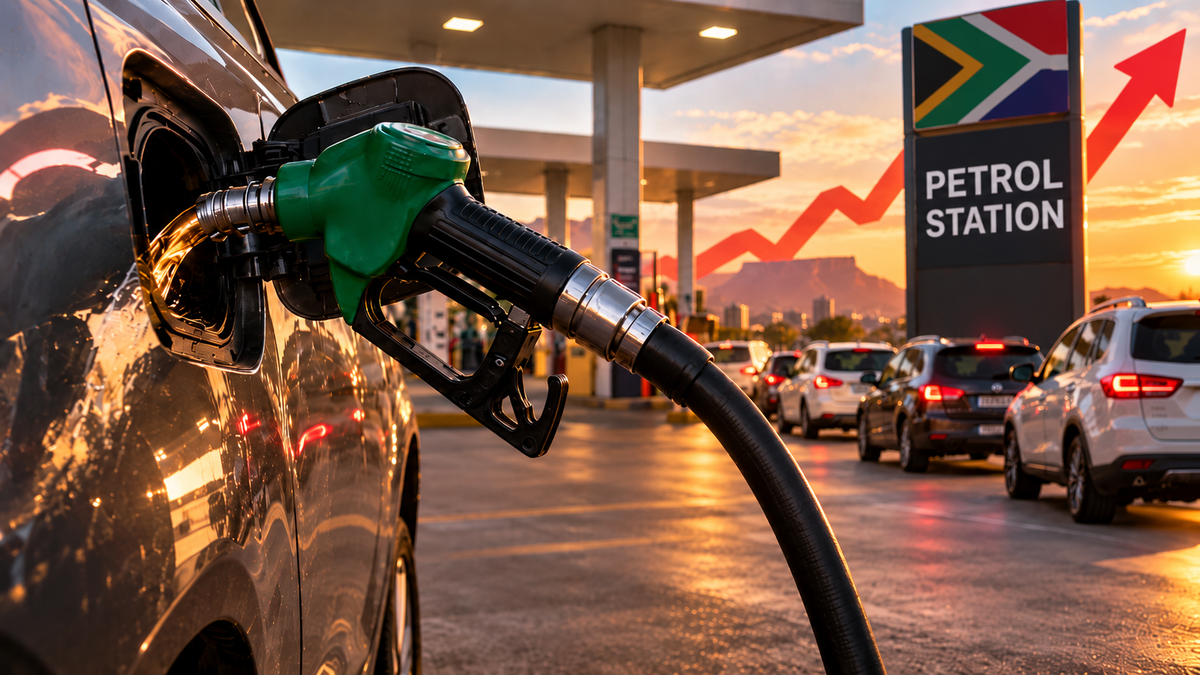
The increase pushed 95-octane petrol in Gauteng from R26.92 to R30.25 per litre. Mail & Guardian reported that this was the highest recorded Gauteng price for 95 petrol, exceeding the previous high of R28.06 per litre in June 2026.
Petrol 93 rose to R29.88 per litre in Gauteng. At the coast, the reported price of 95 petrol was R29.38 per litre.
The regional difference is important. South African fuel prices vary by pricing zone because inland transport and other location-specific costs form part of the price structure. A national headline figure can therefore conceal differences in what motorists actually pay.
The R30 threshold also makes the increase easy to understand in everyday terms. A driver buying 50 litres of 95 petrol in Gauteng would pay R1,512.50 at R30.25 per litre, compared with R1,346 at the previous price of R26.92. That is an additional R166.50 for the same quantity of fuel.
For a driver buying 50 litres every week, the increase amounts to R666 over four such purchases. This is an illustration based on the stated prices and a constant 50-litre purchase, not an estimate of what every household spends.
The impact depends on how much fuel a person uses, how often they fill up, their vehicle’s efficiency and whether they can reduce or avoid journeys. For people who depend on a vehicle for work or have limited alternatives to driving, the increase may be difficult to absorb.
How the increase can spread beyond motorists
Fuel-price increases can affect the economy through several channels. Some effects are direct and immediate; others depend on business decisions, market competition and how long higher prices persist.
Transport and distribution
Road transport depends on diesel and petrol, directly or indirectly. When fuel costs rise, logistics operators face higher operating expenses. Depending on contracts, competition and their ability to absorb costs, some may pass a portion of those expenses on to customers.
That can affect the movement of food, building materials, consumer goods and industrial inputs. But the size and timing of any pass-through cannot be determined from the fuel-price announcement alone. It would require evidence on freight rates, transport contracts and subsequent prices.
Food and agriculture
Agriculture uses fuel for machinery, irrigation in some operations, and the movement of inputs and produce. Food distribution also depends on transport.
Higher diesel costs can therefore add to pressure on the food supply chain. The final effect on retail food prices, however, depends on more than fuel: crop conditions, fertiliser costs, exchange rates, storage, labour, margins and competition also matter.
This is particularly relevant in the current environment. On 15 October, South African Reserve Bank Governor Lesetja Kganyago told Reuters that global energy and food costs remained upside risks to inflation. He also identified fertiliser prices, geopolitical uncertainty and potential weather-related risks as concerns. That warning supports the case for monitoring fuel and food costs together, but it does not establish how much of any future food-price movement will be caused by the October fuel adjustment.
Public and commercial transport
Minibus taxis, buses, delivery vehicles and other transport services may face higher operating costs. The impact on passengers depends on the service, the operator’s cost structure, demand and whether fares are adjusted.
It would be premature to assume that all fares will rise by a fixed amount or immediately after the fuel-price announcement. Operators may absorb some costs temporarily, change routes or schedules, negotiate contracts, or adjust fares at different times.
For households, the risk is that transport becomes more expensive at the same time as other essential expenses are under pressure. For businesses, the risk is that higher fuel costs narrow margins unless they can improve efficiency or pass on some of the increase.
Inflation and interest rates
Fuel has a direct role in transport costs and can also influence the prices of goods and services that depend on distribution. That creates a potential route from a global energy shock to broader inflation.
On 15 October, Reuters reported that the South African Reserve Bank expected inflation to average 4.4% in 2026, with the 3% target expected to be reached only in 2028. Kganyago highlighted risks from global energy and food prices. The bank had raised its policy rate by 25 basis points to 7.25% in September.
The fuel increase does not automatically imply another interest-rate rise. Monetary policy responds to the broader inflation outlook, including whether price increases are temporary or become embedded in wages, services and expectations. But a sustained energy shock can make the inflation task harder, particularly if food and transport costs rise together.
Who bears the cost and what can the government actually control?
The international price of refined fuel is largely outside South Africa’s direct control. The government cannot set the price of Brent crude, eliminate geopolitical risk or dictate international shipping costs.
It does, however, determine or influence parts of the domestic fuel-price structure, including certain taxes, levies, regulated margins and elements of the pricing framework. That distinction is important when evaluating policy responses.
A reduction in a fuel levy could lower the amount motorists pay per litre, depending on how the change is designed and implemented. But it would also have fiscal consequences: the government would collect less revenue from that charge unless it offset the loss elsewhere or accepted a lower fiscal balance. The benefit could also be uneven, because households and businesses that consume more fuel would generally receive a larger direct benefit.
Another option is to change how price shocks are distributed over time. But smoothing an increase does not remove the underlying cost. Depending on the mechanism, it may shift the burden into future prices, require public financing, or allow a balance of under-recoveries to accumulate.
Longer-term measures address different problems. Improving transport alternatives, logistics efficiency and energy resilience may reduce some forms of exposure, but these measures require investment and cannot eliminate the immediate impact of a sudden international price surge.
No single intervention can fully shield South Africa from global energy prices without costs or trade-offs. The relevant policy question is which costs should be borne by consumers immediately, which can reasonably be spread over time, and how any relief should be funded and targeted.
What to watch next
The October adjustment provides a clear set of indicators to monitor in the next fuel-price review:
Brent crude and refined-product prices: A sustained decline could ease the international contribution to domestic fuel costs, while continued disruption could keep it elevated.
The rand-dollar exchange rate: A weaker rand could add to costs even if international prices stabilise.
Shipping and product inventories: These can influence the cost of imported finished fuels beyond movements in crude oil alone.
The slate balance and levy: Further changes would indicate whether accumulated under-recoveries are continuing to influence the domestic price structure.
Transport and food prices: These will help establish how much of the fuel shock is being passed through to households and businesses.
Inflation expectations and monetary policy: The key question is whether higher energy costs remain a temporary shock or contribute to persistent inflation.
The direction of the next adjustment cannot be established from October’s figures alone. It will depend on conditions during the next review period and on how the international and domestic components evolve.
Conclusion: South Africa’s exposure is bigger than the pump price
The October fuel-price increase was driven principally by a sharp rise in international refined-product prices, with crude oil moving above US$100 per barrel during the review period. The rand offered almost no offset, while the slate levy added a relatively small additional increase linked to accumulated under-recoveries.
The result was a record R30.25 per litre for 95 petrol in Gauteng, alongside substantial increases in diesel and paraffin prices.
The economic consequences will depend on how long global costs remain elevated and how much of the increase businesses pass on to customers. The immediate burden is clearest at the filling station, but the wider effects may emerge gradually through freight, food distribution, commuting costs and inflation.
For policymakers, the challenge is not simply to respond to a record price. It is to balance consumer relief, fiscal constraints and a pricing system that reflects the real cost of fuel in an exposed international market. For households and businesses, the key uncertainty is whether October marks a temporary spike or another stage in a longer period of elevated energy costs.
The price at the pump is the most visible part of the story. The broader test is how the shock moves through the economy and who ultimately pays for it.
Citations
- 1.Department of Mineral and Petroleum Resources / South African Government, “Minister Gwede Mantashe announces adjustment of fuel prices effective from 7 October 2026,” 5 October 2026. Official explanation of crude prices, refined-product prices, exchange-rate effects, slate balance and price adjustments.
- 2.https://www.gov.za/news/media-statements/minister-gwede-mantashe-announces-adjustment-fuel-prices-effective-7-0
- 3.Department of Mineral and Petroleum Resources, “Fuel Price Structure.” Official explanation of the Basic Fuel Price, domestic price components and monthly adjustment process.
- 4.https://www.dmpr.gov.za/Branches/Petroleum-Resources/Fuel-Price-Structure
- 5.Mail & Guardian, “Petrol price to hit record R30.25 a litre in Gauteng from Wednesday,” 5 October 2026. Regional price levels, historical comparison and review-period figures.
- 6.https://mg.co.za/news/south-africa/2026-10-05-petrol-price-to-hit-record-r30-25-a-litre-in-gauteng-from-wednesday/
- 7.TimesLIVE, “Record fuel price hikes: what you’ll pay from October 7,” 5 October 2026. Price changes, slate levy and official explanation of the international market drivers.
- 8.https://www.timeslive.co.za/motoring/2026-10-05-record-fuel-price-hikes-what-youll-pay-from-october-7/
- 9.Reuters, “South Africa’s central bank governor Kganyago sees upside risks to inflation,” 15 October 2026. Recent central-bank assessment of inflation risks, energy and food prices, and monetary policy.
- 10.https://www.reuters.com/world/africa/south-africas-central-bank-governor-kganyago-sees-upside-risks-inflation-2026-10-15/
- 11.CAR Magazine, “Confirmed: SA fuel price for October 2026.” The initial report supplied for this article.
- 12.https://www.carmag.co.za/news/confirmed-sa-fuel-price-for-october-2026/
Finish Reading the Full Story and Expert Analysis.
Get the latest legal & regulatory intelligence in South Africa
Wansom is AI and can make mistakes.