
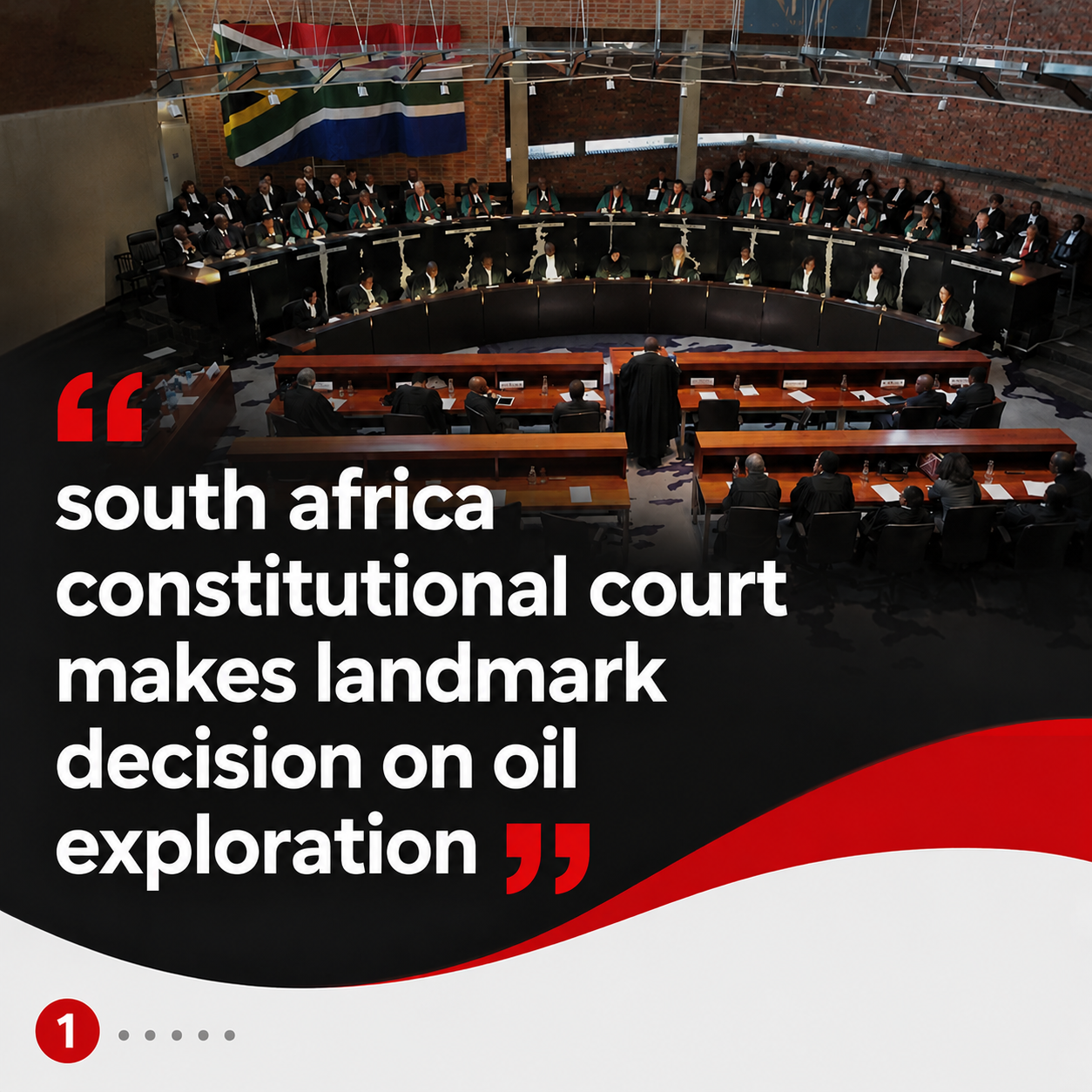
South Africa's constitutional court issues landmark decision on wild coast exploration and climate risk
Abstract
The judgment, authored by Justice Jody Kollapen for the majority, overturned a 2024 Supreme Court of Appeal ruling that had given the companies a route to cure defective community consultation through a further renewal application. The apex court held that procedural injustice in granting resource rights cannot be fixed after the fact, and that commercial investment does not outweigh constitutional violations.
The ruling matters because it is the first time South Africa's highest court has directly addressed community and environmental rights in the context of oil and gas exploitation, and because it draws on the International Court of Justice's 2025 advisory opinion on climate obligations to require that resource decisions account for foreseeable climate impacts
Introduction
The Constitutional Court's judgment brings to a close litigation that began in 2021, when Wild Coast communities and environmental groups sought to stop Shell from conducting a 3D seismic survey under an exploration right originally granted to Impact Africa in 2014. The communities argued that the Department of Mineral Resources and Energy had failed to meaningfully consult them and had disregarded the potential harm to marine life, livelihoods, and cultural and spiritual practices tied to the ocean.
The ruling arrives as offshore exploration disputes multiply across South Africa's coastline and as neighbouring Namibia moves toward developing recently discovered offshore crude reserves. It raises immediate questions for any company holding, or seeking, resource rights in areas with unresolved consultation history: whether existing rights survive scrutiny under the same reasoning, whether regulators can rely on remedial consultation processes going forward, and how the court's reliance on international climate law obligations will be applied in future resource-rights disputes beyond the extractive sector.
Background
Exploration and production rights in South Africa are governed primarily by the Mineral and Petroleum Resources Development Act (MPRDA), which requires applicants to consult with communities and interested parties whose rights may be affected before a right is granted. The Constitution of the Republic of South Africa, 1996, underpins these requirements through Section 24 (the environmental right, including the right to have the environment protected through reasonable legislative and other measures) and Section 33 (the right to administrative action that is lawful, reasonable, and procedurally fair), together with constitutional protections for cultural and customary rights relevant to coastal and indigenous communities.
The Department of Mineral Resources and Energy granted Impact Africa Limited, a subsidiary of Impact Oil & Gas Limited, the original exploration right in 2014. The right was renewed twice, in 2017 and 2021, and in 2021 Impact transferred a 50% participating interest to Shell. When Shell announced plans for a 3D seismic survey later that year, Wild Coast communities and civil society organisations, including Sustaining the Wild Coast and Natural Justice, brought an interdict and later a substantive challenge.
The Makhanda High Court ruled against Shell and the government in 2022, finding the exploration right and its renewals unlawful on three separate grounds: inadequate consultation, failure to consider relevant environmental and community interests, and non-compliance with the MPRDA. Shell, Impact Africa, and the government appealed to the Supreme Court of Appeal, which in June 2024 agreed that the process had been unlawful but held that the High Court had not properly considered a just and equitable remedy. The SCA suspended the setting-aside of the right, giving the companies one further opportunity, a third renewal application, to cure the consultation defects, citing the companies' investment of more than R1 billion in the project.
The communities and environmental organisations challenged that remedy before the Constitutional Court, which heard argument in September 2025 and delivered judgment nearly a year later, on 14 August 2026. The majority, authored by Justice Kollapen and joined by a majority of the bench, reinstated the High Court's order setting aside the right and its renewals, and rejected the renewal-based cure the SCA had permitted. Justices Rogers and Savage dissented, arguing the matter should have been remitted for fresh consultation, citing the scale of the companies' investment and the risk of leaving the application in permanent limbo.
The judgment also draws on the International Court of Justice's July 2025 advisory opinion on states' obligations in relation to climate change, which the majority treated as relevant authority for the proposition that decisions with foreseeable climate consequences must be taken with heightened diligence informed by scientific knowledge and international commitments.
Analysis
The judgment's central legal contribution is its treatment of remedy, not merely its finding of unlawfulness. South African administrative law has long recognised that procedurally defective decisions can sometimes be cured through remittal or a corrective process rather than an outright setting aside.
The Constitutional Court has now held, in the specific context of resource rights affecting community and environmental interests, that this curative route is not available where the underlying process failure goes to the heart of whether affected people had a genuine opportunity to be heard before the right was granted. Regulators can no longer assume that a flawed consultation process can simply be reopened later without consequence to the underlying right
. This raises the evidentiary bar for what counts as adequate consultation from the outset, since companies and departments can no longer treat consultation as something correctable after a challenge succeeds.
The court's use of the ICJ's climate advisory opinion signals that South African courts are prepared to treat international climate law as interpretive authority in domestic administrative and constitutional disputes, even outside formal treaty incorporation. This has implications well beyond oil and gas licensing, potentially extending to any government decision with material greenhouse gas implications, including coal, gas-to-power, and large infrastructure approvals.
Governance Analysis
For companies holding or pursuing resource rights in South Africa, this ruling changes what boards need to see before approving exploration or development spend. Board-level sign-off on projects requiring community consultation should now require documented evidence that consultation was substantively meaningful, not merely procedurally completed, given that the court treated meaningful engagement as a dignity-based requirement rather than a box-ticking exercise. Boards overseeing African or Global South resource portfolios should require legal and government-relations teams to reassess the consultation record on every active or pending right, not only those already under challenge, since the reasoning in this judgment is not confined to the Wild Coast.
Policy and Market Analysis
The ruling sits at the intersection of South Africa's stated policy interest in attracting resource investment and its constitutional commitments to environmental and community rights. The Department of Mineral Resources and Energy's earlier moratorium on new exploration rights across the coastline, referenced in the Supreme Court of Appeal's 2024 reasoning, indicates that policy direction was already shifting toward caution before this judgment. Industry bodies have framed the decision as part of a broader pattern of litigation-driven delay to African resource projects, while environmental and community organisations frame it as overdue recognition that resource decisions cannot proceed without genuine buy-in from affected populations. Regionally, the judgment lands at a moment when Namibia is advancing offshore crude development just across the maritime border, creating a live comparative test of how differently positioned regulatory and judicial systems in the region will treat similar projects.
Conclusion
The Constitutional Court's ruling ends Shell and Impact Africa's Wild Coast exploration campaign outright and establishes, for the first time at the apex court level, that defective community consultation in resource rights licensing cannot be cured after the right has already been exercised or relied upon. Its significance lies less in the fate of one exploration right than in the standard it sets: consultation is a substantive constitutional requirement tied to human dignity, not a procedural formality that can be revisited once a legal challenge succeeds. For companies operating in South Africa's extractive sector, and increasingly elsewhere on the continent as this precedent gets cited, the practical lesson is that early, genuine, well-documented community engagement is no longer simply good practice. It is now a determinative legal requirement, and getting it wrong at the outset may be impossible to fix later.
Citations
- 1.Constitution of the Republic of South Africa, 1996, Section 24 (Environment) and Section 33 (Just Administrative Action).
- 2.Mineral and Petroleum Resources Development Act 28 of 2002 (MPRDA).
- 3.Constitutional Court of South Africa, Judgment of 14 August 2026, Sustaining the Wild Coast NPC and Others v Minister of Mineral Resources and Energy and Others (majority judgment authored by Kollapen J; Rogers J and Savage J dissenting).
- 4.Makhanda High Court, Judgment of 2022, setting aside the exploration right granted to Impact Africa Limited and its renewals.
- 5.Supreme Court of Appeal, Judgment of June 2024, on appeal from the Makhanda High Court, permitting a further renewal-based remedial process.
- 6.International Court of Justice, Advisory Opinion of July 2025, on the obligations of states in respect of climate change.
- 7.Statements of Greenpeace Africa, Natural Justice, the Legal Resources Centre, and Masifundise Development Trust, applicants and representatives in the litigation.
- 8.Statement of the African Energy Chamber responding to the Constitutional Court's judgment, 14 August 2026.
Finish Reading the Full Story and Expert Analysis.
Get the latest legal & regulatory intelligence in South Africa
Wansom is AI and can make mistakes.