
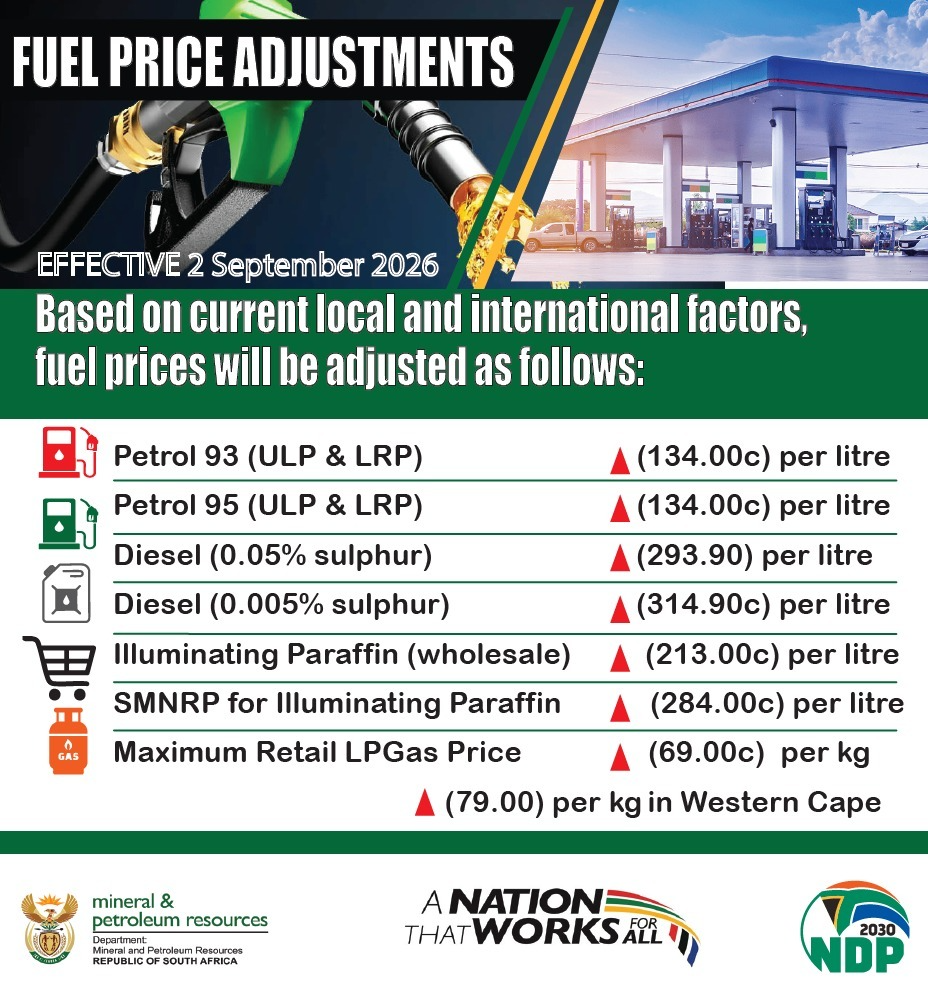
South Africa: DMRE Announces Fuel Price Hikes for September 2026
Summary
- South Africa will implement significant fuel price adjustments, including increases for petrol, diesel, and illuminating paraffin, effective September 2, 2026.
- International factors such as rising Brent Crude oil prices, geopolitical tensions, and supply shortages due to the Russia/Ukraine conflict are primary drivers of the increases.
- A strengthening Rand partially offset these international pressures, reducing the Basic Fuel Price contributions for petrol, diesel, and illuminating paraffin.
- The slate levy for petrol and diesel will increase by 21.90 c/l to 83.28 c/l, addressing a R9.519 billion negative balance.
- Petrol prices will also see an additional 4.9 c/l increase to accommodate forecourt employee wage adjustments stemming from the August 2025 MIBCO agreement.
Overview of September 2026 Fuel Price Adjustments
Compliance officers and legal counsel within these industries should pay close attention to the Department of Mineral and Petroleum Resources fuel price announcement 2026.
South Africa is set to experience significant fuel price adjustments across various categories, effective from September 2, 2026. The Minister of Mineral and Petroleum Resources announced these changes, which are part of the country's monthly review process, influenced by a combination of international market dynamics and domestic economic factors. These adjustments are poised to impact the operational costs for businesses and consumers nationwide.
The forthcoming changes reflect a complex interplay of global supply and demand, geopolitical events, and the local currency's performance against major international currencies. The announcement highlights the ongoing volatility in the energy sector, necessitating continuous monitoring by industries heavily reliant on fuel for their operations.
The specific fuel price schedule for different Magisterial District Zones (MDZ) is expected to be published on the same day the adjustments take effect, September 2, 2026. This detailed breakdown will provide the final figures for various regions, allowing for precise financial planning and budgeting.
Driving Factors Behind the Changes
Several key factors contributed to the impending fuel price increases. Internationally, the average price of Brent Crude oil saw an uptick, climbing from 82.37 US Dollars (USD) to 87.85 USD during the review period. This surge is attributed to heightened tensions between the US and Iran, persistent uncertainty surrounding oil flow through the critical Strait of Hormuz, and an increase in global shipping costs.
Furthermore, international product prices for petrol, diesel, and illuminating paraffin also rose. This was primarily due to supply shortages exacerbated by the ongoing conflict between Russia and Ukraine, coupled with a reduction in global product inventories. These international pressures collectively led to substantial increases in the Basic Fuel Prices (BFP), contributing an additional 127.79 cents per litre (c/l) for petrol, 321.29 c/l for diesel, and 239.06 c/l for illuminating paraffin. Prices for Propane and Butane also experienced an increase during this period.
Conversely, a strengthening Rand offered some mitigation against these international price hikes. The South African Rand appreciated on average against the US Dollar, moving from 16.46 to 16.26 Rand per USD. This currency appreciation resulted in a lower contribution to the Basic Fuel Prices, reducing petrol by 21.07 c/l, diesel by 29.06 c/l, and illuminating paraffin by 26.69 c/l.
Specific Levies and Regulatory Impacts
Beyond market forces, specific levies and regulatory decisions are also shaping the September 2026 fuel price adjustments. A significant development is the increase in the slate levy for both petrol and diesel. This levy, which is part of the Self-Adjusting Slate Levy Mechanism, will be implemented at 83.28 c/l, marking an increase of 21.90 c/l from its previous rate of 61.38 c/l. This adjustment is a direct response to a cumulative negative slate balance that reached R9.519 billion for petrol and diesel by the end of July 2026.
Another notable change impacting the South Africa fuel price is a 4.9 c/l increase specifically for petrol. This adjustment, approved by the Minister of Mineral and Petroleum Resources, is designed to accommodate a wage increase for forecourt employees. It aligns with the Motor Industry Bargaining Council (MIBCO) multi-year Wage Settlement Agreement, which was signed on August 23, 2025, and sees the petrol price structure move from 315.1 c/l to 320.0 c/l.
Additionally, new pricing structures have been set for LPGas imported through the Port of Saldanha Bay. The Maximum Refinery Gate Price (MRGP) for LPGas will be R1516.309 per metric ton, while the Maximum Retail Price (MRP) will be R36.60 per kilogram, both effective from September 2, 2026.
Broader Economic Implications
The upcoming ZA petrol diesel price adjustment in September 2026 carries substantial implications for various sectors of the South African economy. Businesses operating in transport, logistics, and manufacturing, which are heavily reliant on fuel, will need to carefully assess these increases. The higher slate levy and the MIBCO-related adjustments, alongside the general rise in Basic Fuel Prices South Africa, will directly impact operational costs and could necessitate adjustments to pricing strategies and supply chain agreements.
Compliance officers and legal counsel within these industries should pay close attention to the Department of Mineral and Petroleum Resources fuel price announcement 2026. Understanding the specifics of these changes, particularly the South Africa slate levy increase and the MIBCO wage settlement fuel price component, is crucial for ensuring regulatory compliance and mitigating financial risks. The overall impact of these adjustments on inflation and consumer spending will be a key economic indicator in the coming months, underscoring the importance of these monthly fuel price reviews.
Practical Implications
Compliance officers and legal counsel for businesses heavily reliant on fuel (e.g., transport, logistics, manufacturing) should note the September 2026 fuel price increases, particularly the higher slate levy and MIBCO-related adjustments, to assess impacts on operational costs, supply chain agreements, and pricing strategies.
Source
How does this affect you?
Get an AI analysis of this article grounded in your jurisdictions, practice areas, and any policy documents you've uploaded to Wansom.
Finish Reading the Full Story and the Expert Analysis.
Wansom is AI and can make mistakes.