
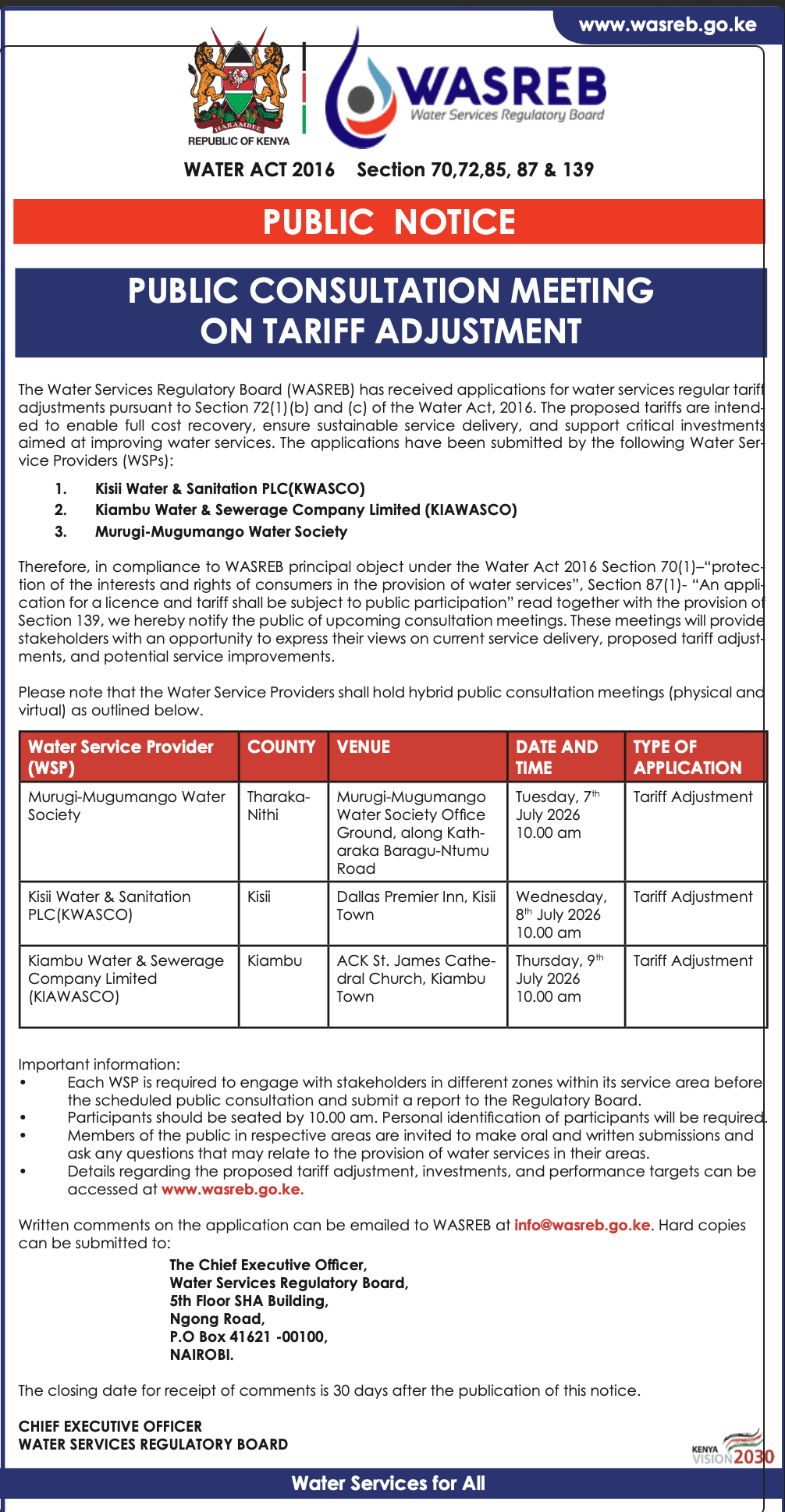
PUBLIC CONSULTATION MEETING ON TARIFF ADJUSTMENT FOR 3.NO WSPS: Kisii Water & Sanitation PLC(KWASCO), Kiambu Water & Sewerage Company Limited (KIAWASCO), Murugi-Mugumango Water Society
Summary
- WASREB conducted public consultations regarding proposed water tariff adjustments.
- The consultation specifically concerned Kisii Water & Sanitation PLC (KWASCO), Kiambu Water & Sewerage Company Limited (KIAWASCO), and Murugi-Mugumango Water Society.
- This process is a key part of WASREB's regulatory mandate to ensure sustainable and affordable water services.
- Public input was crucial for balancing the operational needs of water providers with consumer affordability.
- The consultation aimed to foster transparency and accountability in water tariff setting.
Upcoming Consultations on Water Tariffs
The public consultation meeting served as a direct forum for consumers, community representatives, and other interested parties to engage with the regulatory body and the respective WSPs.
The Water Services Regulatory Board (WASREB) conducted a crucial public consultation process concerning proposed water tariff adjustments for three distinct Water Service Providers (WSPs). This engagement underscored WASREB's commitment to transparent regulatory oversight within the water sector, inviting stakeholders and the general public to contribute their perspectives on the financial frameworks governing water services.
Specifically, the WASREB water tariff adjustment consultation addressed the operational and financial needs of Kisii Water & Sanitation PLC (KWASCO), Kiambu Water & Sewerage Company Limited (KIAWASCO), and the Murugi-Mugumango Water Society. These recent consultations are a standard yet vital component of the regulatory cycle, ensuring that any changes to water tariffs are thoroughly vetted and reflect a balance between service sustainability and consumer affordability.
The public consultation meeting served as a direct forum for consumers, community representatives, and other interested parties to engage with the regulatory body and the respective WSPs. It provided an opportunity to scrutinize the rationale behind the proposed adjustments and to voice concerns or support, thereby shaping the final decisions on water pricing for these specific service areas.
WASREB's Mandate in Tariff Setting
As the independent regulator for water services in Kenya, WASREB is tasked with ensuring the efficient and sustainable provision of water and sewerage services. A core part of this mandate involves the review and approval of water tariffs proposed by WSPs. These tariffs are critical for enabling water companies to cover their operational costs, maintain existing infrastructure, and invest in necessary upgrades and expansions to improve service quality and reach.
WASREB's regulatory framework dictates that any proposed tariff adjustments must undergo a rigorous evaluation process. This includes assessing the WSP's financial health, operational efficiency, and investment plans, alongside the socio-economic context of the service area. The public consultation meeting is a legally enshrined step in this process, designed to gather diverse input before a final determination is made, ensuring that decisions are informed by the realities faced by both providers and consumers.
The board's role extends beyond mere approval; it also involves setting performance standards for WSPs, monitoring their adherence, and promoting consumer protection. The recent WASREB water tariff adjustment consultation for KWASCO, KIAWASCO, and Murugi-Mugumango Water Society was a direct application of these responsibilities, aiming to strike an equitable balance that supports the long-term viability of water services while safeguarding public interest.
The Significance of Public Participation
The involvement of the public in the tariff adjustment process is paramount for several reasons. Firstly, it fostered transparency and accountability, allowing consumers to understand the factors influencing the cost of water and to hold their service providers and the regulator accountable for their decisions. This open dialogue helped to build trust between WSPs, WASREB, and the communities they serve.
Secondly, public input provided invaluable local context that might not be fully captured in financial reports alone. Residents can highlight specific challenges related to water access, quality, or affordability in their areas, ensuring that the final tariff structure is sensitive to local conditions and socio-economic realities. This participatory approach is fundamental to democratic governance and effective regulation.
Ultimately, the WASREB water tariff adjustment consultation was not just a procedural step but a cornerstone of good governance in the water sector. By actively engaging with the communities served by Kisii Water & Sanitation PLC, Kiambu Water & Sewerage Company Limited, and Murugi-Mugumango Water Society, WASREB aimed to arrive at tariff decisions that are fair, sustainable, and conducive to the continuous improvement of water services for all.
Source
How does this affect your business?
Get an AI analysis of this article grounded in your jurisdictions, practice areas, and any policy documents you've uploaded to Wansom.
Wansom is AI and can make mistakes.