
Niger and Mali: How the Sahel Is Renegotiating Its Mining Deals
Development | What is confirmed | Why it matters |
|---|---|---|
Niger’s Madaouela uranium project | A mining convention signed on September 23, 2026, establishes a 40% state interest and 60% for Atomic Eagle, which retains operational control. | Niger has negotiated a larger ownership position while creating a framework for the project’s potential revival. |
Madaouela arbitration | The convention triggers steps to discontinue the dispute, rather than proving that the proceedings have already been formally terminated. | The agreement may reduce a major legal obstacle, but the project still needs financing and further technical work. |
Dasa uranium project | The US Development Finance Corporation approved a debt facility of up to US$414.2 million, subject to material conditions. | The approval signals potential investor interest, but it is not proof that the financing has closed or been disbursed. |
Mali’s Mining Code | The 2023 framework allows state and local participation in eligible new projects to reach a combined 35%, subject to the code’s terms. | The government has a stronger mechanism for securing equity and economic benefits from mineral development. |
Barrick’s Loulo-Gounkoto complex | A collective bargaining agreement with mine unions helped avert the planned late-September strike. | It addresses an immediate labour dispute, not the wider question of mining ownership or state revenue. |
Niger: A negotiated settlement gives the state 40% of Madaouela
On September 23, 2026, Niger and Madaouela Mining Company SA (MAMICO), associated with Australian-listed Atomic Eagle, signed a mining convention establishing a new framework for the Madaouela uranium project. Under the agreement, Niger holds a 40% interest, while Atomic Eagle retains 60% and operational control.
The convention follows a dispute over the project’s mining rights and offers a negotiated route towards restarting development. It also establishes a framework for future financing, uranium offtake arrangements and the legal, fiscal and regulatory conditions under which the project is intended to operate.
The agreement is significant because it combines a larger state interest with a settlement intended to make the project developable again. But it should not be interpreted as evidence that uranium production has resumed.
Why the state’s stake increased
The background goes back to July 2024, when Niger withdrew the Madaouela I exploitation permit from the project’s previous holder, GoviEx Uranium. GoviEx subsequently initiated international arbitration proceedings, arguing that Niger had breached its obligations.
The dispute was suspended in January 2025 while negotiations continued. GoviEx later merged with Tombador Iron to form Atomic Eagle in November 2025.
In August 2026, Niger approved the reallocation of the permit to MAMICO. The September convention then formalised the new arrangement.
There is a discrepancy in published accounts of the previous ownership structure. Niger’s national news agency reported that the state’s previous interest was 10%, while Reuters described the new 40% stake as a doubling from 20%. The figures should not be silently reconciled: the exact comparison depends on which prior ownership arrangement or proposed structure is being referenced. What is clear is that the new convention establishes a 40% state interest.
The change is therefore more than a headline percentage. It forms part of a negotiated resolution to a dispute over control of a strategic mineral asset.
What does Niger’s 40% interest actually mean?
The ownership structure has two distinct components. Atomic Eagle’s project disclosures describe Niger’s interest as a 15% free-carried stake and a further 25% contributing interest.
A free-carried interest generally means that the state receives its agreed ownership share without having to fund its corresponding share of specified project costs during the relevant carried period or under the relevant contractual terms. A contributing interest, by contrast, normally requires the shareholder to fund its share of applicable costs to maintain its economic position.
This distinction matters because a 40% equity stake does not necessarily mean that Niger must finance 40% of every development cost, nor does it mean that all 40% is free to the state. The specific funding obligations, timing and protections are governed by the agreement.
Reuters reported that Atomic Eagle had agreed to cover up to US$40 million of Niger’s future funding commitments. That is a company-related funding arrangement reported by Reuters, not evidence that all future state obligations have disappeared.
The convention also provides for an initial US$10 million payment to the state, according to Niger’s national news agency. More detailed reporting describes staged payments linked to milestones. The distinction matters when assessing timing: an announced payment obligation should not automatically be described as money already received.
Beyond equity and payments, the convention includes commitments concerning local development and the capacity of Niger’s mining administration.
The right to market uranium adds another dimension
Ownership is only one way a government can participate in a mining project. The terms reported for Madaouela also give Niger rights to purchase and market a portion of output corresponding to its shareholding, subject to the convention’s provisions and existing contractual commitments.
Such rights can matter because uranium production is not commercially useful to a producer simply because it owns a mine. It must also be sold, transported and delivered under contracts that satisfy buyers’ technical, regulatory and commercial requirements.
The right to market part of the output could give Niger a more direct role in the commercial chain. However, the precise value of that right depends on the final production profile, pricing arrangements, sales contracts, logistics and the extent to which existing offtake agreements constrain available volumes.
It would therefore be premature to calculate a guaranteed revenue stream from the marketing rights alone. No production from the revived project should be assumed until development and financing milestones have been reached.
What happens to the arbitration?
The new convention is intended to resolve the dispute, but the legal sequence must be described accurately.
World Nuclear News reported that the agreement triggers the process for discontinuing the arbitration proceedings. Atomic Eagle must take the required steps to discontinue the case. This is not the same as independently confirming that the tribunal has formally closed the proceedings.
The distinction matters for investors because a signed settlement can reduce uncertainty while legal and administrative implementation remains outstanding. The agreement’s effectiveness, permit status, fiscal stabilisation provisions and long-term tenure are important steps, but the full resolution should be judged by whether the parties complete the required actions.
Madaouela remains a development project
Atomic Eagle reports a historical resource estimate of 116.5 million pounds of uranium oxide (U₃O₈), comprising 96.9 million pounds in the measured and indicated categories and 19.6 million pounds inferred.
That figure requires an important qualification. The estimate was prepared by the project’s previous holder under Canada’s NI 43-101 reporting framework and is treated as a “foreign estimate” for Australian reporting purposes. Atomic Eagle says it is working to convert the estimate into a JORC-compliant mineral resource, with the work expected towards the end of 2026.
A resource estimate is not the same as a reserve, a final investment decision or proof that the deposit can be developed profitably under current conditions. Further technical work, financing, environmental approvals and a viable development strategy remain relevant.
Reuters reported that Atomic Eagle planned to update feasibility studies, secure environmental approvals and arrange financing over the following two years, with the aim of bringing Madaouela back to construction-ready status.
The key test: whether the new ownership and legal arrangements can be translated into a financeable project with credible development milestones.
Niger’s Dasa project: A separate signal of financing interest
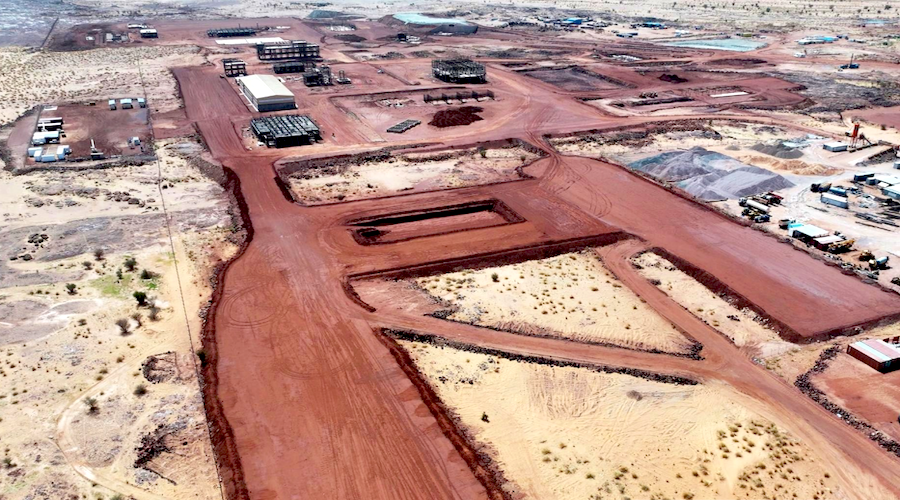
Madaouela is not the only uranium project drawing attention in Niger. On September 16, 2026, Global Atomic announced that the board of the US Development Finance Corporation (DFC) had approved a debt facility of up to US$414.2 million for its separate Dasa uranium project.
The announcement is significant because DFC financing can help support a large project that needs substantial upfront capital. It also suggests that Niger’s uranium sector remains relevant to international supply-chain and energy-security interests despite political and security risks.
But the approval is conditional.
Global Atomic’s announcement says the facility remains subject to material conditions, including a viable export route for uranium concentrate, satisfactory extensions of the project’s mining convention and permit, assurances concerning government approvals for loan repayments, a direct agreement with Niger’s government, and definitive financing documents.
The company explicitly cautioned that there was no assurance the conditions would be resolved in a timely manner, or at all.
The distinction between approval and disbursement is essential. The US$414.2 million is the maximum facility approved by the DFC board, not proof that the entire amount has been contracted, drawn down or invested in construction.
Dasa and Madaouela are also separate projects, with different developers, contractual arrangements and financing pathways. DFC’s decision on Dasa should not be treated as financing for Madaouela or as a guarantee that Madaouela will secure comparable support.
The two announcements nevertheless point to a broader issue: the state can negotiate a larger share of a mineral project, but development still depends on capital, infrastructure, export logistics, permitting and credible commercial arrangements.
Mali: The Mining Code changes the rules for participation
Mali’s approach is broader than Niger’s project-specific settlement. Its 2023 Mining Code, followed by an implementing decree in July 2024, strengthened the framework for state and local participation in new mining projects.
According to the United Nations Conference on Trade and Development (UNCTAD), the code allows the government to take a 10% stake and gives it the option to acquire an additional 20% within the first two years of commercial production. Local stakeholders may acquire a further 5%.
Taken together, these provisions can bring state and private Malian interests to as much as 35% in new projects, compared with up to 20% under the previous framework.
Why the 35% figure needs careful interpretation
It is inaccurate to say that Mali automatically owns 35% of every mine.
The 35% figure combines several possible interests: the state’s initial stake, the state’s option to acquire additional equity, and the potential interest for local stakeholders. The final ownership structure depends on the applicable legal and contractual arrangements and whether the additional interests are taken up.
The distinction between state ownership and local participation also matters. Equity held by local stakeholders is not necessarily equity owned by the central government, and neither category should be confused with tax, royalties or other payments to the state.
The code’s impact on existing operations must also be assessed carefully. A change in general mining legislation does not, by itself, prove that every existing mine has automatically been transferred to the new ownership structure. The applicable permit, contractual terms, transitional provisions and any subsequent agreement need to be examined.
The International Monetary Fund has reported that Malian authorities expected the new framework to generate additional fiscal revenue, while also noting possible governance and transparency risks associated with greater public-sector ownership. That is an expectation about the framework’s potential, not evidence that the forecast revenue has already been collected.
Equity is only one part of the reform
The 2023 code and its implementing decree also address permit allocation, changes in control, local hiring, procurement and other aspects of mining governance.
These provisions reflect a wider policy objective: increasing the share of mining-sector economic activity that benefits Mali, rather than relying solely on the taxes and royalties generated by foreign-operated mines.
But the outcomes will depend on implementation. Local procurement rules have limited effect if domestic suppliers cannot meet the required standards or volumes. Higher equity participation may increase future dividends, but it can also create funding obligations and governance challenges. And the fiscal impact depends on profitability, production, compliance and the details of each project.
For investors, the important questions are therefore not limited to the headline state stake. They include the predictability of the legal regime, how options and obligations are applied, how disputes are resolved and whether the government can administer the framework transparently.
Barrick’s Loulo-Gounkoto agreement: A labour settlement, not an ownership deal
Mali’s wider mining-policy changes have unfolded alongside labour and operational tensions at Barrick Mining’s Loulo-Gounkoto gold complex.
On September 18, Reuters reported that unions representing workers at SOMILO SA and GOUNKOTO SA had issued strike notices. Separate notices involved Food & Events Africa, a catering and support-services contractor, as well as employees of Mali’s mining regulator and other mining-administration agencies.
The reported demands included overtime pay, reimbursement of mission expenses and implementation of labour agreements. The mining-administration notices also concerned unpaid salaries, allowances and sector-related bonuses.
The potential disruption was significant because Loulo-Gounkoto is one of Mali’s major gold-producing complexes. Reuters reported that production had resumed after the earlier dispute between Barrick and the state, but the recovery was gradual; the complex produced approximately 190,000 ounces in the first half of 2026, below pre-dispute levels.
What the September agreement resolved
On September 27, Reuters reported that Barrick had signed a new collective bargaining agreement with unions representing workers at Loulo-Gounkoto. A union official confirmed that the planned strike had been called off following a meeting on September 21.
The agreement addressed the immediate labour dispute involving the mine workforce and related companies, including SOMILO SA, GOUNKOTO SA and Food & Events Africa.
This is a meaningful operational development. Averted strike action can reduce the risk of lost production, disruption to contractors and additional costs associated with labour conflict.
However, the agreement should not be described as a new mining ownership arrangement. It is a collective bargaining agreement, not evidence that the government increased its equity in Loulo-Gounkoto or that Barrick accepted a new ownership split under the 2023 Mining Code.
Nor should the mine agreement automatically be treated as proof that every separate labour dispute across Mali’s mining administration was resolved. Reuters reported a union official’s statement that the other strike actions had also been called off, but independent confirmation of each separate dispute’s final resolution was not established in the reporting reviewed.
That distinction matters because the issues facing mine workers, support contractors and public mining officials are not necessarily identical. They involve different employers, obligations and negotiating processes.
Why labour stability matters to the mining outlook
Mining investment depends not only on the ownership structure and fiscal terms but also on the ability to operate reliably.
Labour agreements can help stabilise production by clarifying pay, allowances, working conditions and the implementation of existing commitments. Conversely, unresolved disputes can delay production, increase operating costs and weaken confidence among suppliers and investors.
Mali’s experience illustrates that a more assertive state role in mining does not eliminate the need for effective industrial relations. A government can seek a larger share of mineral revenues while companies must still maintain workable relationships with employees and contractors.
The labour agreement should therefore be understood as a separate but related component of mining-sector stability, not as proof that the broader tensions around the distribution of mining wealth have disappeared.
Niger and Mali: Two approaches to a similar question
The two countries are often grouped together because both are seeking greater national benefit from mineral resources. But their mechanisms differ.
Issue | Niger: Madaouela | Mali: Mining framework and Loulo-Gounkoto |
|---|---|---|
Main mechanism | Negotiated mining convention following a permit dispute and arbitration | Mining Code reform, alongside separate project and labour negotiations |
Ownership | 40% state interest and 60% Atomic Eagle interest at Madaouela | State and local interests in new projects can reach a combined 35%, subject to the code |
Legal position | Convention triggers steps to discontinue arbitration | The code establishes participation rules, but application depends on the relevant project and legal arrangements |
Commercial challenge | Convert the settlement into financing, permits, technical readiness and eventual development | Apply the legal framework predictably while sustaining investment, production and local participation |
Labour relations | The cited Madaouela agreement primarily concerns project rights and development | A separate collective bargaining agreement helped avert strike action at Loulo-Gounkoto |
Main uncertainty | Whether the project can reach a financeable and construction-ready stage | Whether the framework delivers expected revenues and local benefits without creating avoidable operational and governance risks |
The comparison reveals a common policy ambition but not an identical model. Niger’s agreement resolves a specific dispute and defines participation in a particular uranium project. Mali’s code establishes a broader framework for participation in eligible new projects, while its labour negotiations address immediate workplace disputes.
Both cases also show why a larger state share should not be treated as a complete measure of national benefit. The ultimate outcome depends on whether a project produces, earns revenue, pays its obligations, creates sustainable jobs and supports local economic activity.
What investors and policymakers should watch next
1. Implementation of the Madaouela convention. The next evidence should include confirmation of the required arbitration steps, the status of the exploitation permit and completion of the convention’s payment obligations.
2. Madaouela’s technical and financing milestones. A JORC-compliant resource, updated feasibility work, environmental approvals and a credible financing plan would provide stronger evidence of development progress than the signing ceremony alone.
3. The conditions attached to DFC financing for Dasa. A viable export route, satisfactory permit and convention extensions, definitive loan documentation and satisfaction of the conditions precedent will determine whether the approved facility reaches financial close and disbursement.
4. Mali’s application of the 2023 Mining Code. Investors and local stakeholders should watch how the government exercises its equity options, how local participation is structured and how the rules interact with existing mining titles and agreements.
5. Evidence of actual fiscal gains. Higher potential state ownership does not automatically translate into immediate public revenue. Production, profitability, dividends, taxes and royalties will determine the realised benefit.
6. Labour relations and operational recovery. The Barrick agreement is a positive step for labour stability, but the longer-term test is whether the parties implement the agreement and whether production can recover sustainably.
7. Security and export logistics. Niger’s uranium projects remain exposed to the practical challenges of moving product from a landlocked country and operating in a difficult security environment. Financing and ownership agreements cannot substitute for workable transport routes and secure operations.
Conclusion: Renegotiation is the beginning, not the outcome
Niger’s 40% stake in Madaouela and Mali’s revised participation framework reflect a broader effort to capture more value from strategic mineral resources. Both approaches can strengthen the state’s role in the mining economy, but neither guarantees that the intended benefits will be realised.
In Niger, the immediate test is whether the Madaouela settlement can move from a legal and commercial agreement to a financed development project. Dasa’s conditional DFC facility offers a separate indication of potential financing interest, but its conditions remain material.
In Mali, the challenge is to translate a stronger legal framework into predictable rules, realised public revenue and tangible local benefits. The Barrick labour agreement demonstrates the importance of resolving operational disputes, but it does not settle the wider questions of ownership, taxation or the distribution of mining wealth.
The central lesson is that renegotiating a mining deal is only one stage of resource governance. The lasting test is whether the resulting terms support viable projects, transparent public revenue, local economic participation and stable operations.
Citations
- 1.Niger — Madaouela uranium project
- 2.Agence Nigérienne de Presse — Niger raises its participation in Madaouela to 40% — Government-reported terms of the September 23 convention, including the ownership structure and initial payment.
- 3.World Nuclear News — Agreement clears way for resumption of Niger uranium project — Convention, legal framework, arbitration process and project status.
- 4.Atomic Eagle — Madaouela Uranium Project — Company disclosures on ownership, resource estimates and planned technical work.
- 5.Reuters via Kitco — Atomic Eagle expects renewed financing interest in Niger after uranium deal — Funding obligations, project plans and the wider investment context.
- 6.Engineering News — Niger uranium project agreement reached — Reported commercial terms, including production-marketing rights and payment milestones.
- 7.Niger — Dasa and DFC financing
- 8.Global Atomic — Dasa uranium project financing update, September 16, 2026 — The company’s announcement of the DFC board approval, maximum facility amount and material conditions.
- 9.Mali — Mining Code and participation
- 10.UNCTAD — Mali adopts new Mining Code and implementing decree — Overview of the 2023 code and the possible state and local equity interests.
- 11.IMF — Mali country report — Analysis of the participation framework, fiscal expectations and potential governance considerations.
- 12.Mali — Barrick and labour relations
- 13.Reuters — Multiple unions threaten strikes at Barrick’s flagship Mali gold mine — Initial strike notices, affected worker groups and reported demands.
- 14.Reuters — Barrick reaches deal with unions at Mali gold mine, easing strike threat — Confirmation of the collective bargaining agreement and cancellation of planned strike action.
Finish Reading the Full Story and Expert Analysis.
Get the latest legal & regulatory intelligence in Niger
Wansom is AI and can make mistakes.