
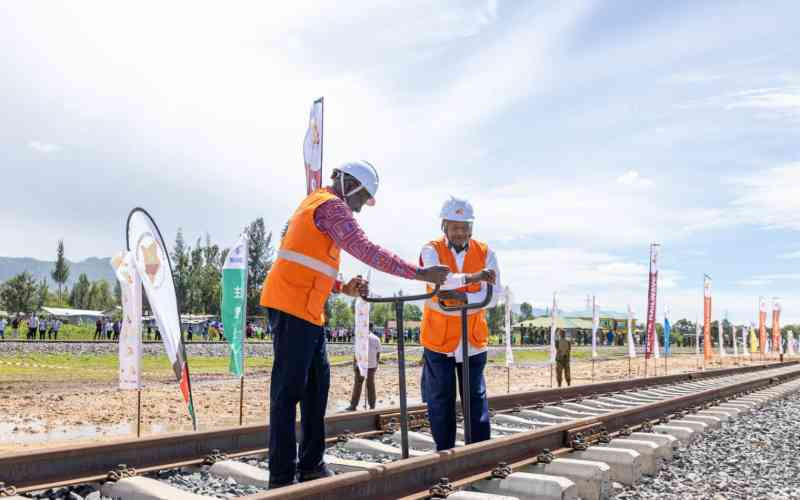
Kenya Railways MD Phillip Mainga Faces Court Over SGR Contracts Audit
Summary
- A court battle has erupted over Kenya Railways operations, with the petitioner seeking to push out Managing Director Phillip Mainga.
- Mainga was appointed on permanent terms in 2018, contrary to state corporations' hiring practices.
- The Standard Gauge Railway (SGR) project has been at the center of public debate over procurement practices and transparency.
- Transparency International indicated that SGR had a 4.49 out of 5 corruption risk score, making it a high-risk project.
Court Battle Erupts Over Kenya Railways Operations
A court case has been filed against the Managing Director of Kenya Railways, Phillip Mainga, and the corporation's board. The petitioner claims that Mainga was appointed on permanent terms in 2018, which is contrary to state corporations' hiring practices. According to the petitioner, Mainga's tenure should have lapsed in 2024, but he remains in office. This has raised concerns about transparency and accountability in the management of major projects undertaken by the corporation.
The Standard Gauge Railway (SGR) project has been at the center of public debate over procurement practices, transparency, and debt sustainability. Transparency International this year indicated that SGR had a 4.49 out of 5 corruption risk score, making it a high-risk project.
The petitioner argues that the people of Kenya have a legitimate constitutional interest in how the project was conceived, procured, financed, and implemented. He claims that public institutions, including KR, repeatedly failed to provide information requested by accountability actors and researchers.
Relevant Legal and Regulatory Context
The petitioner's case is based on the Kenyan Constitution, which requires state corporations to hire their bosses on short-term contracts. The office of the Managing Director is not meant to be occupied indefinitely, according to prevailing governance principles applicable to state corporations.
The petitioner also cites Transparency International's assessment, which concluded that public institutions failed to provide sufficient information for effective public oversight. This has raised concerns about the adequacy of procurement procedures, transparency of contractual arrangements, and disclosure of project costs.
The case may set a precedent for future audits and reviews of major projects undertaken by parastatals in Kenya.
Why It Matters
The outcome of this court case may have significant implications for the management of state corporations in Kenya. Lawyers and compliance officers should watch for the potential implications on procurement procedures, transparency, and accountability.
If the petitioner's claims are upheld, it could lead to a re-evaluation of how major projects are managed by parastatals in Kenya. This may also set a precedent for future audits and reviews of such projects.
The case highlights the need for greater transparency and accountability in the management of state corporations and their major projects.
Practical Implications
Lawyers and compliance officers should watch for the potential implications of this court case on the management of state corporations in Kenya, particularly with regards to procurement procedures, transparency, and accountability. The outcome may set a precedent for future audits and reviews of major projects undertaken by parastatals.
Source
How does this affect your business?
Get an AI analysis of this article grounded in your jurisdictions, practice areas, and any policy documents you've uploaded to Wansom.
Wansom is AI and can make mistakes.