
India lacks a Court system that supports Arbitration: Justice Badar Durrez Ahmed
Abstract
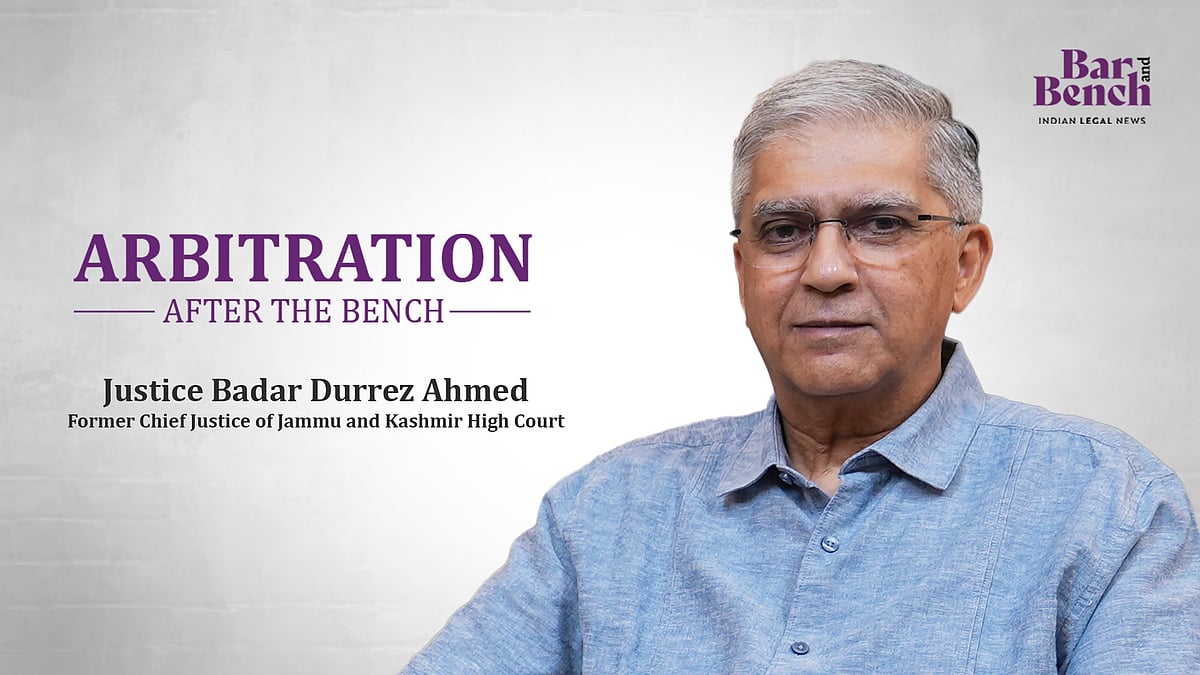
Justice Badar Durrez Ahmed, a former Delhi High Court judge and now a prominent arbitrator, has sharply criticised India's court system for undermining the efficacy of arbitration. He contends that Section 34 petitions, intended for limited challenges to arbitral awards, have effectively become a "disguised second appeal" due to the Supreme Court's emphasis on detailed reasoning, which compels High Courts to re-examine awards on their merits. This judicial overreach, he argues, runs contrary to the legislative intent of promoting arbitration as an expeditious and final dispute resolution mechanism. Furthermore, Justice Ahmed expressed concerns regarding the composition of the proposed Arbitration Council of India, highlighting potential issues of executive interference and compromised autonomy within the arbitration framework.
Introduction
India's ambition to establish itself as a global hub for arbitration faces persistent challenges, not least from within its own judicial system. A recent critique by Justice Badar Durrez Ahmed, a former judge of the Delhi High Court and now a leading arbitrator, has reignited the debate surrounding judicial intervention in arbitral awards. Justice Ahmed, drawing from his extensive experience, particularly in adjudicating Section 34 petitions, asserts that the current court system, rather than supporting arbitration, often impedes its core principles of finality and efficiency.
At the heart of Justice Ahmed's concern is Section 34 of the Arbitration and Conciliation Act, 1996 (the "Act"), which he describes as functioning in practice as a "disguised second appeal." This observation points to a fundamental disconnect between the legislative intent of providing limited grounds for challenging an arbitral award and the judicial appetite for detailed scrutiny, which often leads to a re-evaluation of the merits of the award. This article will delve into Justice Ahmed's criticisms, examine the statutory framework and its judicial interpretation, and explore the broader implications for the future of arbitration in India, including the role of the proposed Arbitration Council of India.
Background
The Arbitration and Conciliation Act, 1996, was enacted to consolidate and amend the law relating to domestic arbitration, international commercial arbitration, and enforcement of foreign arbitral awards, largely based on the UNCITRAL Model Law on International Commercial Arbitration. A cornerstone of this framework is Section 34, which provides the exclusive recourse to a court against an arbitral award. The legislative intent behind Section 34 was to limit judicial intervention to specific, narrowly defined grounds, thereby upholding the finality and expeditious nature of arbitration.
Prior to significant amendments, the interpretation of grounds under Section 34, particularly "public policy of India," had been broad, leading to concerns about excessive judicial interference. The Arbitration and Conciliation (Amendment) Act, 2015, sought to address this by narrowing the scope of "public policy" and introducing "patent illegality" as a ground for setting aside domestic awards, explicitly stating that an award shall not be set aside merely on the ground of an erroneous application of law or by re-appreciation of evidence. This amendment aimed to reinforce the pro-arbitration stance and minimise judicial review on the merits. Further amendments in 2019 introduced the concept of the Arbitration Council of India (ACI) to promote institutional arbitration and accredit arbitrators, though its implementation and composition have drawn criticism.
Analysis
Justice Badar Durrez Ahmed's assertion that Section 34 has become a "disguised second appeal" directly challenges the effectiveness of the 2015 amendments designed to curtail judicial intervention. He points out that the Supreme Court's demand for detailed reasoning has inadvertently pushed High Court judges to scrutinise arbitral awards on an issue-by-issue basis, irrespective of the merits, effectively transforming a summary review into a full-fledged appellate process. This practice undermines the principle that courts, when reviewing awards under Section 34, do not act as appellate courts.
Indeed, landmark Supreme Court judgments, such as *Associate Builders v. Delhi Development Authority* (2015) and *Ssangyong Engineering and Construction Co. Ltd. v. National Highways Authority of India* (2019), have consistently reiterated the limited scope of Section 34, emphasising that courts should not re-appreciate evidence or delve into the merits of the dispute. The *Associate Builders* case, in particular, clarified the contours of "public policy" and "patent illegality," stressing that an award could only be set aside for reasons that shock the conscience of the court or demonstrate perversity. Similarly, in *Vijay Karia v. Prysmian Cavi E Sistemi S.R.L.* (2020), the Supreme Court underscored the narrow interpretation of "public policy" in the context of enforcing foreign awards, a principle that also informs Section 34 challenges for international commercial arbitrations seated in India.
However, the practical application, as highlighted by Justice Ahmed, often deviates from these pronouncements. The inherent tension between legislative intent for minimal intervention and judicial inclination for detailed scrutiny persists. A recent five-judge Constitution Bench decision in *Gayatri Balasamy v. M/s. ISG Novasoft Technologies Limited* (2025) further addressed the contentious issue of whether courts exercising jurisdiction under Sections 34 and 37 have the power to modify arbitral awards. While affirming that courts generally do not have a broad power to modify awards, the majority held that modification is permissible in "limited circumstances," such as for severable parts or to correct computational, clerical, or typographical errors, but explicitly not for re-appreciating evidence or reviewing merits. This nuanced position, while aiming for efficiency, still leaves room for judicial interpretation and potential intervention.
Another point of criticism from Justice Ahmed concerns the composition of the proposed Arbitration Council of India (ACI), established by the Arbitration and Conciliation (Amendment) Act, 2019. The ACI is tasked with grading arbitral institutions and accrediting arbitrators, aiming to institutionalise arbitration in India. However, critics argue that the significant involvement of the Central Government in appointing its members and determining its functions raises concerns about executive intervention, potential conflicts of interest (especially when the government is a party to arbitration), and a compromise of party autonomy, thereby potentially undermining the independence and credibility of the arbitration process.
Conclusion
Justice Badar Durrez Ahmed's candid remarks serve as a critical reminder that despite legislative efforts to foster an arbitration-friendly environment, the practical realities within the Indian court system continue to pose significant hurdles. The transformation of Section 34 petitions into a "disguised second appeal" not only prolongs disputes but also erodes the fundamental advantages of arbitration: speed, cost-effectiveness, and finality. For practitioners, this implies a continued need for meticulous drafting of arbitration clauses and awards, anticipating potential judicial scrutiny that may extend beyond the statutorily defined limited grounds.
Looking ahead, the legal fraternity must closely monitor how the Supreme Court's pronouncements on the limited power to modify awards are applied by High Courts, ensuring that this does not become another avenue for re-litigation. Furthermore, the operationalisation and functioning of the Arbitration Council of India will be crucial. Its ability to foster institutional arbitration without succumbing to executive overreach will be key to building confidence among domestic and international parties. Ultimately, achieving India's vision as a global arbitration hub requires a concerted effort from both the legislature and the judiciary to align practice with principle, ensuring that arbitration remains a truly independent and efficient mechanism for dispute resolution.
Citations
- 1.Arbitration and Conciliation Act, 1996
- 2.Arbitration and Conciliation (Amendment) Act, 2015
- 3.Arbitration and Conciliation (Amendment) Act, 2019
- 4.Associate Builders v. Delhi Development Authority, (2015) 3 SCC 49
- 5.Ssangyong Engineering and Construction Co. Ltd. v. National Highways Authority of India, (2019) 15 SCC 131
- 6.Vijay Karia v. Prysmian Cavi E Sistemi S.R.L., (2020) 11 SCC 1
- 7.S.B.P. & Co. v. Patel Engineering Ltd. & Anr., (2005) 8 SCC 618
- 8.Gayatri Balasamy v. M/s. ISG Novasoft Technologies Limited (2025) (Supreme Court of India, 5-judge Constitution Bench decision, 30 April 2025)
- 9.Project Director, NHAI v. M. Hakeem, (2021) 9 SCC 1