
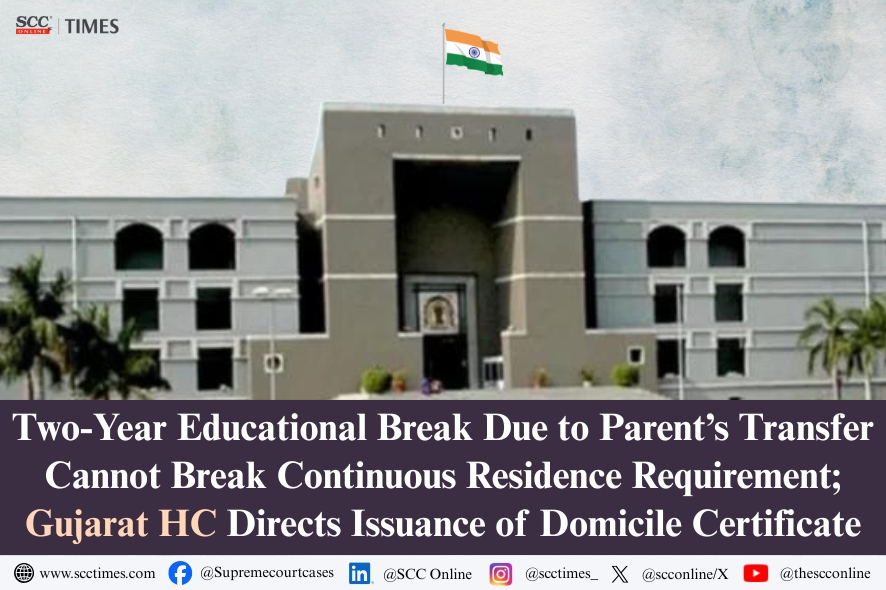
Gujarat High Court: No Mandatory 10-Year Continuous Residence for Domicile Certificate
Summary
- The Gujarat High Court ruled that a two-year educational break due to a parent's transfer does not break continuous residence requirements for obtaining a domicile certificate.
- The court held that the applicable rules do not prescribe a mandatory requirement of 10 years' continuous physical residence.
- Individuals who have been physically present in a state for less than 10 years may still be eligible to obtain a domicile certificate.
- Lawyers should advise their clients on the updated requirements for continuous residence following this ruling.
What Happened
The court held that the applicable rules do not prescribe a mandatory requirement of 10 years' continuous physical residence, and such a condition cannot be introduced or enlarged through executive or administrative instructions.
The Gujarat High Court has issued a ruling that will impact the issuance of domicile certificates in India. In a recent decision, the court clarified that a two-year educational break due to a parent's transfer does not break continuous residence requirements for obtaining a domicile certificate. The court held that the applicable rules do not prescribe a mandatory requirement of 10 years' continuous physical residence, and such a condition cannot be introduced or enlarged through executive or administrative instructions.
The ruling has significant implications for individuals seeking domicile certificates in India. Lawyers should note that this decision may impact their clients who are seeking domicile certificates and advise them on the updated requirements for continuous residence.
Legal Context
The Gujarat High Court's decision is based on existing rules and regulations governing the issuance of domicile certificates in India. The court's ruling emphasizes that the applicable rules do not prescribe a mandatory requirement of 10 years' continuous physical residence, which means that individuals who have been physically present in a state for less than 10 years may still be eligible to obtain a domicile certificate. This decision is likely to impact the issuance of domicile certificates across India and has significant implications for individuals seeking to establish their domicile in a particular state.
Why It Matters
The Gujarat High Court's ruling on continuous residence requirements for domicile certificates has far-reaching implications for individuals, lawyers, and policymakers. The decision highlights the importance of understanding the nuances of domicile certificate requirements and the need for clarity in regulatory frameworks. Lawyers should be aware of this development and advise their clients accordingly to ensure that they meet the updated requirements for continuous residence. This ruling is also likely to impact the issuance of domicile certificates across India and has significant implications for individuals seeking to establish their domicile in a particular state.
Practical Implications
Lawyers should note that this ruling may impact clients seeking domicile certificates, and they should advise clients on the updated requirements for continuous residence.
Source
Source: Original reporting via SCC Times
How does this affect your business?
Get an AI analysis of this article grounded in your jurisdictions, practice areas, and any policy documents you've uploaded to Wansom.
Wansom is AI and can make mistakes.