
Ghana Tightens the Export Proceeds Net: The Revised Letter of Commitment Rules Explained
Summary
The LOC: an ICUMS-generated export document, in place since 2016, that commits exporters to repatriate foreign-currency proceeds through Ghana's banking system. Formal exports cannot leave without it.
Who it covers: exporters who receive proceeds in foreign currency, are resident in Ghana, are licensed by the relevant agencies and hold a valid TIN. Informal cross-border traders are exempt.
Legal basis: the Foreign Exchange Act, 2006 (Act 723), including section 15(4), and BoG Notice No. BG/GOV/SEC/2016/03 on Rules on Repatriation of Export Proceeds, with later notices limiting LOC extensions.
The campaign: sessions for agencies (8 September), banks (9 September), freight forwarders (10 September) and free zone companies (11 September), followed by regional sessions for exporters in the Western and Central regions.
Free zones: the Ministry of Finance's Head of Revenue Assurance says about US$3 billion in export proceeds has been lost through them.
Forwarders: warned not to use clients' credentials without consent to generate LOCs for traders who do not qualify.
Banks' concerns: delays restoring suspended accounts, misuse of LOC numbers, SWIFT payment problems and weak inter-agency coordination.
What the Letter of Commitment Is
The document. A Letter of Commitment (LOC) is an export document generated through Ghana's Integrated Customs Management System (ICUMS) for formal exports of merchandise. It records the exporter's commitment to bring the foreign-currency proceeds of the export back to Ghana through the banking system. Without an LOC alongside the customs declaration, a formal export cannot leave Ghana, whether by sea, air or road.
Why it exists. The Bank of Ghana (BoG) introduced the LOC regime in 2016 to monitor all exports leaving the country and to ensure that export proceeds are repatriated. Each LOC creates a record against which the BoG and the exporter's bank can track whether the foreign currency actually came back.
Who must generate an LOC. Under the BoG's guidelines, an LOC is mandatory only for exporters who meet all of the following conditions:
Condition | Meaning |
|---|---|
Receive proceeds in foreign currency | Exports paid in foreign exchange |
Resident in Ghana | The exporter is a Ghanaian resident entity or person |
Registered and licensed | Licensed by the relevant government agencies for the export activity |
Valid Tax Identification Number | Needed for ICUMS access |
Entities that do not meet all four conditions do not qualify to generate an LOC.
What the revised guidelines emphasise.
Informal cross-border traders are outside the regime. The BoG has clarified that informal cross-border transactions do not require an LOC, and that the LOC should not be included in their documentation.
No borrowed credentials. Freight forwarders and customs house agents must not use their own Tax Identification Numbers, or clients' credentials without consent, to generate LOCs for traders who do not qualify.
No compulsion of foreign buyers. Customs officers must not compel cross-border buyers from neighbouring countries to generate an LOC.
Limits on extensions. A BoG notice under the Foreign Exchange Act introduced a structured framework to limit the number of extensions granted for LOCs, tightening the time exporters have to bring proceeds home.
Taken together, the revisions narrow the LOC to the exporters it was designed for, and make it harder for anyone to use the system to disguise who the real exporter is.
The Legal Basis
The statute. The LOC regime rests on the Foreign Exchange Act, 2006 (Act 723), which gives the Bank of Ghana authority over foreign exchange transactions, including the repatriation of export proceeds. BoG directives on the LOC cite section 15(4) of the Act as their basis.
The rules. The core instrument is BoG Notice No. BG/GOV/SEC/2016/03, Rules on Repatriation of Export Proceeds, issued when the LOC regime was introduced. Later notices have built on it, including:
Instrument | Effect |
|---|---|
Notice No. BG/GOV/SEC/2016/03 | Rules on repatriation of export proceeds; foundation of the LOC regime |
Notice No. BG/GOV/SEC/2025/34 | Structured framework limiting the number of LOC extensions |
BoG guidelines on cross-border trade and LOC requirements | Define who must generate an LOC; exempt informal cross-border traders; restrict forwarders and agents |
Revised LOC guidelines | The subject of the September 2026 nationwide sensitisation campaign |
How compliance is monitored. Each LOC generated in ICUMS sets up an expected inflow of foreign currency. The exporter's bank receives the proceeds and reports against the LOC. Where proceeds do not arrive within the permitted period, as extended within the new limits, the LOC remains open, and the exporter becomes a defaulter in the system.
Sanctions. Non-compliance has carried consequences since the regime began. At banking-sector sessions, participants referred to suspended accounts and delays in restoring them, a sign that account-level restrictions are among the tools used against defaulters. Exporters have also sought reassurance on the risk of prosecution. The BoG has indicated that it distinguishes deliberate default from genuine inability to repatriate. The Ministry of Finance has likewise called for remedies for legitimate difficulties alongside effective sanctions for deliberate non-compliance.
The September Campaign: Four Audiences, Four Messages
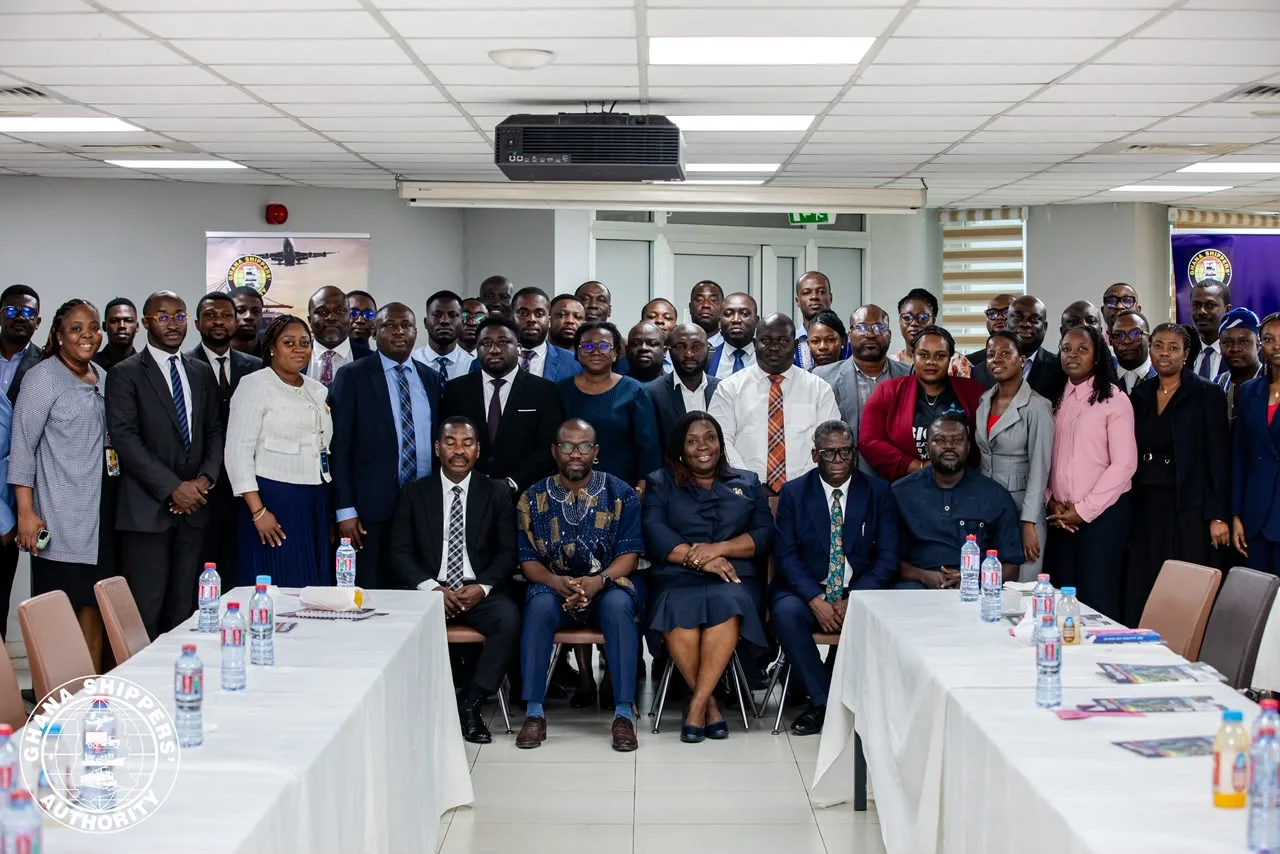
From 8 to 11 September 2026, the Bank of Ghana and the Ghana Shippers' Authority (GSA) ran a sensitisation campaign on the revised guidelines. The first three sessions took place at Shippers' House in Accra; the fourth was held at the Ghana Free Zones Authority (GFZA). Sessions for exporters in the Western and Central regions followed later in September.
Date | Audience | Main focus |
|---|---|---|
8 September | Ministries, departments and agencies: Finance, Transport, Trade, Food and Agriculture, Ghana Export Promotion Authority, GRA Customs, GFZA | Roles of each agency; integrity of trade data in ICUMS |
9 September | Commercial banks, including Zenith, Absa, GCB, Republic, Access, First Bank, National Investment Bank and GT Bank | Practical implementation problems |
10 September | Freight forwarder associations | Misuse of credentials to generate LOCs |
11 September | Free zone enterprises, with the GFZA | Free zone obligations under the LOC regime |
Later in September | Exporters in the Western and Central regions | Regional rollout |
The policy message. Eric Kwaku Hammond, Advisor to the BoG Governor, said concerns about foreign exchange and the repatriation of export proceeds had driven the refinement of the regime. Ghana's currency stability depends heavily on export inflows. In his words: "if the forex does not come in, we shall all bear the brunt."
Free zones in the spotlight. Kofi Baidoo, Head of Revenue Assurance at the Ministry of Finance, said about US$3 billion in export proceeds had been lost through the free zones, money needed to service Ghana's debt. He said the Ministry would enforce the revised requirements, while distinguishing genuine cases where exporters cannot repatriate from deliberate default.
Data integrity. Participants raised concerns about abuse of invoicing platforms and misclassification of goods. Both distort ICUMS trade records, weaken oversight and cost revenue.
Forwarders on notice. The guidelines warn freight forwarders and customs house agents not to use clients' credentials without consent to generate LOCs for traders who do not qualify.
Banks' practical concerns:
Issue | Why it matters |
|---|---|
Delays in restoring suspended accounts | Exporters who regularise can remain cut off, hurting legitimate business |
Misuse of LOC numbers by service providers | Proceeds may be credited against the wrong LOC, or LOCs generated for the wrong parties |
SWIFT payment difficulties | Delays or mismatches in incoming payments make it hard to link proceeds to the right LOC |
Weak coordination among agencies | Customs, banks and the BoG need consistent, timely data for the system to work |
The Trade-Law Analysis
The Trade-Law Analysis
1. Repatriation rules in international law
Requirements to repatriate export proceeds are common in countries managing foreign exchange pressure. In international law they sit primarily in the monetary domain, not the trade domain. GATT Article XV defers to the IMF on exchange matters. Under the IMF's framework, a repatriation requirement is generally viewed as an exchange measure. It becomes more sensitive when it effectively restricts payments for current international transactions, or when it is applied in a discriminatory way. Ghana's LOC regime, which requires proceeds to come home through banks but does not prevent exporters from using them, sits at the less restrictive end of the spectrum, provided extensions and remedies work fairly in practice.
2. Free zones: a regime under pressure across West Africa
Free zones are designed to attract export-oriented investment with fiscal incentives and operational freedom. The Ministry of Finance's figure of about US$3 billion in proceeds lost through Ghana's free zones shows why governments are now applying tighter monitoring. The pattern is regional. In September 2026, Nigeria also moved to tighten its free zone rules, targeting diversion of goods and related-party mispricing. Free zone enterprises in Ghana should expect the LOC regime to be applied to them with the same rigour as to exporters in the customs territory, and their trade data to be scrutinised more closely.
3. Data integrity and customs law
The concerns about invoicing-platform abuse and misclassification link the LOC regime to customs law. An LOC is only as reliable as the declaration it accompanies. Under-invoiced exports, or goods declared under the wrong tariff line, mean that the expected foreign currency is understated from the start. Better data matching between ICUMS, banks and the BoG is therefore as much a customs-compliance issue as a foreign exchange one.
4. Intra-African trade and payments
The exemption for informal cross-border traders recognises that small-scale regional trade often runs in local currencies or cash and cannot realistically be forced into a foreign currency repatriation system. As formal intra-African trade grows under the AfCFTA, regional payment platforms that settle trade in local currencies could reduce reliance on foreign currency for some regional exports, and change how repatriation rules apply to them.
5. Fairness and due process
Account suspensions and potential prosecution are serious consequences. To be fair and legally robust, the regime needs clear criteria for extensions, prompt reinstatement once exporters comply, and a route to show genuine inability to repatriate, such as buyer default or payment-system failures. The banks' concerns about SWIFT problems and LOC-number misuse show how an exporter can appear non-compliant through no fault of its own.
What It Means for Each Stakeholder
Exporters in the customs territory
The obligation: every formal export paid in foreign currency needs an LOC, and the proceeds must come back through the banking system within the permitted period, with fewer extensions available. The risk: open LOCs can lead to account suspension and, in deliberate cases, prosecution. What to do: match each export invoice to its LOC and the incoming payment. Instruct buyers to quote the correct LOC reference on payments, and monitor open LOCs monthly. Where a buyer defaults or a payment is delayed, notify your bank and the BoG early, with evidence.
Free zone enterprises
The change: free zones are now a stated priority, with the Ministry of Finance citing about US$3 billion in lost proceeds. What to do: confirm which of your exports require LOCs, review how proceeds are received and held, and make sure related-party pricing and invoicing reflect real values. Expect closer scrutiny of trade data.
Commercial banks
The role: banks are the channel through which proceeds are received and matched against LOCs. The pain points: delays in restoring suspended accounts, misuse of LOC numbers, SWIFT payment difficulties and weak coordination between agencies. What to do: strengthen processes to match inbound payments to LOCs, flag mismatches quickly, and escalate system issues through the BoG.
Freight forwarders and customs house agents
The warning: using a client's credentials without consent, or your own TIN, to generate LOCs for traders who do not qualify is prohibited. What to do: generate LOCs only for qualifying exporters with documented authority, keep records of client instructions, and train staff on the revised guidelines.
Informal cross-border traders
The clarification: informal cross-border trade does not require an LOC, and LOCs should not be included in such transactions. What to do: do not let agents generate LOCs on your behalf if you do not qualify, since that can create obligations you cannot meet.
Foreign buyers, especially in neighbouring countries
The clarification: customs officers must not compel cross-border buyers from neighbouring countries to generate LOCs. What to do: pay Ghanaian exporters through banks, quoting the LOC reference, so proceeds are matched quickly.
Government agencies (BoG, GRA Customs, GFZA, Ministry of Finance)
The task: coordinated data flows between ICUMS, banks and the BoG, consistent enforcement, and a fair process that separates genuine difficulties from deliberate default.
Lawyers and compliance advisers
The work includes LOC compliance reviews for exporters and free zone firms, responding to account suspensions, structuring sales contracts with clear payment terms, and defending clients where non-repatriation was caused by buyer default or payment-system failures.
What to Watch
Milestone | Why it matters |
|---|---|
Further regional sensitisation sessions | How the revised guidelines are explained to exporters outside Accra |
Enforcement against free zone enterprises | Whether the Ministry of Finance's focus turns into audits, suspensions or prosecutions |
Fixes for banks' operational problems | Faster account reinstatement, better LOC-to-payment matching and SWIFT issues |
Application of extension limits | How strictly the BoG applies the cap on LOC extensions |
Data-integrity measures in ICUMS | Action against invoicing-platform abuse and misclassification |
Frequently Asked Questions
What is a Letter of Commitment in Ghana? An export document generated through ICUMS for formal merchandise exports, recording the exporter's commitment to repatriate the foreign-currency proceeds to Ghana through the banking system.
Who must generate an LOC? Exporters who receive proceeds in foreign currency, are resident in Ghana, are registered and licensed by the relevant agencies, and hold a valid Tax Identification Number.
Do informal cross-border traders need an LOC? No. The Bank of Ghana has clarified that informal cross-border transactions do not require an LOC.
What is the legal basis? The Foreign Exchange Act, 2006 (Act 723), including section 15(4), and BoG Notice No. BG/GOV/SEC/2016/03 on Rules on Repatriation of Export Proceeds, as updated by later notices.
Can freight forwarders generate LOCs for clients? Only for qualifying exporters with their consent. Forwarders must not use clients' credentials without consent, or their own TIN, to generate LOCs for traders who do not qualify.
Why are free zones a focus? The Ministry of Finance says about US$3 billion in export proceeds has been lost through the free zones.
Citations
- 1.• Ghana Shippers' Authority, Bank of Ghana Take Revised LOC Guidelines to Ghana's Trade Sector, Ghana Shippers' Authority (15 September 2026)
- 2.• Letter of Commitment (LOC) archive, Ghana Shippers' Authority
- 3.• Notice on Extension Period for Letter of Commitment – LOC, Bank of Ghana
- 4.• Bank of Ghana issues guidelines on cross-border trade and letter of commitment requirements, 3News
- 5.• Bank of Ghana exempts informal cross-border traders from LOC requirement, Modern Ghana
- 6.• Shippers Authority, Bank of Ghana sensitize exporters on Letter of Commitment requirement, GhanaWeb
Finish Reading the Full Story and Expert Analysis.
Get the latest legal & regulatory intelligence in Ghana
Wansom is AI and can make mistakes.