
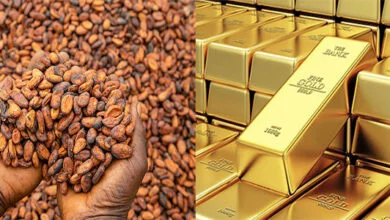
Ghana's Two Pillars of Export: GoldBod Pauses Gold Exports and a New Legal Era for Cocoa
Summary
Gold export pause: GoldBod has paused gold exports since mid-August 2026, the Bank of Ghana Governor said at the opening of the 132nd Monetary Policy Committee on 23 September. It is an operational decision, not a legal change, and no resumption date has been published.
Gold context: gold is about two-thirds of Ghana's exports. Gold reserves fell to 24.4 tonnes in June 2026, large-scale miners must now sell 30% of output to the central bank, and GoldBod's purchases are now financed by commercial banks.
New cocoa law: the Ghana Cocoa Board Act, 2026 (Act 1182), assented to on 26 August, guarantees farmers at least 70% of the realised gross FOB price, reserves at least 50% of beans for local processing, creates domestic financing, and replaces PNDCL 81 of 1984.
2026/27 price: GH¢42,400 per tonne (GH¢2,650 per bag) from 25 September, up about 2.4%, equal to 71.18% of realised gross FOB value.
Freight: the Ghana Shippers' Authority and the Cocoa Marketing Company agreed 2026/27 cocoa freight rates on 24 September.
Trade law: both bodies are state trading enterprises under GATT Article XVII. The 50% processing rule operates as a raw-bean export limit, testable against GATT Articles XI and XX(i).
Gold: GoldBod Pauses Exports
What was disclosed. Opening the Bank of Ghana's 132nd Monetary Policy Committee meeting on 23 September 2026, Governor Dr Johnson Asiama said that the Ghana Gold Board (GoldBod) had paused gold exports since mid-August 2026. He linked the pause to a weaker current account and declining reserves, and said they call for a careful look at Ghana's buffers ahead of the usual rise in foreign exchange demand in the fourth quarter. Rebuilding reserves, he said, would be a key priority for the Bank in the coming months.
Why it matters. Gold is Ghana's largest export, about two-thirds of total exports in January to August 2026, with first-half gold export earnings reported at about US$12.5 billion. A pause by the state gold aggregator changes the timing and size of foreign currency flowing into the economy from the gold it buys.
What GoldBod is. GoldBod is the state body created by the Ghana Gold Board Act, 2025 to centralise the buying and exporting of gold, in particular from small-scale and artisanal mining. It aggregates locally produced gold for export and for reserve accumulation, transferring part of the bullion to the Bank of Ghana to strengthen reserves and support the cedi.
The surrounding policy changes:
Date | Change |
|---|---|
May 2026 | Share of annual output large-scale miners must sell to the Bank of Ghana raised from 20% to 30% |
June 2026 | Ghana's gold reserves at 24.4 tonnes, down from 33 tonnes a year earlier, after gold sales in 2025 and lower-than-targeted purchases from large-scale miners |
July 2026 | GoldBod's financing shifted: commercial banks now provide the cash for gold purchases, rather than the Bank of Ghana |
Mid-August 2026 | GoldBod pauses gold exports |
23 September 2026 | Governor discloses the pause; reserve rebuilding named a key priority |
Operational, not legal. No law or regulation has been changed to stop gold exports. The pause is an operational decision by the state buyer. Its reasons have not been set out in detail, but the Governor presented it alongside the priority of rebuilding reserves. The pause concerns GoldBod's own exports; large-scale miners remain subject to the separate obligation to sell 30% of output to the Bank of Ghana. No date for resuming GoldBod exports has been published.
The macro backdrop. Gross international reserves cover about 4.2 months of imports, according to the Governor. The current account is projected to record a deficit in the third quarter as gold shipments slow and service payments rise. The central bank's policy rate stood at 14% going into the meeting.
Cocoa: The First Season Under a New Law
The Ghana Cocoa Board Act, 2026 (Act 1182)
President John Mahama assented to the Ghana Cocoa Board Bill on 26 August 2026. The new Act repeals the Ghana Cocoa Board Act, 1984 (PNDCL 81), which had governed the sector for more than four decades, and puts several commitments into law:
Provision | What it does |
|---|---|
70% farmer guarantee | Farmers must receive at least 70% of the realised gross free-on-board (FOB) price of cocoa |
Pricing mechanism | Producer prices adjust automatically to international cocoa prices, exchange rates and other relevant factors |
50% local processing | At least 50% of Ghana's cocoa beans must be reserved for processing in Ghana |
Domestic financing | A new framework to fund cocoa purchases from domestic sources, replacing reliance on offshore syndicated loans |
No quasi-fiscal activities | COCOBOD is barred from quasi-fiscal activities |
Farm protection | Stronger protection of cocoa farms against illegal small-scale mining (galamsey) |
Price-setting | Producer prices approved jointly by COCOBOD and stakeholders named in the Act, including the Minister of Finance, farmers and the Chamber of Cocoa Marketers |
The 2026/27 producer price
On 25 September 2026, COCOBOD Chief Executive Dr Randy Abbey opened the season and announced the new farm-gate price:
2025/26 | 2026/27 | |
|---|---|---|
Per tonne | GH¢41,392 | GH¢42,400 |
Per 64kg bag | GH¢2,587 | GH¢2,650 |
Change | — | +GH¢1,008 per tonne (about 2.4%) |
Share of realised gross FOB value | — | 71.18%, above the 70% statutory floor |
Why financing matters
For more than three decades, COCOBOD funded its purchases mainly through syndicated international loans, repaid by selling much of the crop forward. Officials say forward sales, and using beans as loan collateral, limited supplies to local processors. The new model raises money domestically, through a planned GH¢16.3 billion programme, which should free more beans for local factories and reduce reliance on foreign-currency borrowing.
Freight
On 24 September 2026, the Ghana Shippers' Authority and the Cocoa Marketing Company concluded 2026/27 freight rates for Ghana's cocoa shipments, setting the shipping cost base for the season's exports.
Headwinds
The season starts under pressure. Cocoa production is forecast to fall by at least 16% in 2026/27, partly because of weather. The Ghana National Cocoa Farmers Association has criticised the new law as preserving a COCOBOD-centred model and doing too little to move Ghana beyond raw-bean exports. Analysts question whether domestic processors have the capacity and financing to absorb half of the crop.
The Trade-Law Analysis

1. State trading enterprises
Both GoldBod and COCOBOD are state trading enterprises: government bodies with exclusive or special rights to buy and sell a commodity. GATT Article XVII allows such bodies, but requires them to act consistently with the general principle of non-discrimination and, in their purchases and sales, according to commercial considerations. WTO members must also notify their state trading enterprises to the WTO. A key interpretive note makes clear that the GATT's rules on import and export restrictions also cover restrictions made effective through state-trading operations. A government cannot do through a state monopoly what it could not do by decree.
2. The gold export pause
A formal ban on gold exports would be an export restriction subject to GATT Article XI. The GoldBod pause is different in form: an operational decision by a state buyer to hold rather than sell the gold it has bought, while large-scale miners operate under separate rules, including their 30% sale obligation to the central bank. Holding gold to build reserves is a recognised monetary objective. The more the pause looks like a general barrier to gold leaving the country, rather than a reserve-management decision on the state's own stock, the closer it comes to trade-law scrutiny. In practice, the main risks are commercial: buyers relying on Ghanaian gold, and small-scale miners who depend on GoldBod for payment, face uncertainty while no resumption date is published.
3. The 50% processing requirement
Reserving half of the cocoa crop for domestic processing is, in effect, a limit on raw-bean exports. Export restrictions are generally prohibited by GATT Article XI, but Article XX(i) allows restrictions on exports of domestic materials needed to ensure essential quantities for a domestic processing industry while the domestic price is held below the world price as part of a government stabilisation plan, provided they do not operate to protect that industry. Ghana's cocoa regime, with a statutory producer price and a state marketing board, has features of such a plan. Whether the 50% rule fits the exception depends on how it is applied. As with Indonesia's nickel export ban, which the EU has challenged at the WTO, mandatory processing rules attract trading partners' attention.
4. Market access for processed cocoa
The value of local processing depends on market access for cocoa liquor, butter, powder and chocolate. Tariff escalation in some markets, where duties rise with the degree of processing, can blunt the benefit. Ghana's processed products enter the EU duty-free under its Economic Partnership Agreement, and the AfCFTA offers a growing African market for finished cocoa products.
5. Traceability and the EU Deforestation Regulation
The EU's deforestation regulation requires proof that cocoa placed on the EU market was not produced on recently deforested land. COCOBOD has signalled readiness on traceability. The new Act's stronger protection of cocoa farms against illegal mining also supports the evidence Ghana's exporters will need.
What It Means for Each Stakeholder
Gold
Small-scale and artisanal miners. GoldBod is the central buyer for their output. The export pause does not by itself stop GoldBod from buying, but its financing model changed in July, with commercial banks now providing purchase funds, and its export income is currently on hold. Miners should watch for any change in purchase volumes, prices or payment times, and keep their sales documentation in order.
Large-scale mining companies. The separate obligation to sell 30% of annual output to the Bank of Ghana, up from 20% since May, continues to shape their export volumes and foreign-currency receipts. They should model the impact of that sale obligation on cash flow and offtake contracts, and track any further reserve-building measures.
International gold buyers and refiners. Supplies from GoldBod are on hold with no published restart date. Buyers relying on Ghanaian state-sourced gold should diversify and review supply contracts for force majeure and delay clauses.
Banks. Commercial banks now fund GoldBod's purchases and rely on gold-backed foreign exchange. A longer pause affects the timing of foreign currency they receive and the wider foreign exchange market ahead of fourth-quarter demand.
Importers and businesses needing dollars. The Bank of Ghana has flagged pressure on the external position and named reserve rebuilding as a priority. Businesses should plan for possible tightness in foreign exchange and keep an eye on monetary policy.
Cocoa
Cocoa farmers. The price rises to GH¢42,400 per tonne (GH¢2,650 per bag), and the law now guarantees at least 70% of the realised gross FOB price. The rise is modest, about 2.4%, and production is forecast to fall. Farmers should confirm that licensed buying companies pay the new price promptly.
Licensed buying companies. They must pay the new price from 25 September and depend on COCOBOD's new domestic financing to buy the crop. Delays in financing would delay purchases and payments to farmers.
Local cocoa processors (CPC, WAMCO and private grinders). The 50% rule gives them priority access to beans and a policy push to expand. But they must finance purchases, run plants efficiently and find buyers for processed products. Capacity and working capital are the main constraints.
International cocoa traders and chocolate makers. Less raw bean will be available for export as the 50% rule bites, and forward-sale arrangements are changing with the new financing model. Buyers should expect more Ghanaian cocoa to arrive as liquor, butter and powder, and plan sourcing accordingly. EU buyers also need full traceability for deforestation compliance.
Investors. The domestic financing programme and processing target create opportunities in cocoa bonds or notes, processing capacity and logistics. The trade-law position of the 50% rule and the season's production outlook are the key risks.
Shipping lines and forwarders. The 2026/27 freight rates agreed with the Cocoa Marketing Company set the cost base. As processed exports grow, cargo mix will shift from beans towards semi-finished products.
Across both sectors
Lawyers and advisers. The work includes advising on GoldBod supply and sale agreements, the 30% central-bank sale obligation, COCOBOD's new legal framework, processing and offtake contracts, cocoa financing instruments, and EU traceability compliance.
What to Watch
Milestone | Why it matters |
|---|---|
Resumption date for GoldBod exports | Ends uncertainty for miners, buyers and the foreign exchange market |
Bank of Ghana reserve data | Whether holding gold rebuilds reserves as intended |
Any formal rule on gold exports | Would turn an operational pause into a legal measure |
COCOBOD's GH¢16.3 billion financing programme | Whether domestic funding arrives in time to buy the crop |
Implementation of the 50% processing rule | Processor capacity, bean allocation and any reaction from trading partners |
2026/27 crop size | A forecast fall of at least 16% tests every part of the new model |
EU deforestation compliance | Market access for Ghanaian cocoa in the EU |
Frequently Asked Questions
Has Ghana banned gold exports? No. The state gold buyer, GoldBod, has paused its own gold exports since mid-August 2026, as the Bank of Ghana Governor disclosed on 23 September. It is an operational decision, not a legal ban.
Why did GoldBod pause exports? The reasons have not been set out in detail. The Governor linked the pause to a weaker current account and declining reserves, and named rebuilding reserves as a priority.
What is Ghana's cocoa producer price for 2026/27? GH¢42,400 per tonne, or GH¢2,650 per 64kg bag, effective 25 September 2026. That is 71.18% of the realised gross FOB value.
What does the new Ghana Cocoa Board Act do? The Ghana Cocoa Board Act, 2026 (Act 1182), assented to on 26 August 2026, guarantees farmers at least 70% of the realised gross FOB price, requires at least 50% of cocoa beans to be processed locally, creates a domestic financing framework, strengthens protection of cocoa farms against illegal mining, and bars COCOBOD from quasi-fiscal activities. It repeals PNDCL 81 of 1984.
Is the 50% processing rule compatible with WTO rules? It operates as a limit on raw-bean exports, which GATT generally prohibits. However, GATT Article XX(i) allows certain export restrictions to supply domestic processors under a price-stabilisation plan. Its compatibility will depend on how it is applied.
Citations
- 1.• BoG warns of pressure on reserves as GoldBod pauses exports, MyJoyOnline (23 September 2026)
- 2.• Ghana to focus on rebuilding reserves as gold exports pause, Reuters via Mining.com (23 September 2026)
- 3.• Ghana to focus on rebuilding reserves as gold exports pause, Mining Weekly
- 4.• BoG warns of pressure on reserves as GoldBod pauses exports, Adomonline
- 5.• Review of the producer price of cocoa for the 2026/27 cocoa season, COCOBOD (25 September 2026)
- 6.• COCOBOD sets 2026/27 cocoa producer price at GH¢42,400, Citi Newsroom
- 7.• COCOBOD raises farmer price as GH¢16.3bn cocoa financing takes shape, GNBCC
- 8.• Parliament approves landmark COCOBOD reforms, MyJoyOnline
- 9.• Ghana cocoa farmers reject new COCOBOD law, Food Business MEA
- 10.• 50% of Ghana's cocoa to be processed locally under new reform plan, Graphic Online
- 11.• Letter of Commitment and freight rates archive, Ghana Shippers' Authority
Finish Reading the Full Story and Expert Analysis.
Get the latest legal & regulatory intelligence in Ghana
Wansom is AI and can make mistakes.