
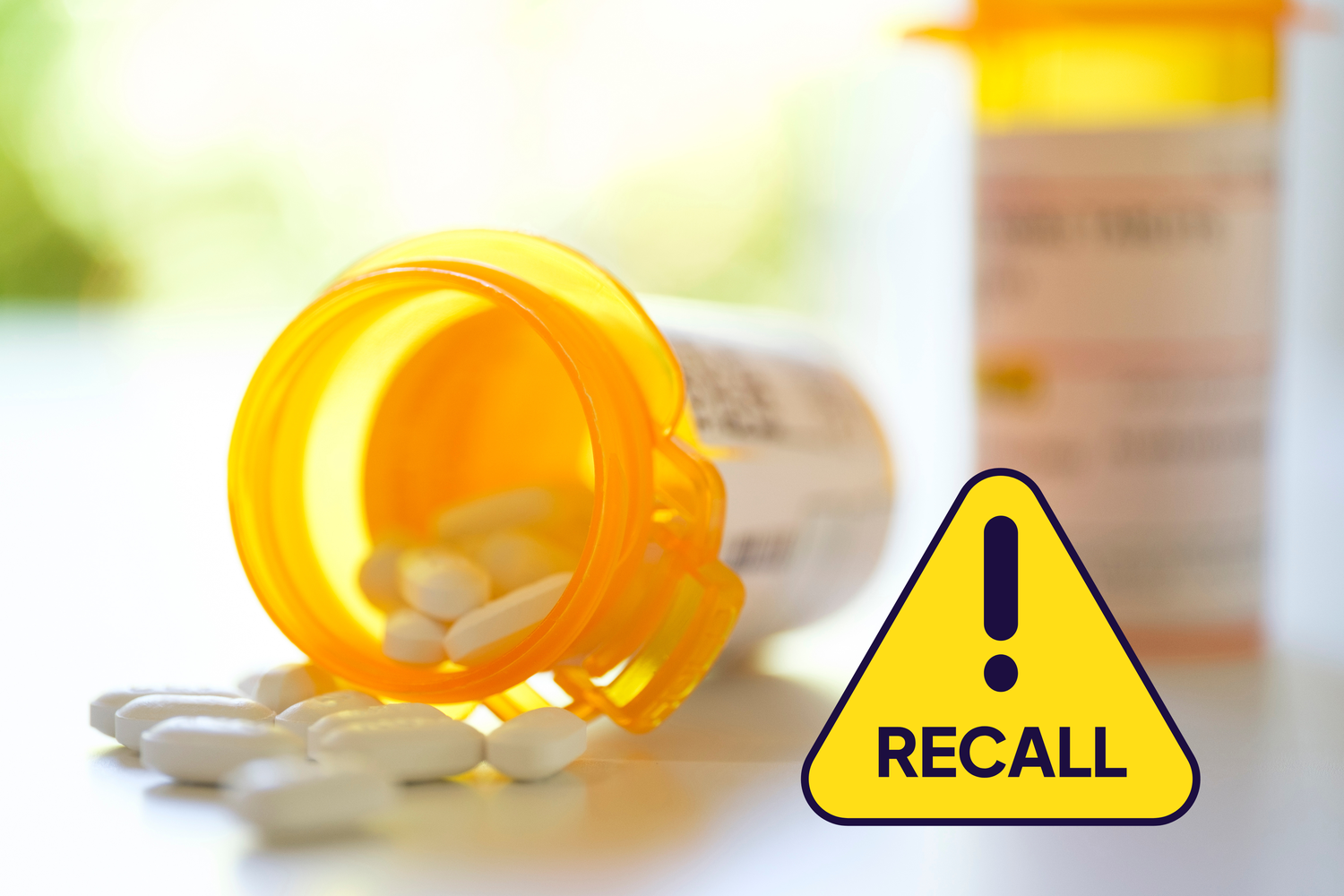
FDA Classifies Chlorthalidone Recall as Class II: The Legal Framework Behind a Generic Drug Recall
Summary
The recall. Inventia Healthcare Limited (Mumbai) voluntarily recalled Chlorthalidone Tablets, USP, 25 mg (NDC 64980-599-01, batch RISA24002, expiry 04/2027) on 3 September 2026. Rising Pharma distributed them nationwide. FDA classified the recall as Class II on 17 September. A June recall of 11,460 bottles, for the same reason, is also Class II.
The framework. Drug recalls are voluntary under 21 CFR Part 7, and FDA has no general power to order a prescription drug recall. Classification is FDA's own health-hazard determination, not an escalation of the recall.
The legal defect. A USP drug that fails its dissolution standard is potentially adulterated under section 501(b) of the FD&C Act. The failure also raises CGMP questions under 21 CFR Part 211.
The manufacturer's exposure. Recall execution and status reporting, Field Alert Reports, and a possible escalation to inspection, a Warning Letter or an import alert. The repeat failure is the key risk factor.
Civil liability. Mensing and Bartlett preempt most label and design claims against generics, but manufacturing-defect claims survive. Proving causation remains the main obstacle.
Patients should not stop the medicine. They should contact their pharmacist or prescriber for a replacement supply.
The Recall: What Happened
Inventia Healthcare Limited, a Mumbai-based manufacturer, has now recalled chlorthalidone tablets twice in 2026 for the same reason: failed dissolution specifications. Both actions are voluntary recalls that the FDA has classified as Class II.
June 2026 recall | September 2026 recall | |
|---|---|---|
Product | Chlorthalidone Tablets, USP, 25 mg | Chlorthalidone Tablets, USP, 25 mg, 100 tablets per bottle, Rx only |
Quantity | 11,460 bottles (100- and 1,000-tablet sizes) | 13,567 bottles |
Identifiers | NDC 64980-599-01; batch RISA24002; expiry 04/2027; FDA recall number D-0852-2026 | |
Distribution | Nationwide | Nationwide, distributed by Rising Pharma Holdings, Inc. |
Reason | Failed dissolution specifications | Failed dissolution specifications |
Recall initiated | June 2026 | 3 September 2026 |
FDA classification | Class II | Class II, on 17 September 2026 |
The product. Chlorthalidone is a thiazide-like diuretic prescribed mainly for high blood pressure and for fluid retention linked to heart failure, kidney disease and liver cirrhosis. Controlling blood pressure reduces the long-term risk of heart attack, stroke, heart failure and kidney damage.
The defect. Dissolution testing measures how quickly and completely a tablet releases its active ingredient under standard laboratory conditions. A batch that fails may release less drug than intended and therefore work less predictably. A laboratory failure does not show how much medicine any individual patient absorbed. Neither the company nor the FDA has published further detail on the root cause.
The patient message. Patients should not stop the medicine on their own. Abruptly stopping antihypertensive treatment carries its own risk. Anyone holding the affected batch should contact their pharmacist or prescriber about a replacement supply and report any symptoms.
The Legal Framework: How a Drug Recall Actually Works
Voluntary by design. Drug recalls in the United States are governed mainly by 21 CFR Part 7, subpart C (sections 7.40 to 7.59). A manufacturer or distributor can recall a product at any time, either on its own initiative or at FDA's request. FDA treats a recall as an alternative to court action, such as seizure or injunction, for removing violative products from the market.
No general power to order a drug recall. FDA has statutory authority to order recalls of medical devices, food, infant formula, biologics, tobacco products and, since the 2018 SUPPORT Act, controlled substances that pose a risk of serious harm or death. It has no general mandatory recall authority for prescription drugs such as chlorthalidone. In practice this gives FDA real leverage, because a firm that refuses a requested recall faces the court remedies instead. But the recall itself remains the firm's action.
Classification is FDA's call, not the firm's. After a firm recalls, FDA runs a health hazard evaluation and assigns a class under 21 CFR 7.3(m):
Class | Definition (21 CFR 7.3(m)) | Example |
|---|---|---|
I | Reasonable probability that use or exposure will cause serious adverse health consequences or death | Contamination with a direct path to serious harm |
II | Use or exposure may cause temporary or medically reversible adverse health consequences, or the probability of serious harm is remote | This recall: sub-potent release of an antihypertensive |
III | Use or exposure is not likely to cause adverse health consequences | Minor labeling error |
"Elevated" is not quite right. Several headlines describe the FDA as having raised or elevated the recall to Class II. Legally, nothing was escalated. Inventia initiated the recall on 3 September. FDA completed its classification on 17 September and published it in its weekly Enforcement Report, which lists recalls it monitors whether classified or not. FDA's own guidance says that classification and posting should not be read as expanding a firm's voluntary recall. What changed on 17 September was FDA's formal risk assessment, not the scope of the recall.
Why Class II fits. A tablet that under-releases chlorthalidone would most plausibly cause poorer blood-pressure control. That harm is typically temporary and medically reversible once a patient switches to a compliant supply. Serious consequences are possible, but FDA judged their probability remote.
Why a Dissolution Failure Is a Legal Problem, Not Just a Lab Result
The product is "USP", and that matters. The recalled tablets are labelled "Chlorthalidone Tablets, USP". A drug sold under a name recognised in the United States Pharmacopeia must meet that compendium's standards for strength, quality and purity. For solid oral tablets those standards include a dissolution test.
Adulteration under the FD&C Act. Section 501(b) of the Federal Food, Drug, and Cosmetic Act treats a compendial drug as adulterated if its strength differs from, or its quality or purity falls below, the official standard. A batch that fails its dissolution specification is therefore potentially adulterated as a matter of law, even if every tablet contains the right amount of active ingredient. Introducing an adulterated drug into interstate commerce is a prohibited act under section 301.
The manufacturing-quality overlay. Separately, section 501(a)(2)(B) treats a drug as adulterated if the methods, facilities or controls used to make it do not conform to current good manufacturing practice (CGMP). The CGMP rules for finished drugs in 21 CFR Part 211 require, among other things:
testing each batch against its specifications before release (section 211.165);
a stability programme confirming that products keep meeting specifications through their expiry date (section 211.166); and
a thorough investigation of any unexplained discrepancy or failed specification, extended to other batches that may be affected (section 211.192).
Dissolution failures typically come to light either at release testing or later, through stability testing. Either way, the CGMP question is the same: why did a batch fail, and does the cause reach other batches?
Why the second recall matters. A single out-of-specification batch can be an isolated event. A second recall of the same product, for the same failure, three months later, is the pattern FDA investigators look for. It raises questions about formulation robustness, raw-material variability, process control and whether the June investigation was broad enough under section 211.192.
What Happens to the Manufacturer
Immediate obligations under the recall
Once a recall is under way, Part 7 sets out what FDA expects of the recalling firm and its distributor:
Obligation | Rule | What it means here |
|---|---|---|
Recall strategy | 21 CFR 7.42 | Define the depth of the recall (wholesale, retail or patient level), whether a public warning is needed, and the level of effectiveness checks |
Recall communications | 21 CFR 7.49 | Notify consignees promptly, identifying the product, NDC, batch and reason, with instructions to stop distributing and return stock |
Status reports | 21 CFR 7.53 | Report progress to FDA periodically, including how many consignees were reached and how much product was returned |
Effectiveness checks | 21 CFR 7.42(b)(3) | Verify that consignees received the notice and acted on it |
Termination | 21 CFR 7.55 | FDA ends the recall only when satisfied that all reasonable efforts have been made to remove or correct the product |
For a product under an approved generic application, the application holder must also file a Field Alert Report with FDA within three working days of learning that a distributed batch fails to meet its specifications (21 CFR 314.81(b)(1)(ii)).
The escalation ladder
A Class II recall is not itself a penalty, but repeated quality failures can trigger a well-established sequence of FDA responses:
For-cause or surveillance inspection of the manufacturing site, focusing on dissolution method validation, out-of-specification investigations and the June corrective actions.
Form FDA 483. The investigators' observations, issued at the close of the inspection.
Warning Letter. A public finding of significant violations, usually requiring a detailed remediation plan.
Import alert. Because Inventia manufactures in India, FDA can refuse admission at the US border under section 801(a)(3) where the manufacturing methods or controls appear not to conform to CGMP. This can block a firm's US supply without any court action.
Application consequences. An adverse compliance status for a site can hold up approval of pending generic applications that name it.
Court action. Seizure or injunction under sections 304 and 302 of the FD&C Act, reserved for serious or persistent violations.
Where Inventia starts. FDA's inspection database shows Inventia's Thane site was last inspected for drug quality in February 2025, with a "Voluntary Action Indicated" outcome. That means FDA recorded objectionable conditions but did not take regulatory action. Two recalls for the same cause within a year are the kind of signal that can prompt closer FDA scrutiny of the site.
Commercial exposure. Beyond the regulator, the distributor and its customers will look to supply and quality agreements to recover recall costs, lost sales and replacement-product expense. Buyers may also re-source the product. Recalls of generics often leave pharmacies to switch patients to another manufacturer's supply.
Civil Liability: Who Could Sue, and on What Theory

No private right of action under the FD&C Act. Patients cannot sue a manufacturer directly for violating the FD&C Act. Enforcement belongs to the United States (21 U.S.C. § 337(a)). The Supreme Court in Buckman Co. v. Plaintiffs' Legal Committee (2001) also held that state claims resting solely on a firm's dealings with FDA are preempted. Any civil case must therefore be built on state law.
Generic preemption narrows the field. Two Supreme Court decisions shape claims against generic manufacturers:
Case | Holding | Effect |
|---|---|---|
PLIVA, Inc. v. Mensing (2011) | State failure-to-warn claims against generic makers are preempted, because federal law requires a generic's label to match the brand's | Label-based claims largely unavailable |
Mutual Pharmaceutical Co. v. Bartlett (2013) | State design-defect claims against generic makers are preempted, because a generic cannot change its approved formulation | Design-based claims largely unavailable |
What survives: manufacturing defects. Neither decision protects a generic manufacturer whose product departs from its own approved specifications. A tablet that fails its dissolution specification is, on its face, a product that did not conform to what FDA approved. Claims framed as manufacturing defect, breach of warranty or consumer protection violations can proceed under state law, provided they rest on a state-law duty that parallels the federal requirement rather than on the FD&C Act itself.
The causation hurdle. A personal-injury plaintiff would still have to prove that the recalled tablets actually under-performed in their body, and that this caused a specific injury rather than, say, underlying disease. For a Class II defect in a blood-pressure drug, that is a demanding burden. It usually requires the plaintiff's own supply, testing and medical records showing loss of blood-pressure control during the relevant period.
Economic-loss claims. A second theory avoids injury altogether: that purchasers and third-party payers paid for a drug that was not what it was represented to be. That theory drove the multidistrict litigation over nitrosamine-contaminated generic valsartan, where manufacturers, distributors, pharmacies and insurers all became parties. A recall covering 13,567 bottles is far smaller in scale. The legal theory, though, does not depend on scale.
Is the recall itself evidence? Federal Rule of Evidence 407 generally excludes subsequent remedial measures when offered to prove culpability, but courts disagree on how it applies to product recalls, particularly those undertaken at a regulator's request. The underlying test results, investigation reports and FDA correspondence are generally discoverable in any case.
What This Case Illustrates
This recall will not produce a court judgment, but it shows several principles in practice.
1. A recurrence changes the regulatory picture. One out-of-specification batch can be handled as an isolated event. A second batch failing the same test tests whether the first investigation was broad enough. That is why investigations under section 211.192 must extend to other batches that may be affected, and why the June recall's corrective actions are now the central compliance question.
2. Performance defects count, not just contamination. Many high-profile drug recalls involve contaminants such as nitrosamines, microbes or particles. This case concerns a tablet that may not release its dose as intended. Under the compendial and CGMP rules, a failed performance specification such as dissolution is a potential adulteration issue in its own right.
3. Voluntary recall is the default, for now. Because FDA cannot order a prescription drug recall, the system relies on firms recalling promptly and on FDA's leverage through inspections, import alerts and court action. Whether that model is enough for prescription drugs, when FDA can already order recalls of devices, food and controlled substances, is a recurring policy question.
4. Generic liability turns on specifications. After Mensing and Bartlett, the realistic route to liability for a generic manufacturer is proof that the product departed from its own approved specifications. A documented specification failure, confirmed by a recall, is exactly that kind of evidence. Well-kept quality records are therefore a legal defence as much as a regulatory requirement.
5. Supply-chain concentration is a legal risk. A single overseas manufacturer supplying a common generic through a US distributor concentrates quality risk. For distributors and pharmacies, supplier qualification, quality agreements and recall-cost allocation are the tools that manage it.
Practical Implications
For generic manufacturers and application holders.
Treat any dissolution failure as a potential systemic issue. Extend investigations to all batches made with the same materials, equipment and process window, and document why other batches are or are not affected.
Confirm that Field Alert Reports were filed within three working days and are consistent with recall notices and FDA correspondence.
Prepare for inspection. Have dissolution method validation, stability data, out-of-specification investigations and corrective-action effectiveness checks ready for review.
For distributors and wholesalers.
Execute the recall to the depth specified, keep evidence of consignee notification and returns, and meet status-reporting requests.
Review quality and supply agreements for recall-cost allocation, indemnities, audit rights and remedies for repeat failures.
For pharmacies and health systems.
Quarantine NDC 64980-599-01, batch RISA24002 (and the June lots), and check dispensing records to identify affected patients.
Switch patients to an alternative supply without interrupting therapy, and document counselling. Patients should not stop the medicine abruptly.
For patients. Check the label for the NDC, batch number and expiry date. Keep taking the medicine unless your prescriber or pharmacist advises otherwise, ask for a replacement, and report any symptoms or changes in blood-pressure readings. Adverse events can also be reported to FDA's MedWatch programme.
For litigators and insurers. Preserve records now: the patient's bottle and lot number, pharmacy dispensing history and blood-pressure records. Any claim will depend on tying a specific recalled lot to a specific loss.
Frequently Asked Questions
Which chlorthalidone is being recalled? Chlorthalidone Tablets, USP, 25 mg, 100 tablets per bottle, made by Inventia Healthcare Limited: NDC 64980-599-01, batch RISA24002, expiry 04/2027. The recall covers 13,567 bottles distributed nationwide. An earlier June recall covered 11,460 bottles.
What does a Class II recall mean? Under 21 CFR 7.3(m), use of the product may cause temporary or medically reversible adverse health consequences, or the probability of serious harm is remote.
Did the FDA order this recall? No. Inventia initiated it voluntarily on 3 September 2026, and FDA classified it on 17 September. FDA has no general authority to order prescription drug recalls.
Why is a dissolution failure a legal issue? A compendial drug whose strength or quality falls below the USP standard is adulterated under section 501(b) of the FD&C Act. Distributing adulterated drugs is prohibited under section 301.
Can patients sue the manufacturer? Not under the FD&C Act, which has no private right of action. State-law claims for manufacturing defects are not preempted by Mensing or Bartlett, but a plaintiff must prove the recalled tablets caused a specific injury.
Should I stop taking my medication? No. Contact your pharmacist or prescriber for a replacement supply before making any change.
Citations
- 1.• Blood pressure medication recalled nationwide under FDA's Class II risk level, Nexstar/WKBN (28 September 2026)
- 2.• Chlorthalidone FDA Recall: Why the Blood Pressure Tablets Were Recalled, HollywoodLife (28 September 2026)
- 3.• Chlorthalidone Recall Covers 13,567 Bottles, FinChannel (28 September 2026)
- 4.• Blood Pressure Drug Recall Hits Nearly 14,000 Medicines in US, Benzinga (September 2026)
- 5.• 21 CFR 7.3 – Definitions, eCFR
- 6.• Enforcement Report Information and Definitions, FDA
- 7.• Product Recalls, Including Removals and Corrections: Guidance for Industry, FDA
- 8.• Medical Product Regulation: Drugs, Biologics, and Devices, Congressional Research Service
- 9.• Inventia Healthcare Limited FDA inspection history, PharmaCompass
Finish Reading the Full Story and Expert Analysis.
Get the latest legal & regulatory intelligence in United States
Wansom is AI and can make mistakes.