
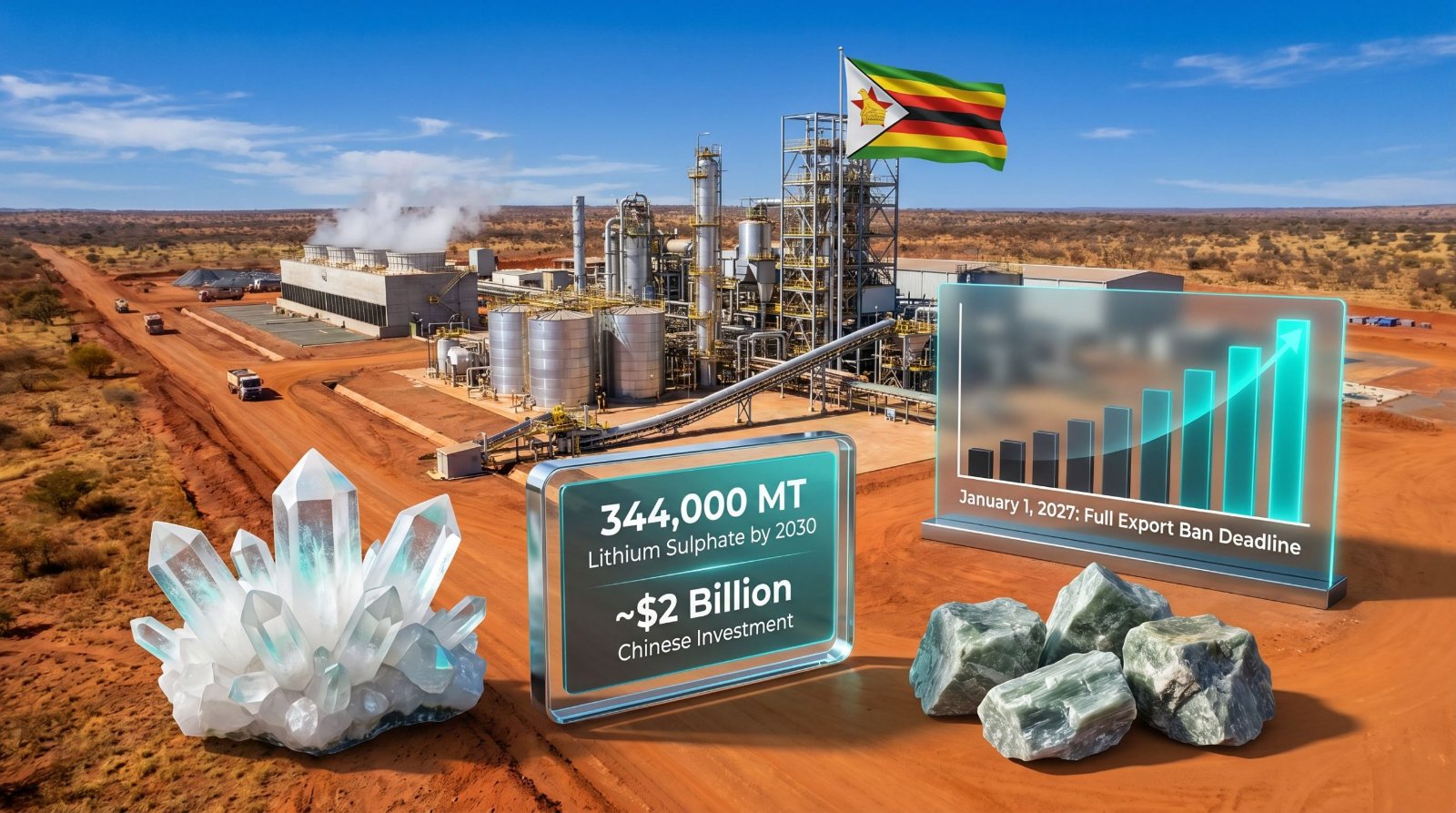
Eighty-Six Days to Zimbabwe's Lithium Concentrate Ban, and the Sulphate Plants Are Running Late
Summary
The rule: concentrate exports banned from 1 January 2027; only lithium sulphate or higher-value products may leave. Exports run until then under producer quotas and a 10% export tax.
The refusal: in June 2026, the Lithium Association said only one of seven major producers, Zhejiang Huayou Cobalt, was ready, and asked for an extension to mid-2027. Finance Minister Mthuli Ncube said no, and told producers to sign tolling agreements with PLZ and Bikita.
The tolling gap: in July, Arcadia (PLZ) said it has no capacity to process other producers' concentrate. Bikita's 100,000-tonne sulphate plant now targets completion and commissioning in July 2027.
The slipping date: Bikita's plant moved from "this year" (Mining Zimbabwe, 7 July) to Q2 2027 (company statement the same week), mid-2027 (Reuters, 25 August) and July 2027 (management, 25 September).
The bridge: Sinomine received quotas totalling 500,000 tonnes for 2026, including an extra 300,000 tonnes disclosed on 25 August.
Late starters: Zheli Mining announced its sulphate plant on 6 October, with equipment due in December. Kamativi targets mid-2027.
The stakes: about US$673 million of first-half 2026 lithium earnings came from concentrate, against US$73 million from sulphate.
The Rule: From Concentrate to Sulphate
The deadline: From 1 January 2027, Zimbabwe will ban exports of lithium concentrate, the semi-processed product made by crushing and upgrading lithium ore. To keep exporting, producers must first convert concentrate into lithium sulphate, a higher-value chemical intermediate that can be refined into battery-grade lithium carbonate or hydroxide.
How the policy has tightened, step by step:
Date | Measure |
|---|---|
December 2022 | Export ban on raw lithium ore; concentrates still allowed |
10 June 2025 | Cabinet announces the concentrate export ban from January 2027; Mines Minister urges producers without plants to sign tolling agreements with Bikita and Prospect Lithium Zimbabwe |
26 February 2026 | Government suspends exports of lithium concentrate and other unprocessed minerals, citing malpractices and leakages |
2 April 2026 | Mines Ministry letter sets conditions for resuming exports: producer-specific quotas, published financial statements, labour, safety and environmental standards, and written commitments on timelines for sulphate plants before 1 January 2027 |
April 2026 onwards | Quotas issued; Prospect Lithium begins Africa's first lithium sulphate exports |
1 January 2027 | Concentrate exports banned |
The tax. Until the ban takes effect, concentrate exports pay an export tax of 10% on unbeneficiated lithium. Reuters reported in April that the 10% tax would continue until the ban, and Zimbabwe's Finance Act sets 10% export taxes on unbeneficiated lithium and other raw minerals. On top of it come royalties of 7%, a 3% community development levy and a 1% marketing fee to the Minerals Marketing Corporation of Zimbabwe. Some analysts cite a 16% figure, but it does not match the statutory 10% rate.
Why the stakes are high. Lithium earned Zimbabwe US$746 million in the first half of 2026. Of that, US$672.8 million came from spodumene concentrate and only US$73.2 million from lithium sulphate. On current flows, about nine-tenths of lithium export earnings come from the product that will be banned in January.
The Industry Asked for Time. The Answer Was No.
The request. In mid-June 2026, the Lithium Association of Zimbabwe, chaired by Innocent Rukweza, asked the government to move the deadline to mid-2027, about five months later. Its case was simple: of Zimbabwe's seven major lithium producers, only one, Zhejiang Huayou Cobalt, through Prospect Lithium Zimbabwe, had completed and commissioned a lithium sulphate plant. The industry had pledged about US$1.45 billion in processing plants and also asked for tax relief to sustain the build-out.
The refusal. On 24 June 2026, Finance Minister Mthuli Ncube said the government would stick to the 2027 deadline. Producers without plants should sign tolling agreements, paying a company with a plant to process their concentrate. He named the two partners: "We can't expect everybody to come up with a lithium concentrator, it's expensive," he said. "So they should sign MoUs with PLZ and Bikita Minerals." As long as other producers' output is processed through those two companies, he said, that would be adequate.
Where the plants stand:
Plant | Owner | Status | Capacity |
|---|---|---|---|
Arcadia (Goromonzi) | Zhejiang Huayou Cobalt / Prospect Lithium Zimbabwe | Completed (about US$400 million); exporting lithium sulphate since April 2026 | 50,000–60,000 tonnes a year |
Bikita (Masvingo) | Sinomine Resource Group | Under construction; company now targets about July 2027 | 100,000 tonnes a year at full capacity |
Kamativi (west) | Sichuan Yahua | Under construction; expected around mid-2027 | — |
Sandawana | State-owned | Processing feasibility study | — |
Others | Smaller producers, such as Zheli Mining | Plans at earlier stages | — |
The problem with the tolling plan. On 17 July 2026, during a visit by Mines Minister Polite Kambamura, Arcadia's mine manager said its sulphate plant has no capacity to process other producers' concentrate. Its concentrator produces about 400,000 tonnes a year, and the sulphate plant can only handle Arcadia's own output. "We don't have space for other players," he said. The minister restated that the January 2027 deadline still stands.
Bikita: The Main Tolling Partner Keeps Slipping
Why Bikita matters: Bikita, in Masvingo province, is Zimbabwe's largest lithium mine. It is owned by China's Sinomine Resource Group and has a history going back more than a century. Its two concentrators can produce 600,000 tonnes of spodumene concentrate a year, plus petalite concentrate. Its planned 100,000-tonne-a-year sulphate plant would be the largest in Africa. And Bikita is one of the two companies the Finance Minister named as tolling partners for everyone else.
How the completion date has moved:
Report | Source | Stated timing |
|---|---|---|
7 July 2026 | Mining Zimbabwe | First phase to be commissioned this year (2026); Bikita said it was "not waiting" for the deadline |
Same week (9–11 July 2026) | Company statement, as reported by Financial Afrik | First phase of 60,000 tonnes a year to start operating in Q2 2027 |
25 August 2026 | Reuters, from Sinomine's half-year report | Plant expected to be completed in mid-2027 |
25 September 2026 | Bikita management | Completion and commissioning in July 2027 |
Investment estimates for the plant range from about US$400 million (company statements in 2026) to US$500 million (earlier Reuters reports).
The quota bridge. Instead of stopping, Bikita has been given room to keep shipping concentrate in 2026. Sinomine received a quota of 200,000 tonnes in April and an additional 300,000 tonnes in July, disclosed on 25 August. That brings its 2026 allocation to 500,000 tonnes, after export stoppages between February and April. Sinomine says supply from Bikita is now sufficient for its smelting operations in China.
The gap. If the ban applies on 1 January and Bikita's sulphate plant starts only around July 2027, about six months of Bikita's own concentrate output, and any third-party concentrate it was expected to toll, has no lawful export route and no domestic processing route. Arcadia, the only operating plant, has already said it cannot take other producers' material.
The arithmetic of the tolling plan. The government's fallback, tolling through PLZ and Bikita, depends on two plants. On 1 January 2027, one will be full with its own output and the other will not yet exist.
Smaller Producers: Only Now Getting Started
Zheli Mining. On 6 October 2026, during a Minerals Marketing Corporation of Zimbabwe (MMCZ) media tour of its processing plant in Zvishavane, Zheli Mining said it plans to set up a lithium sulphate plant "somewhere in Zimbabwe" with Chinese partners. Equipment is already on its way and is expected to arrive in December 2026. Even on an optimistic schedule, a plant whose equipment arrives weeks before the ban will not be producing sulphate on 1 January.
Kamativi. Sichuan Yahua's Kamativi Mining Company in western Zimbabwe has invested more than US$200 million in its sulphate project, which is expected to commission around mid-2027.
Sandawana. The state-owned Sandawana mine is still at the feasibility-study stage for processing.
The pattern. Outside Huayou's Arcadia, Zimbabwe's processing build-out is real but late:
Producer | Status on the eve of the ban |
|---|---|
Prospect Lithium (Huayou) | Operating; full with own output |
Bikita (Sinomine) | Under construction; about July 2027 |
Kamativi (Yahua) | Under construction; around mid-2027 |
Zheli Mining | Planning; equipment due December 2026 |
Sandawana (state) | Feasibility study |
Other producers | Plans vary; tolling is the government's stated fallback |
The industry projects annual lithium sulphate output of about 344,000 tonnes by 2030. The question is not whether Zimbabwe will process its lithium, but what happens in the gap between January 2027 and the dates plants actually come online.
The Trade and Investment Law Analysis

1. A beneficiation export ban under WTO rules
Zimbabwe is a WTO member. GATT Article XI generally prohibits export bans and quotas, and the WTO has rejected similar beneficiation-driven restrictions: China's export restrictions on raw materials and rare earths and, more recently, Indonesia's nickel ore export ban. The available exceptions, conservation of exhaustible resources (Article XX(g)) and supply to a domestic processing industry under a price-stabilisation plan (Article XX(i)), are narrow. In practice, enforcement is limited while the WTO's appeal system is not functioning, and most of Zimbabwe's concentrate goes to Chinese buyers that are themselves investing in local processing.
The 10% export tax is on firmer ground. WTO rules do not generally prohibit export duties unless a member has made specific commitments.
2. Quotas, written commitments and administrative discretion
Since April 2026, the right to export has depended on producer-specific quotas and on written commitments to plant timelines. That gives the Mines Ministry wide discretion over who exports and how much. Sinomine's additional 300,000-tonne quota shows the system can be used to bridge delays. The legal question for other producers is whether quotas are allocated on consistent criteria, and whether a producer that misses its written timeline will be treated the same way as others.
3. What happens if a promised timeline is missed?
The April letter made written timelines a condition of trading until January 2027. Bikita's own target has moved from 2026 to July 2027. If commitments that were conditions of quota allocation are not met, the government could, in principle, reduce quotas, impose penalties or simply extend. How it treats Bikita will set the precedent for every producer.
4. Tolling as a compliance route
Tolling, processing another company's concentrate for a fee, is the government's stated route for producers without plants. Legally, tolling agreements raise issues of:
title and export rights: who owns the sulphate produced, and who holds the export permit;
pricing and transfer pricing: tolling fees between related Chinese groups can shift profit, which ZIMRA will scrutinise;
capacity and priority: whether a toller must prioritise its own output, as Arcadia says its capacity requires.
Without available capacity, a tolling MoU signed today does not create a compliant export route on 1 January.
5. Investment protections
Chinese companies have invested about US$2 billion in Zimbabwe's lithium sector since 2021. Investment agreements and bilateral investment treaties can protect against abrupt regulatory changes that frustrate legitimate expectations. But the concentrate ban was announced in June 2025, giving about 18 months' notice, which weakens claims of unfair surprise. Disputes are more likely to centre on discretionary quota decisions and enforcement than on the ban itself.
What It Means for Each Stakeholder
Producers without sulphate plants
The risk: from 1 January, no lawful export route for concentrate, and no tolling capacity available. Arcadia is full, and Bikita's plant is not due until about July 2027. What to do: maximise exports under existing quotas before 31 December, and plan stockpiling capacity and cash flow for a period without sales. Document good-faith efforts: signed tolling MoUs, plant timelines and equipment orders. They will matter if the government grants case-by-case relief. Engage the Mines Ministry now, through the Lithium Association, on transitional arrangements.
Sinomine and Bikita
The position: Bikita has a 500,000-tonne 2026 quota and a plant due around July 2027, but it is also the government's named tolling partner. Its timeline slippage puts it under scrutiny. What to do: secure clarity on how its own concentrate will be treated between January and July 2027, and be cautious about tolling commitments it cannot meet before commissioning.
Huayou and Prospect Lithium Zimbabwe
The position: the only compliant producer, already exporting lithium sulphate. It has said it has no spare capacity for others, but may come under pressure to create some. What to do: consider whether expansion or third-party tolling makes commercial sense, and on what terms.
Chinese offtakers and converters
Imports of Zimbabwean concentrate will stop for most producers in January, unless the deadline moves. Converters should plan alternative feed, or contract for lithium sulphate as an input instead of spodumene.
The Zimbabwean government
The dilemma: enforce strictly and risk a sharp fall in export earnings, about nine-tenths of which came from concentrate in the first half of 2026, or extend and lose credibility after repeatedly rejecting delays. A quiet, producer-by-producer extension through quotas is a possible middle path.
Workers and communities
A stop in concentrate exports without processing capacity could lead to reduced shifts, stockpiling or temporary shutdowns at mines and concentrators. Workers and suppliers in lithium-producing areas such as Masvingo, Goromonzi and Zvishavane are exposed.
Investors and lenders
The ban is the clearest test yet of whether African beneficiation policy can be enforced on schedule. Lenders to Zimbabwean lithium projects should stress-test cash flows for a six-month export gap and a delayed processing ramp-up.
Lawyers and advisers
The work includes drafting tolling agreements, quota and compliance submissions, transfer-pricing positions on tolling fees, force majeure and change-in-law clauses in offtake contracts, and responses to enforcement action after January.
Key Dates
Date | Event |
|---|---|
10 June 2025 | Cabinet announces the concentrate export ban from January 2027 |
26 February 2026 | Exports of lithium concentrate suspended over alleged leakages |
2 April 2026 | Quotas and written plant-timeline commitments set as conditions to resume exports; 10% export tax continues |
April 2026 | Prospect Lithium makes Africa's first lithium sulphate exports; Sinomine gets a 200,000-tonne quota |
18–25 June 2026 | Producers ask for an extension to mid-2027; Finance Minister Ncube refuses on 24 June |
7–11 July 2026 | Conflicting reports on Bikita's plant date: 2026 versus Q2 2027 |
17 July 2026 | Arcadia says it has no capacity to toll other producers' concentrate |
25 August 2026 | Sinomine discloses an extra 300,000-tonne quota; plant expected mid-2027 |
25 September 2026 | Bikita management confirms completion and commissioning in July 2027 |
6 October 2026 | Zheli Mining announces a sulphate plant, equipment due in December |
1 January 2027 | Concentrate export ban takes effect |
What to Watch
Milestone | Why it matters |
|---|---|
A formal or quiet extension | Whether the government moves the deadline, or uses quotas to soften it producer by producer |
Signed tolling agreements | Whether MoUs with Bikita and Prospect Lithium are concluded, and with what real capacity |
Fourth-quarter export quotas | How much concentrate leaves before the ban, and for whom |
Bikita and Kamativi commissioning | When processing capacity actually arrives in 2027 |
The November Zimbabwe–Zambia meeting at Livingstone | A possible venue for regional coordination on lithium processing |
Frequently Asked Questions
When does Zimbabwe ban lithium concentrate exports? From 1 January 2027. After that, producers must convert concentrate into lithium sulphate in Zimbabwe before exporting.
How many lithium sulphate plants are operating? One: Zhejiang Huayou Cobalt's plant at Prospect Lithium Zimbabwe's Arcadia mine, which says it cannot process other producers' concentrate.
When will Bikita's plant be ready? Bikita management now says completion and commissioning will be in July 2027, about six months after the ban takes effect.
What is the export tax on lithium concentrate? A 10% export tax on unbeneficiated lithium applies until the ban, alongside royalties and other levies.
Did the government agree to extend the deadline? No. In June 2026, Finance Minister Mthuli Ncube said the government would stick to the 2027 deadline and urged producers without plants to sign tolling agreements.
Citations
- 1.• Zimbabwe insists on 2027 lithium concentrates export ban deadline despite extension plea from miners, Xinhua (25 June 2026)
- 2.• Zimbabwe insists on 2027 lithium concentrates export ban deadline, NewZimbabwe (27 June 2026)
- 3.• Zimbabwe to introduce lithium export quotas, sets conditions for resumption of shipments, Reuters via Mining.com (April 2026)
- 4.• Zimbabwe's sole lithium salt plant unable to process third-party metal, official says, Reuters via Mining Weekly (17 July 2026)
- 5.• Sinomine secures additional Zimbabwe lithium export quota, Reuters via Mining Weekly (25 August 2026)
- 6.• Bikita Minerals to Commission Zimbabwe's Biggest Lithium Sulphate Plant This Year, Mining Zimbabwe (July 2026)
- 7.• Zimbabwe: Bikita prepares a lithium sulfate plant as part of a $400 million program, Financial Afrik (11 July 2026)
- 8.• Can Zimbabwe's lithium processing build-out match the January 2027 deadline?, Equity Axis (August 2026)
- 9.• Lithium Producers Pledge US$1.45 Billion in Processing Plants, Plead for Tax Relief, Mining Zimbabwe (August 2026)
- 10.• Zheli Mining Plans Sulphate Plant as 2027 Lithium Export Ban Nears, Mining Zimbabwe (7 October 2026)
- 11.• Zimbabwe to ban export of lithium concentrates in 2027, EnviroPress (June 2025)
- 12.• Finance Act, 2025 (No. 7 of 2025), ZimLII
Finish Reading the Full Story and Expert Analysis.
Get the latest legal & regulatory intelligence in Zimbabwe
Wansom is AI and can make mistakes.