
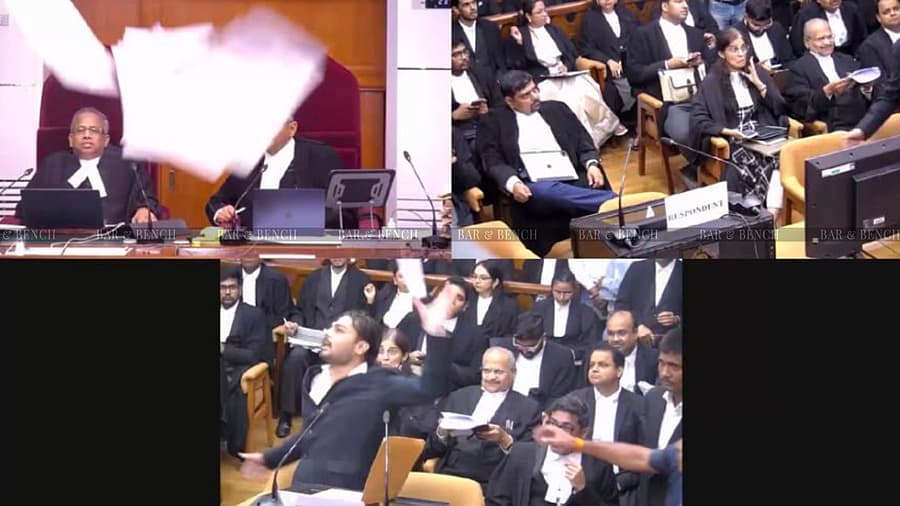
Delhi court grants bail to law students disrupting Supreme Court
Summary
- Two law students, Prabal Pratap Singh and Chanderbhan, disrupted Supreme Court proceedings on July 10.
- The duo used abusive language against the Chief Justice of India and threw papers in the courtroom.
- Singh allegedly pushed a security official, obstructing him from performing his duty.
- The Patiala House Court granted bail to Singh and Chanderbhan on July 27.
Disrupting Court Proceedings
According to eyewitnesses, Singh allegedly pushed and used criminal force against a security official, obstructing him from performing his duty.
In a shocking incident on July 10, two law students, Prabal Pratap Singh and Chanderbhan, disrupted the proceedings in court No. 13 of the Supreme Court. The duo, who were appearing as petitioners-in-person in a case, threw papers in the courtroom and directed abusive language at the Chief Justice of India. This behavior not only caused chaos but also put the security staff on high alert. According to eyewitnesses, Singh allegedly pushed and used criminal force against a security official, obstructing him from performing his duty.
Legal Context
The incident has sparked a heated debate about the conduct of litigants in court. The Supreme Court's rules are clear: no one, regardless of their status or representation, can use abusive language against judges or disrupt proceedings. In fact, the Chief Justice of India is accorded the highest respect and dignity in the judicial system. The Patiala House Court has taken a stern view of the incident, with Judicial Magistrate First Class (JMFC) Ravi observing that such behavior is unacceptable and will not be tolerated.
Consequences
The bail granted to Singh and Chanderbhan on July 27 comes as a relief to the duo, but it also serves as a reminder of the consequences of their actions. The incident has highlighted the need for litigants to maintain decorum in court and respect the authority of judges. Lawyers and compliance officers should take note that using abusive language against judges or disrupting proceedings can have serious repercussions, including arrest and potential disciplinary action.
Practical Implications
Lawyers and compliance officers should be aware that using abusive language against judges or disrupting court proceedings can have serious consequences, including arrest and potential disciplinary action.
Source
How does this affect your business?
Get an AI analysis of this article grounded in your jurisdictions, practice areas, and any policy documents you've uploaded to Wansom.