
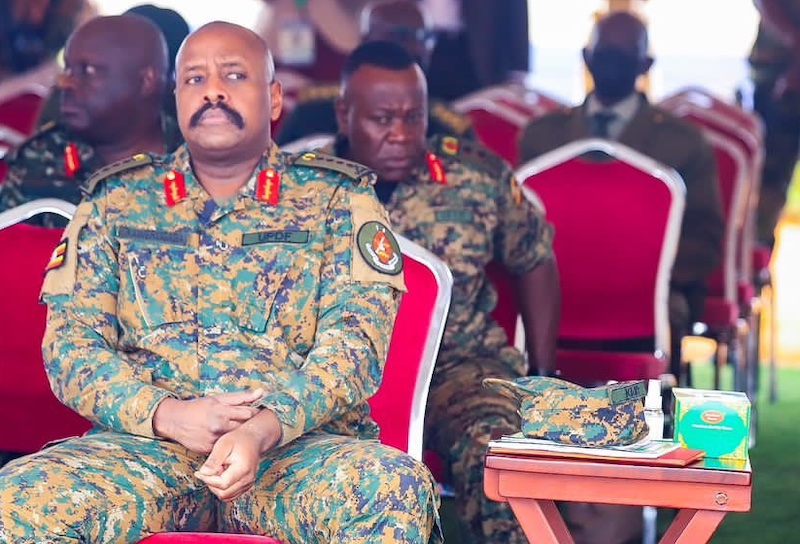
Court orders Muhoozi to file defence in Besigye hanging case
Abstract
The High Court in Kampala has issued a significant order, directing General Muhoozi Kainerugaba, Uganda's Chief of Defence Forces (CDF), to file a defence within seven days in an application brought by jailed opposition leader Dr. Kizza Besigye. Dr. Besigye alleges that Gen. Kainerugaba made a series of public statements, primarily on social media, that threatened his life and prejudiced his right to a fair trial. This development underscores the ongoing legal and political tensions in Uganda, particularly concerning the accountability of high-ranking public officials and the protection of fundamental human rights amidst politically charged criminal proceedings. The court's directive sets the stage for a critical examination of free speech, the rule of law, and the constitutional rights of individuals in the country.
Introduction
The High Court in Kampala has taken a decisive step in a contentious legal matter, ordering General Muhoozi Kainerugaba, the Chief of Defence Forces (CDF) and son of President Yoweri Museveni, to submit his defence within seven days. This order stems from an application filed by Dr. Kizza Besigye, a prominent opposition figure currently facing treason charges, who accuses Gen. Kainerugaba of making public statements that allegedly threatened his life and undermined his right to a fair trial. The directive, issued by Justice Emmanuel Baguma of the Criminal Division, also extends to three other respondents, including the Attorney General, who are required to file their responses by June 18, 2026, with a hearing scheduled for June 30, 2026.
At the heart of Dr. Besigye's application are allegations that Gen. Kainerugaba used social media platform X to issue statements such as, “We will hang KB on Heroes' Day. That's the best day for him to die,” and “Besigye wanted to kill Mzee, so as far as we are concerned, UPDF, he is a dead man walking.” These statements are contended to amount to public prejudgment of guilt, threats of extrajudicial punishment, and psychological torture, thereby violating Dr. Besigye's constitutional rights. The court's intervention in compelling a high-ranking military official to respond to such serious allegations highlights the judiciary's role in upholding the rule of law and safeguarding individual liberties, even in politically sensitive cases.
Background
The legal proceedings against Gen. Kainerugaba arise within a broader context of Dr. Besigye's ongoing detention and trial for treason and misprision of treason. Dr. Besigye and his co-accused, Hajj Obeid Lutale, were allegedly abducted in Nairobi, Kenya, in November 2024, and forcibly returned to Uganda without formal extradition proceedings. They were subsequently held at Makindye Military Barracks and initially arraigned before the General Court Martial, despite recent Supreme Court rulings that restrict the trial of civilians by military courts. Their current application seeks to terminate these criminal proceedings, citing grave violations of their constitutional rights, including unlawful abduction, torture, prolonged detention, and the prejudicial public statements made by the CDF.
Uganda's civil litigation framework is primarily governed by the Civil Procedure Act (Cap 71) and the Civil Procedure Rules, which are largely based on English common law traditions. These rules typically mandate a defendant to file a Written Statement of Defence (WSD) within 15 days of receiving a summons and plaint, accompanied by a summary of evidence, list of documents, witnesses, and legal authorities, along with a Mediation Case Summary. Failure to comply can result in a default judgment. While criminal defamation was recently declared unconstitutional by the Constitutional Court, nullifying relevant sections of the Penal Code Act, 1950, civil remedies for defamation remain actionable. Furthermore, the Human Rights (Enforcement) Act, 2019, provides a mechanism for courts to order the release of unlawfully detained persons and criminalizes disobedience of such orders, potentially limiting the scope of immunity for public officials.
Analysis
The High Court's order for Gen. Kainerugaba to file a defence is a critical procedural step that carries significant legal and constitutional implications. Dr. Besigye's application, filed as Miscellaneous Application No. 922 of 2026 arising from Criminal Session Case No. 335 of 2025, directly challenges the legality of his ongoing prosecution and detention, asserting that the CDF's public pronouncements have irrevocably compromised his right to a fair trial. The alleged statements, which include explicit threats of execution, directly impinge on fundamental rights guaranteed under the Constitution of Uganda, such as the right to life, freedom from torture, and the presumption of innocence.
The requirement for Gen. Kainerugaba, as the CDF, to formally respond to these allegations underscores the principle that no individual, regardless of rank or position, is above the law. The Human Rights (Enforcement) Act, 2019, is particularly relevant here, as it empowers courts to enforce human rights and potentially hold officials accountable for actions that violate these rights, even if they might otherwise claim immunity. This Act provides a statutory basis for challenging actions that undermine constitutional protections, such as the alleged extrajudicial threats and psychological torture cited by Dr. Besigye.
The seven-day timeline for filing the defence, though shorter than the standard 15 days for a WSD, reflects the urgency and gravity of the application. This procedural demand is further highlighted by recent events, including the reported abduction of Dr. Besigye's lead defence counsel, Erias Lukwago, while he was attempting to serve court documents on Gen. Kainerugaba. This incident raises serious concerns about obstruction of justice and the challenges faced by legal practitioners in pursuing accountability against powerful state actors. The court's insistence on a formal defence filing, despite these tensions, signals a commitment to due process.
Furthermore, Dr. Besigye's application also challenges the legality of his continued prosecution in light of the Supreme Court's decision in *Attorney General vs Michael Kabaziguruka*, which restricted the trial of civilians before military courts. Although Dr. Besigye is a retired soldier, he is legally considered a civilian, and the Supreme Court has clarified that military tribunals lack jurisdiction over civilians. The alleged threats by Gen. Kainerugaba, particularly those made on social media, could be interpreted as an attempt to influence public opinion and judicial proceedings, thereby prejudicing Dr. Besigye's right to an impartial hearing. The court's handling of this application will therefore be a significant test of judicial independence and the enforcement of constitutional safeguards in Uganda.
Conclusion
The High Court's order for General Muhoozi Kainerugaba to file his defence marks a pivotal moment in Uganda's legal landscape, emphasizing the judiciary's commitment to holding even the highest-ranking officials accountable for their public statements and actions. For legal practitioners, this case highlights the critical importance of the Civil Procedure Act and Rules, as well as the Human Rights (Enforcement) Act, 2019, in navigating complex litigation involving state actors and fundamental rights. The strict timeline for filing the defence, coupled with the politically charged nature of the allegations, demands meticulous and prompt legal strategy.
Going forward, practitioners will closely watch how Gen. Kainerugaba's defence addresses the specific allegations of threatening statements and prejudice to a fair trial, particularly in light of the recent decriminalization of defamation and the existing civil remedies. The outcome of this application will have far-reaching implications for the balance between freedom of expression, the protection of individual constitutional rights, and the accountability of public officials in Uganda. It serves as a reminder that the pursuit of justice, especially in cases with significant political undertones, often requires navigating complex procedural and substantive legal challenges with unwavering dedication to the rule of law.
Citations
- 1.The Civil Procedure Act, Cap. 71
- 2.The Civil Procedure Rules
- 3.The Penal Code Act, 1950
- 4.The Anti-Terrorism Act, 2002
- 5.The Human Rights (Enforcement) Act, 2019
- 6.Attorney General vs Michael Kabaziguruka (Supreme Court of Uganda)
- 7.The Constitution of the Republic of Uganda, 1995
How does this affect your business?
Get an AI analysis of this article grounded in your jurisdictions, practice areas, and any policy documents you've uploaded to Wansom.
Wansom is AI and can make mistakes.