
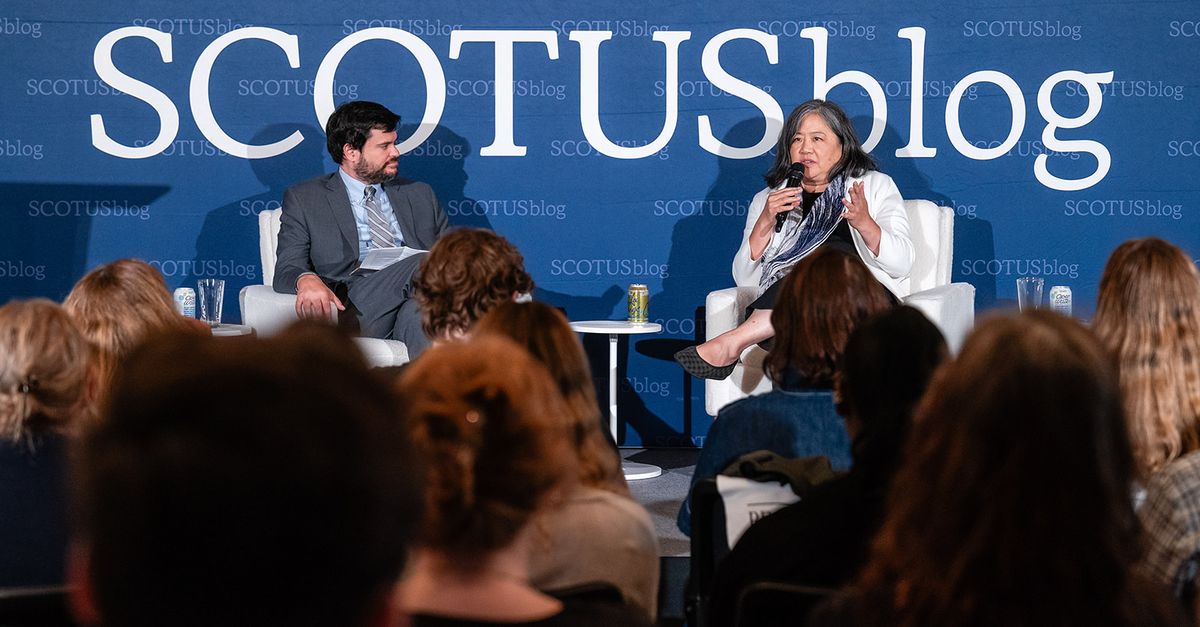
At SCOTUSblog’s term-in-review event, National Legal Director of the ACLU Cecillia Wang speaks about arguing birthright citizenship, the term in general, and what’s next on the organization’s docket
Abstract
The recent Supreme Court decision in *Trump v. Barbara* affirmed the enduring principle of birthright citizenship in the United States, rejecting an executive order that sought to curtail this constitutional guarantee. Cecillia Wang, National Legal Director of the American Civil Liberties Union (ACLU), spearheaded the successful challenge, underscoring the vital role of the Fourteenth Amendment’s Citizenship Clause. The Court's ruling, notably Chief Justice John Roberts's opinion, reinforced over a century of precedent, including *United States v. Wong Kim Ark*, and drew upon historical scholarship, such as that by Martha Jones, to solidify the understanding of citizenship by birth within U.S. territory. This landmark decision has significant implications for immigration law and constitutional interpretation, reaffirming a foundational aspect of American identity.
Introduction
The United States Supreme Court recently delivered a pivotal ruling in *Trump v. Barbara*, a case that squarely addressed the constitutionality of birthright citizenship. This decision, argued by Cecillia Wang, National Legal Director of the American Civil Liberties Union (ACLU), marked a significant victory for civil liberties advocates and a reaffirmation of a core tenet of American law. The case arose from a challenge to an executive order issued by President Donald Trump, which aimed to end the guarantee of U.S. citizenship for individuals born within the country's borders.
Wang's argument, which she described as the "most high-stakes and stressful task of my professional life," culminated in the Court's upholding of birthright citizenship. The ruling has profound implications, ensuring that the principle of *jus soli* – citizenship by birth within the territory – remains a cornerstone of American legal identity. This article will delve into the legal framework underpinning birthright citizenship, analyze the Supreme Court's reasoning in *Trump v. Barbara*, and consider the broader implications for legal practitioners and the future of immigration law.
Background
The concept of birthright citizenship in the United States is deeply rooted in the Fourteenth Amendment to the U.S. Constitution, ratified in 1868. Specifically, the first sentence of Section 1, known as the Citizenship Clause, declares: "All persons born or naturalized in the United States, and subject to the jurisdiction thereof, are citizens of the United States and of the State wherein they reside." This clause was a direct response to the 1857 *Dred Scott v. Sandford* decision, which denied citizenship to African Americans.
The Supreme Court definitively interpreted the scope of the Citizenship Clause in *United States v. Wong Kim Ark*, 169 U.S. 649 (1898). In that landmark case, the Court held that a child born in the United States to parents of Chinese descent, who were not U.S. citizens but were permanent residents, was a U.S. citizen by virtue of the Fourteenth Amendment. The *Wong Kim Ark* decision established that the phrase "subject to the jurisdiction thereof" excludes only children of foreign diplomats and invading forces, not children of resident aliens. This precedent has since served as the bedrock for the universal application of birthright citizenship, regardless of parents' immigration status.
Analysis
The challenge presented in *Trump v. Barbara* directly confronted this established constitutional principle, with the executive order seeking to reinterpret or circumvent the clear mandate of the Fourteenth Amendment. Cecillia Wang, representing the ACLU, argued forcefully against the executive order, asserting that it was incongruent with the history, text, and judicial precedent surrounding the Citizenship Clause. Her arguments likely emphasized the historical context of the Fourteenth Amendment, which was designed to ensure that all individuals born on U.S. territory, irrespective of race or origin, were granted citizenship.
Chief Justice John Roberts, in his opinion for the Court in *Barbara*, reportedly cited the scholarship of historian Martha Jones. Jones's work, particularly "Birthright Citizens: A History of Race and Rights in Antebellum America," illuminates how African American activists in the pre-Civil War era championed the concept of birthright citizenship, laying intellectual groundwork that influenced the drafting and ratification of the Fourteenth Amendment. This historical grounding provided a robust foundation for the Court's reaffirmation, demonstrating that birthright citizenship was not merely an incidental outcome but a deliberate and fundamental aspect of the post-Civil War constitutional settlement.
The Court's decision in *Trump v. Barbara* thus reinforced the enduring vitality of *United States v. Wong Kim Ark* and the original intent of the Fourteenth Amendment. By rejecting the executive order, the Supreme Court affirmed that the power to define citizenship, as articulated in the Constitution, cannot be unilaterally altered by executive action. This outcome underscores the judiciary's role in safeguarding constitutional principles against attempts to narrow fundamental rights, particularly those related to national belonging. The ruling effectively closed a potential avenue for future administrations to challenge birthright citizenship through executive fiat, solidifying its status as a fundamental constitutional right.
Conclusion
The Supreme Court's decision in *Trump v. Barbara* is a resounding affirmation of birthright citizenship, a principle integral to the fabric of American society and law. For legal practitioners, this ruling provides crucial clarity and stability regarding the acquisition of U.S. citizenship. Attorneys advising clients on immigration matters can confidently rely on the continued application of *jus soli*, as enshrined in the Fourteenth Amendment and consistently upheld by the Supreme Court. The victory for the ACLU, spearheaded by Cecillia Wang, highlights the critical role of impact litigation in defending constitutional rights against executive overreach.
Looking ahead, while the immediate threat to birthright citizenship via executive order has been thwarted, the broader landscape of immigration law remains dynamic. The ACLU's docket will undoubtedly continue to focus on protecting immigrant rights, challenging discriminatory policies, and ensuring due process for all individuals within U.S. borders. Practitioners should remain vigilant for legislative efforts or other legal challenges that might seek to alter citizenship laws, though the *Barbara* decision sets a strong precedent against such attempts. The case serves as a powerful reminder of the enduring strength of the U.S. Constitution and the importance of its foundational guarantees.
Citations
- 1.U.S. Const. amend. XIV, § 1
- 2.United States v. Wong Kim Ark, 169 U.S. 649 (1898)
- 3.Dred Scott v. Sandford, 60 U.S. 393 (1857)
- 4.Martha S. Jones, *Birthright Citizens: A History of Race and Rights in Antebellum America* (Cambridge University Press 2018)
- 5.Trump v. Barbara (Supreme Court of the United States, decided April 2026)
How does this affect your business?
Get an AI analysis of this article grounded in your jurisdictions, practice areas, and any policy documents you've uploaded to Wansom.